I have this little problem…You see, those little things on the music that I think are notes are whole lot of garble to me…so in turn I spend hours writing fingering charts…can you help. I can only play slow airs (the fingers can’t keep up with any other things) and I’m looking for fingering charts for any slow airs etc…HELP. 
Where did i see a computer font that did a whistle fingering chart automatically?
Do a web search for a piece od freeware called “Tablature Karaoke”. You can feed it a midi or other tune and it’ll display or print it out in whistle tablature form.
You might also find a link by searching the archives here - not sure about that part.
Bill Ochs’ tutor book has a good explanation of how western musical notation works.
Still, it’s best to have a recording when trying to learn a new song, even if you can read the dots on the lines.
Especially if you are playing slow airs, why not forget the notation or finger charts and learn by ear? It’s a bit weird at first but it doesn’t take long to get better at. And it’s very much fun.
Added bonus: you get to snigger at those who read music. 
Ive been playing for 2 years and never bothered to learn how to read music in 51, I mean 41, 37 years of living.
If you are comfortable playing by ear, go for it. You may get overwhelmed trying to play along to a CD but you will get it in time.
Start slow, like playing along airs as suggested.
Try this:
Yet](http://sniff.numachi.com/~rickheit/dtrad/%22%3EYet) Another Digital Tradition Page is a fantastic tune resource with notation available in various formats, including pennywhistle notation.
Persevere Anne,
I know how frustrating it must be for you, If you can find annother whistle player to practice with, with you can watch their fingerings, and i have to agree with the others, playing by listening to music and trying to play along is very gratifying.
I have met many great musicians who cannot read music, dont let that be a barrier to you…a few obnoxious notes at first soon turn into sweet music,
Best of luck
regards
David
I started out with this book from The Whistle Shop called “Tinwhistle for Beginners” by Donna Gilliam and Mizzy McCaskill. If you can’t read music now you will have no trouble after using this book. It is a simple little book and the tunes are simple ones…but…it makes learning to read music a snap.
I don’t use it anymore for obvious reasons (!) so if you would like to take a look at it I will send it to you. Just email me at ANDREAZ54@AOL.COM.
I think learning to play by ear is the best and it is something I am working on myself. But knowing how to read music definately has its place too. I think it gives you a leg up sometimes. I am finding that it all comes in time..just gotta keep plugging along. One thing I have NEVER been able to do is read fingering charts! I find them totally perplexing and I can see how they would slow up your playing.
Cheers!!
Without meaning to step into the shark-infested waters of “how to learn whistle” arguments, it’s just occured to me that the different methods of learning tunes correspond neatly to the Three Styles of learning: visual, aural and kinetic. Sorry if this is old hat, but I hadn’t seen it mentioned here before (and I’ve been churning through the archives a bit). Visual learners are going to do best with sheet music, while aural learners are those folk who learn by ear - and getting a fraction closer to being on topic, Anne - you sound like a kinetic learner.
This also explains people get so bewildered that other folk don’t use the same method as them (brain wiring is a weird thing!) Umm, not that this helps especially, but anyway.
When I started playing (all of 2 months ago!) I found a “font” which you can install and then just type keyboard letters in to have it spit back the fingering charts. Still means you have to work out the notes the first time through, and there’s no guidance to note lengths, but it shurly does beat writing them out by hand! Hope this helps, Anne.
Cori
I brought up the same point on GC a couple of months ago, and it went straight over everyone’s heads.
The “pure” or perhaps “holy” method of learning, is, of course, by ear. Some of us, lacking sufficient sanctity, or perhaps just less musically talented, require visual cues. I’ve quit trying to explain. Fortunately, there are sources of scores for many traditional tunes. Or, for folks who need tablature scores, there are plenty of ways to convert.
I cheat!
I can read music, and I can learn by ear.
I do both at the same time!
I use midinotation to learn lots of tunes.
You can slow it down or speed it up.
The notes are highlighted when played.
Not all tunes replay well on midi, e.g. The Lonesome Boatman, this is best and easiest learned by ear, but most tunes can be learned via the above programme, which is free for 30 days.
Once you can read music from the sheet, you will never forget, and you can pick up tunes that you may never hear otherwise.
I can only speak for myself, but I didn’t find it that hard to do.
The other thing I like about sheet music is that sometimes(!) I forget how a tune ‘goes’. Especially if I haven’t played it for a while. A quick look at the sheet while tooting the whistle, and it usually comes back.
Just my 2p/c/(insert own denomination here )'s worth
Thanks Chuck…got there and it’s not bad.thankyou from an Aussie chick 
Cori…Wow, that’s a lot for an aussie chick to take in, but thanks for the advise. I may be a kinetic what’s me call it, but I am a ear, play and whistle it too. I can listen and play , look and play, and read and play but best at read a fingering chart, listen to a mida file and blow…and hope that the cows enjoy it …if they do I know that it’s good…thanks Cori
Learning by ear is certainly a good skill to have, but so is learning to read notes. You have already learned to read a type of notation which is MUCH harder: English!
I’ll second the Ochs book recommendation. Work your way through it lesson by lesson, and you WILL learn to read music. It’s actually a lot easier than tab, and will open up literally thousands of tunes to you.
Hi Anne,
Reading music for Irish Traditional music is actually quite easy. So simple I’m going to give you a crash course.
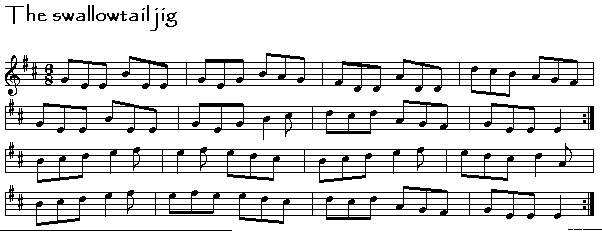
Looking at the above example, stolen from Brother Steve’s excellent website, of the Swallowtail Jig.
Starting on the left, the first symbol is the treble clef. All music you play on the whistle is played on this clef. There are alto and bass clefs for other instruments with lower ranges, but you can now ignore this symbol.
Next is the key signature. This has one # on the top line, which is F, so all Fs are sharp. the second one is on the second space down, which is C, so all Cs are sharp. This is actually the key of D, and on your D whistle, these sharps are already built into the instrument, so you can now ignore the key signature for any tunes showing two ##s, which covers more than half of all the Irish traditional tunes ever written.
Next comes the time signature. This one is 6/8, so there are six beats in eash bar, each one lasting 1/8th of a full note. If you look at the first bar, you can see six black dots, so six notes. Count 123 456, emphasis on the 1 and the 4, and that’s the beat sorted. So you can now ignore this.
OK, now the actual notes. In the third bar you can see 4 black dots hanging under the bottom line. This is the lowest note you can play on your D whistle, all fingers down, D. Lift one finger and you play E, which is the note sitting astride the bottom line. As you keep lifting fingers, the notes keep moving up the stave (that’s the bunch of five lines), space, line, space line etc. On your whistle the easy way to remember notes is that they spell BAGFED, the B is your first finger down, A being two fingers down, etc down to all fingers down, D.
An easy way to remember which note sits on which line or space is using these phrases: The spaces spell FACE, reading from the bottom up, the lines spell the phrase Every Good Boy Deserves Fun, EGBDF, again from the bottom up. So the fourth line up, D, is the first note of the second octave on the whistle.
Looking at the music as a whole, you see there are sixteen bars (groups of six notes) in total. These are broken into 8 bars and 8 bars by the symbol showing two dots placed vertically , a thin line & a thick line. THis means you repeat the first 8 bars before moving on to the second part. You then repeat the second part, and start again. You would normally do this 3 times in total before starting a new tune.
Sometimes a note lasts more than one beat, for example in the first bar on the third line there are only 5 notes. The fourth note has no tail on the vertical line, and this indicates that it lasts 2 beats. the count for this bar would be 123 4(5)6, the fourth note being held for the 4th & 5th beats. If one of these notes has a dot immediately beside it, that adds another beat. The last note before each repeat sign should have this, but they have been missed out in error.
This gives you the basic notes for a tune, but of course you have none of the expression or feel - for this you need to actually hear the piece!
That’s plenty to absorb in one go, but one last thing. Although I’ve mentioned a D whistle, you can use the same sheetmusic and the same fingering on ANY key of whistle, it doesn’t matter, and you’ll still be playing the tune, just in a different key. So if you should happen to pick up a Bb whistle to play this tune, you’ll be playing in Bb rather than D, but it still plays the same tune. Whistles are kind to us in this way.
Good luck!
Bravo Martin–atta crash course!
I yam impressed, earnestly.
Sometimes, watching the behaviour of you kkknnnigget Brits fills my soul with hope :roll:
It’s like peering at the blue eyes of your cows. Beyond their obvious craze, there’s the faint gleam of an elevated soul, a.k.a. helicopter. 
Martin: Thanks for the crash lesson. Brilliant work. I really have had no music experience, (I went in to more detail in a thread some time ago, and won’t bore everyone with it again). Your lesson explained the basics much more clearly than anything I have so far read.
All the Best, Tom
I am also a rank beginner. However, I learned to read music very quickly. If you have some familiar songs, hymns or christmas carols worked for me, that have the music notation and tablature you can learn all three ways at once. Before long the tablature will just be in the way. Not only do we learn by stimulating multple senses, it is stored in different ways in the brain. The more ways you can store things the easier it is to retrieve because of multiple links. Take everybodies advice and learn in multiple ways. But most of all play for the pure enjoyment of making a piece of tubing sing.
BTW Martin nice crash course.
Ron