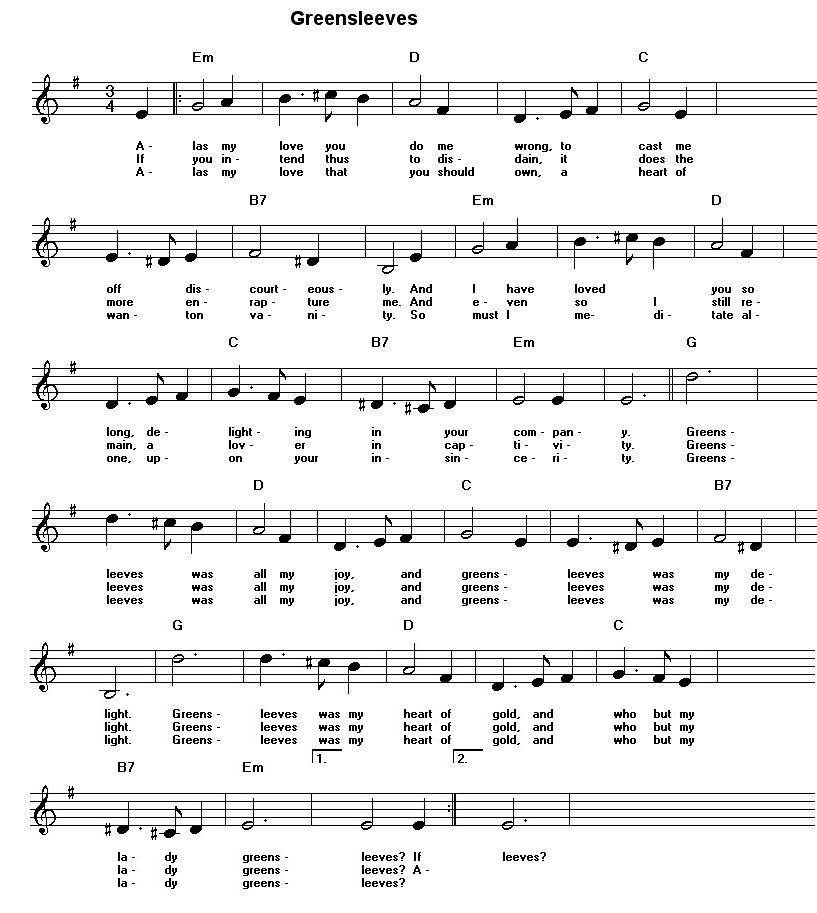
it seems as if theres music missing from the first bar, its e-g-a-b-c-b-a-f-d-e-f-g-e-e-d-e
and it ends there, it sounds good if I add a further -f-d on the end, but then it goes down to C-E am I making some mistake reading this sheet music? Just want to get clarification that my D whistle is capable of playing this? maybe my whistle doesnt have a note required.
I would really appreaciate any light on this, thanks in adance
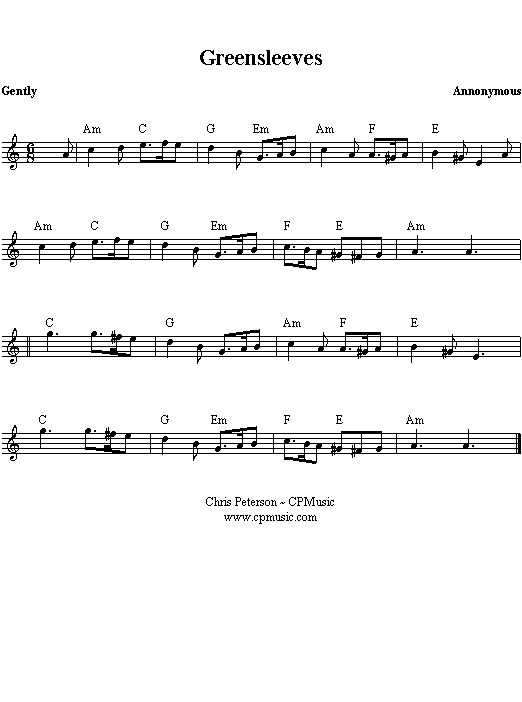
FWIW, I downloaded the PDF from the original link above, and it looks fine. On whistle, the tune works better in Am, as in Denny’s 3rd version. Just substitute F#s for the F-nats, which puts it into A Dorian. And half-hole or cross-finger the G#s.
I firmly believe that anyone who writes music with more than 2 or 3 sharps or flats is in the service of Satan.
In our Christmas concert, we had some music with 5 flats, which I got used to well enough, but the 5 sharps still threw me right up to the concert itself. It’s really annoying to play a low D# on a violin. I’m so used to just playing that open string when I see a D come across. My hands were moving all over the place. It was ridiculous.
All very well, but the way I learnt that tune by ear (probably singing it in junior school to the old Singing Together programmes on BBC Schools Radio) in my childhood was slightly different and I have always felt that the version apparently represented in all the transcriptions above was a classicalised, tidied up setting putting a modal tune “properly” into a minor key.
Based on Denny’s first version in one sharp, I’d play/sing it thus:- Cnat, not# in Bars 2 & 10; Dnats, not #s in Bars 6 & 7, 22 & 23: otherwise, as it is. Those D#s/Ebs in particular always grate on my ear! (But not the ones in the cadences with the associated C#s - they’re “right”.)
The third setting Denny gives is the most whistle friendly in terms of tessitura and accidentals, but still requires half-holed F nats. Here’s what I would consider to be an optimum-on-whistle (or keyless flute) setting:
T:Greensleeves
C:Traditional
O:English
Z:Jem Hammond 2:1:09
M:6/8
L:1/8
K:B Aeolian
B | d2e f>gf | e2c A>Bc | d2B B>AB | c2A F2B | d2e f>gf | e2c A>Bc |
d>cB ^A>^GA | B3 B2 ||z | a3 a>^gf | e2 c A>Bc | d2B B>AB |
c2A F2 z | a3 a>^gf | e2 c A>Bc | d>cB ^A>^GA | B3 B2 |]
The 2nd 8ve G# can be cross-fingered xxo xox or xxo xxo on most whistles, and the bottom 8ve A# and G# are commonly available fingered xox xxx and xxo xxx respectively - again, fairly easy-to-learn fingering patterns/combinations.
Also FWIW, although this tune is one that I suspect almost everyone has in their aural memory in some form, it isn’t an ideal beginner’s tune either for reading music or for playing on whistle because of the accidentals. “Easy” in my book would usually entail sticking to the main diatonic scale, straight-off fingerings, then starting to introduce tunes with cross-fingered c-nat way before venturing into other accidentals. There are so many lovely modal folk tunes, both song airs and dance tunes out there that only require simple fingering…
That’s the tune I learned years ago on this side of the pond but with the As in the third and fourth full measures sharpened. If you transpose the Jem’s version down from B minor (Aeolian mode = natural minor scale) down to A minor, all those accidentals fall on the C, G and F notes, making that a fairly easy fingering as well.
I just play it in A minor (pretty much the way the third sheet music Denny posted shows it), which is very easy on the whistle. All you have to half-hole is the G sharps. The standard setting goes down below the range of the whistle, so that doesn’t really work. If you learn it in A minor on a D whistle, you can just use the same fingering on a whistle in A to get it in the same key as the standard setting.




 Amen!
Amen!