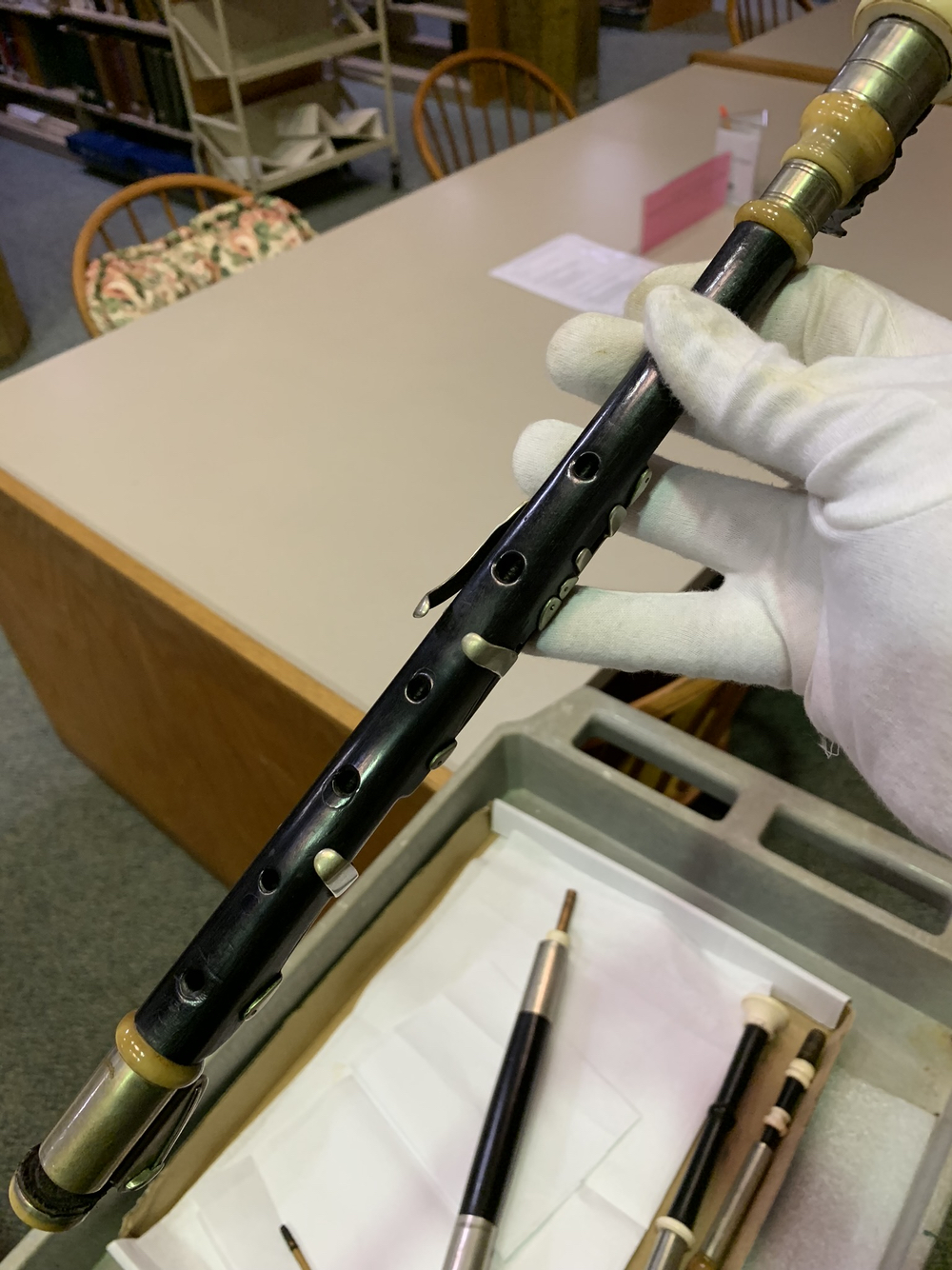
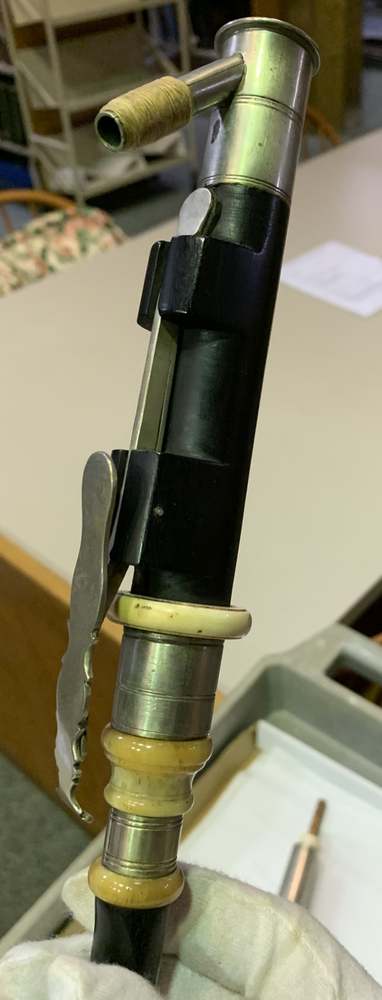
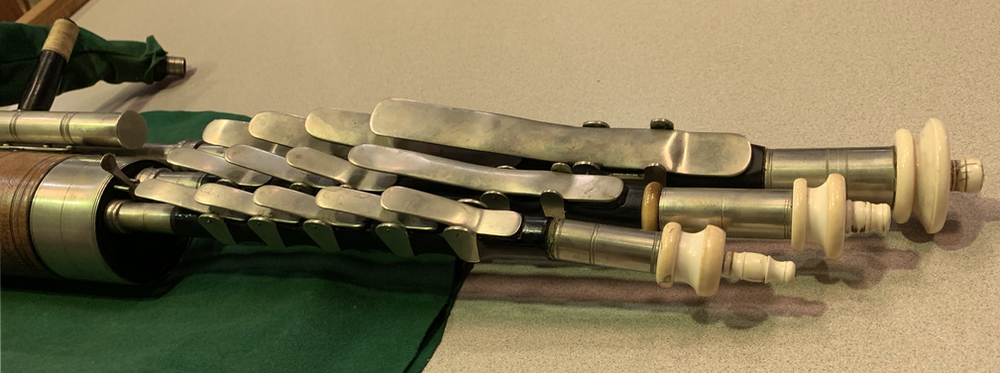
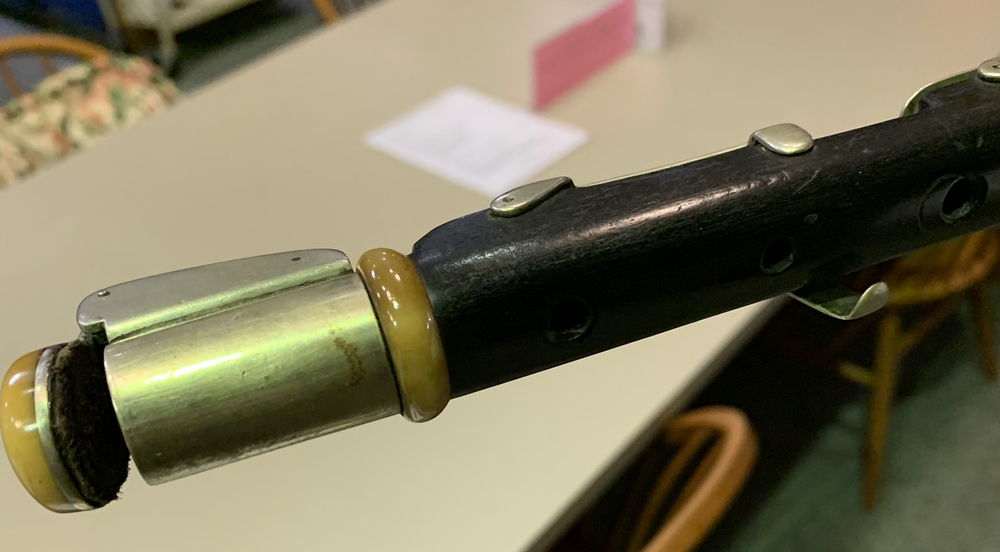
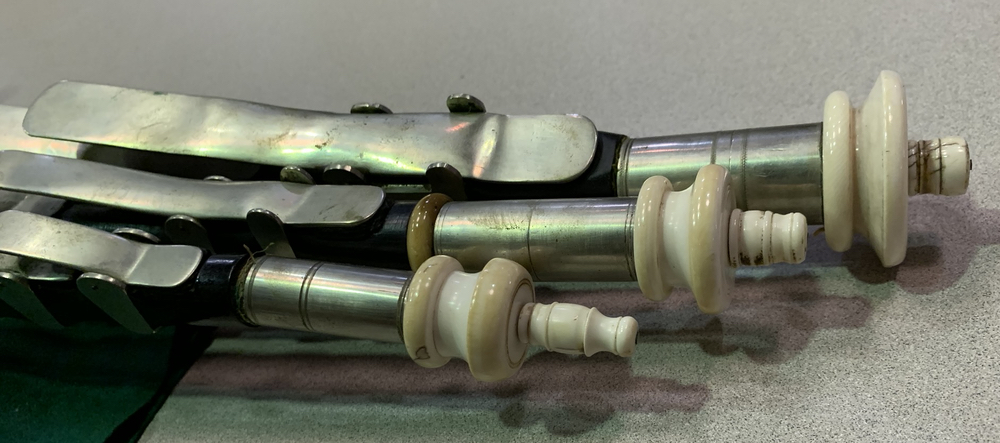
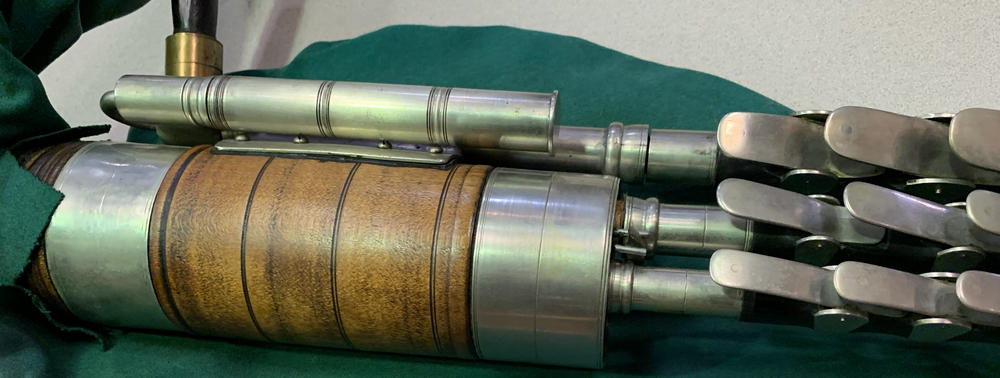
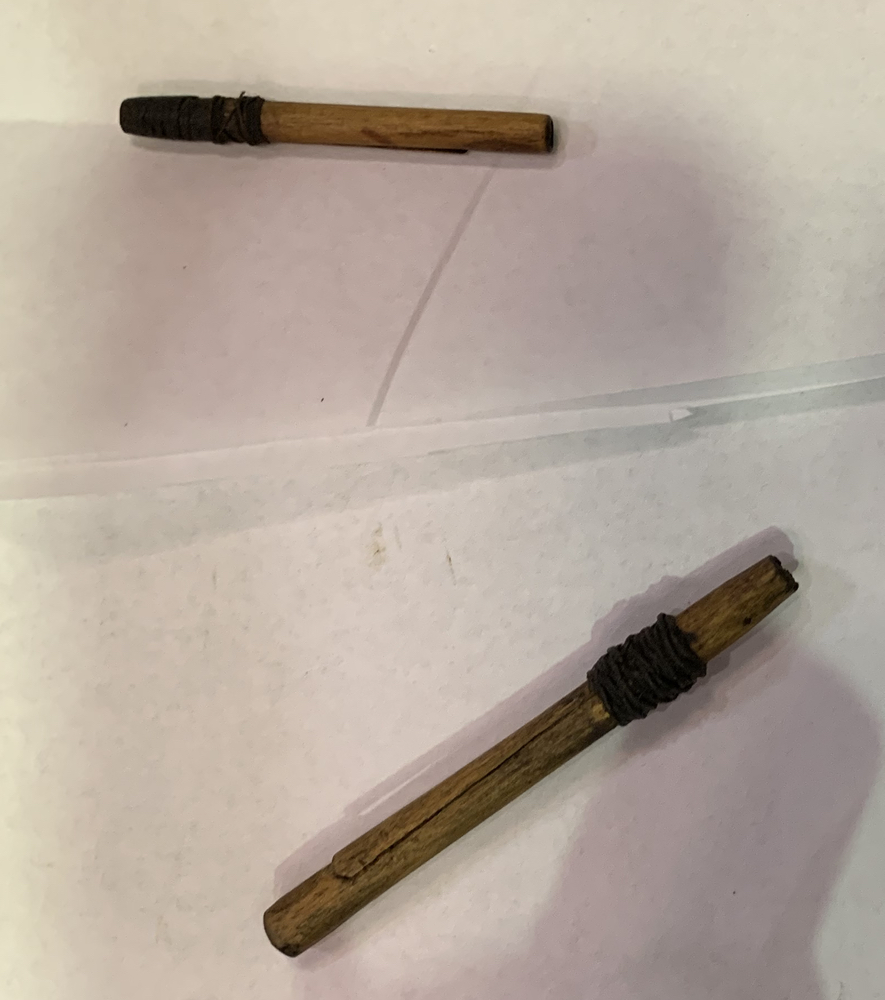
A couple weeks ago I did some research at the Mercer Museum in Doylestown, PA, and go to examine the set of Taylor pipes they have. Mercer, the museum’s founder, was a big fan of Irish music and visited the Taylor workshop multiple times. These pipes, and Mercer, have been written up in An Piobaire and so I’m not presenting anything new, but I thought a few pictures might be of interest.
They were fascinating–I’ve never actually held or looked closely at a set of pipes before. The Taylors had a high degree of skill in multiple areas–metal work, wood turning, carving, leather work. The key mechanisms were fascinating. Very robust.
The pipes are disassembled–I held them gingerly with gloves on.
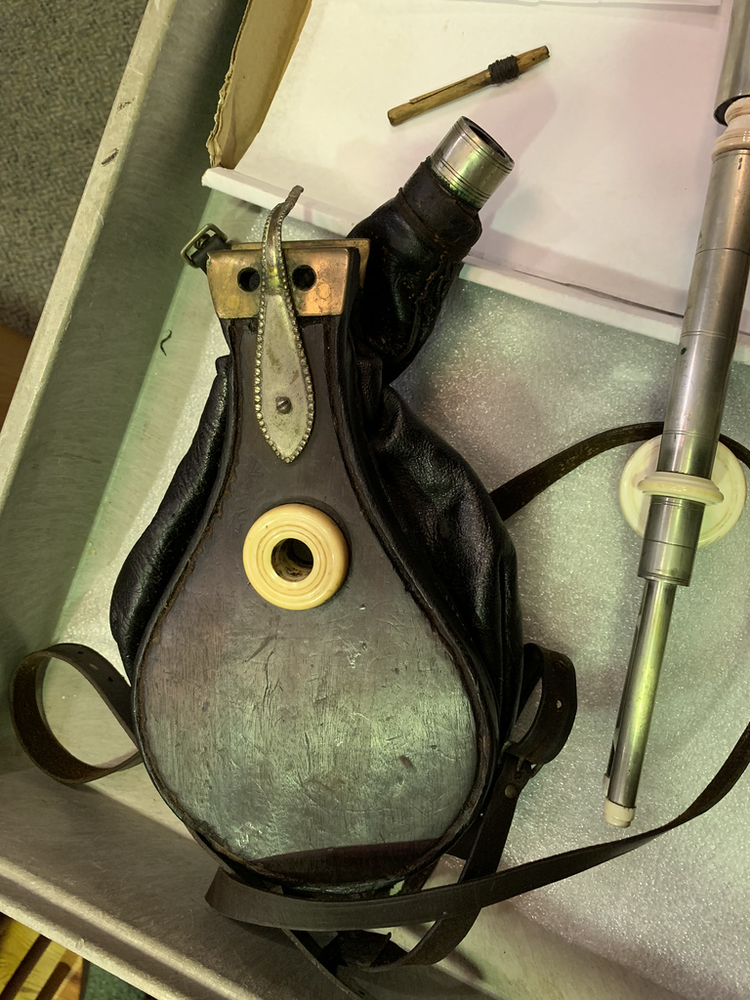
Thanks for the pix - very interesting…do you think the ‘flatware’ handle on the bellows was original? It looks like a spoon handle - what is that for if the bellows are held together by straps? (I have to wonder).
These do look a lot like George Balderose’s Taylor set, which I got to hear last fall when we did the Pittsburgh version of play the u. pipes day (the official NPU name of that event slips my mind). They do sound different from the few other sets I’ve heard (I’m a beginner), but I don’t have the literary skill to describe it.
I don’t remember about the bellows, pudinka, but will check if I get another chance.
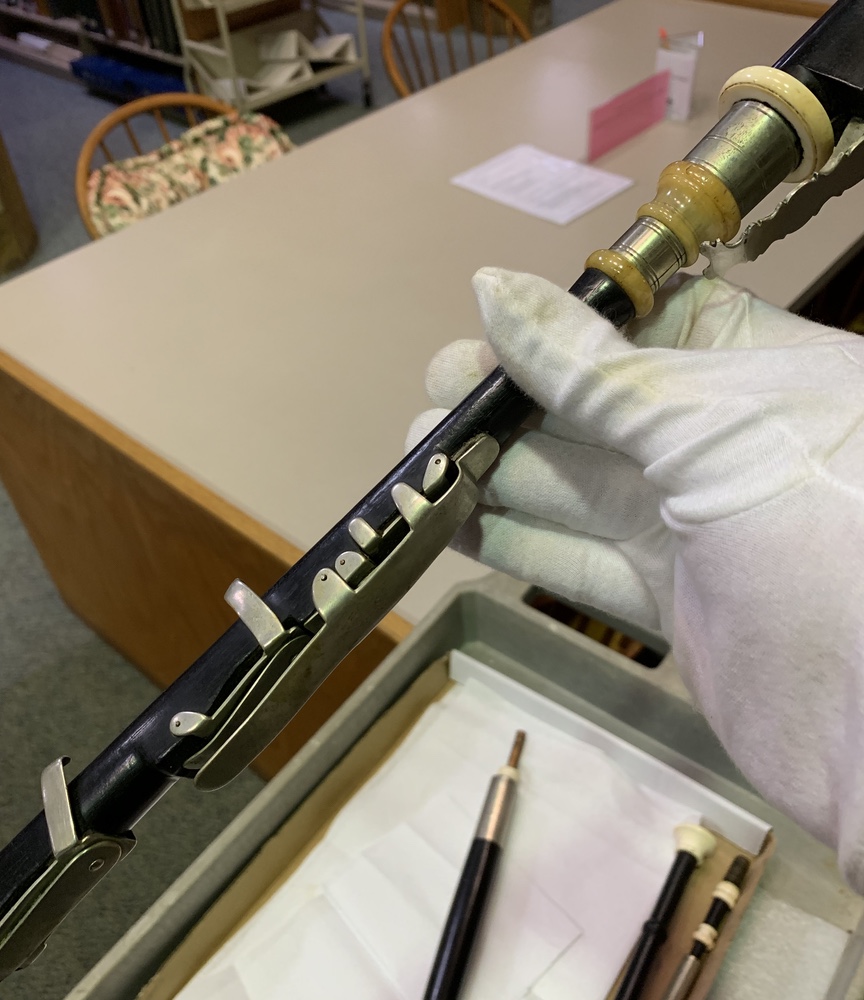
Interesting to see that the lower hand tone holes on the chanter seem to have been extensively altered, redrilled, filled, etc. I wonder if this was typical of Taylors - part of the tuning - or was it done by someone else?
Please understand I know next to nothing about the pipes. The spoon shaped fixture on the bellows was connected to a leather strap that seemed to be designed to hold the bellows closed, but the leather was partly broken and missing
There’s something odd about the chanter. The ivory (if it is ivory) has not aged the same as the ivory on the rest of the set, including the chanter top. Might it be bone or antler or something else?
There is a certain mixing of materials, isn’t there. You see a touch of it on the baritone reg, too, but that’s all there appears to be apart from what’s on the chanter (which also appears to have a spot of what is clearly ivory as well). Rather than ivory, its translucent quality brings horn to mind.
Thanks for posting the photos. Interesting set. I grew up not far from the museum and have always intended to visit when home on family holidays but never have the time.
The set is clearly the work of more than one maker, and some of the bits are definitely not Taylor. Although the chanter could well be (although the top perhaps not). The Taylors (and some other early American makers) often used bone for chanter mounts rather than ivory, or a mix of bone and ivory. Hence the different ‘look’ of the chanter decorations and the rest of the set, as Geoff points out.
The ivory work on the reg mounts is certainly not Taylor. Much too crude, and lacks their sense of artistry. Whether that has any deeper significance for the provenance of the regs themselves is hard to tell (the mounts could be replacements). However the bass reg keys are certainly not as artful and symmetrical as one would expect from Taylor, which makes me think that reg (at least) is by another maker.
The bellows have the end of a silver spoon tacked on for decoration, which (while imaginative!) I can’t imagine the Taylors themselves doing. The bellows for my set are certainly cutlery free!.
The old reeds are cool. Bet they still work too.
Likely a combination of makers from the period. I’ve heard the Mercer Museum set came via Hutton, so perhaps a mix of original Taylor bits and Hutton’s own work? Nice stuff.
The museum is a strange and astonishing place and absolutely worth a trip, just for the maze-like castle-like building alone. He would add rooms as he found new stuff, so sometimes you’re walking along what was once the roof until he added a bunch of new rooms. Mercer’s house, “Fonthill,” is also kind of astonishing. The furniture, for example, is made of concrete with upholstery; the dressers are concrete with wooden drawers. He liked to work by natural light so he had work spaces that tracked the sun as it moved across the sky. I grew up near there as well (Lansdale), my dad grew up in Doylestown, and we went there pretty often to visit my grandparents.
Mercer’s letters are full of the greatest enthusiasm for “irish folk music.” He really gushes about it. He talks about visiting the Taylor brothers in their shop–in several shops–and he tries to get their tools after they pass away, but they end up in the hands of a guy in delaware who “won’t answer my letters,” says Mercer. He clearly had a great deal of respect for the Taylors as craftsmen.
Mercer’s letters are full of the greatest enthusiasm for “irish folk music.” He really gushes about it. He talks about visiting the Taylor brothers in their shop–in several shops–and he tries to get their tools after they pass away, but they end up in the hands of a guy in delaware who “won’t answer my letters,” says Mercer. He clearly had a great deal of respect for the Taylors as craftsmen.
Fascinating. Do you have access to these documents at the museum? Sounds like a treasure trove of information well worth trying to make more widely accessible.
A lot of the Mercer correspondence was written up in I think the most recent issue of An Piobaire. It’s not on their website yet. Peter Laban kindly sent me a copy.
The museum library is an archive, so you can view what they have but you need to make an appointment in advance. And you need to demonstrate some degree of seriousness–most archives worry about “frivolous” requests, because they want to preserve the documents. But there’s no value in an archive nobody sees
Mercer wrote to WH Grattan Flood asking him if anyone had ever written on Irish Dance music, and Flood referred him to O’Neill’s books. Below is Mercer to Flood, remembering when he saw John Egan in Doylestown
“about 1885, I heard John Eagan who was then considered the best Irish bagpipe player on this side of the water…I was astonished and immensely delighted not only at the amazing skill of the performer but at the perfectly delightful and then to me new and unique field of folk music which he introduced to me…”
Egan tells Mercer the pipes were made by William Taylor In Philadelphia, and Mercer goes and visits the shop, where Taylor plays a
"thoroughly exhilirating and remarkable reel called “the Boyne Hunt” which has been running through my head as a sort of refreshing and curative elixer ever since. The remarkable feature of this music seems to be…that while great songs of Ireland all express an exquisite sadness which brings tears, these tunes on the other hand are steeped with a tumultuous, unalloyed gayety [sic] and complete absence of sensualism or sorrow not to my mind found in similar Italian, Greek, Slavik, German, Scandinavian or Scottish dance music "
Mercer says he visited the shop often.
I’m still transcribing some of the letters. Mercer’s are typed, but O’Neill’s are handwritten.
A lot of the Mercer correspondence was written up in I think the most recent issue of An Piobaire. It’s not on their website yet. Peter Laban kindly sent me a copy.
A two part article by Caoimhin MacAoidh. Concluding part in the next issue.