Stoney End’s Brittany model, a 22-string lap harp; nylon strings, walnut body, laminated birch soundboard, no sharping levers. Fresh out of the workshop. Looks like this example:
Harps are a completely different beast from any other instrument I’ve ever played before, so I am truly a beginner again, in every way.
Curious who the Mary Bergin of Irish traditional harp might be—someone who has made high quality readily available recordings that set the standard for the instrument.
We are fortunate to have many excellent contemporary harpers in Irish trad.
You could do a lot worse than to start with the recent (2020) TG4 Gradam Ceoil honoree, Laoise Kelly.
For my money, they don’t get any better than Cormac de Barra, But I also love Gráinne Hambly, Kathleen Loughnane, and Aibhlín McCrann (though Aibhlín has not been recorded much in recent years). And Siobhán Armstrong is in a class by herself on the wire-strung harp, if that is your cup of tea.
I love the ringing tone of a wire harp; it seems to speak on an elemental level. My wife has a small wire harp made by William MacDonald on Skye. Even before you grow your fingernails, it is much more work to tune (and keep in tune) than a conventional harp.
Congratulations on your acquisition Nano, and I hope it brings you years of pleasure.
I love the wire harp, too. It’s special, and we’re lucky it was revived. My first introduction to it was in the mid-1980s via cassettes of Patrick Ball’s playing. Needless to say, I was enchanted and it opened for me an aspect of the Gaelic tradition I had never dreamt of. I also confess a certain amount of pride in being able to claim the pioneering Ann Heymann as a fellow Minnesotan. I’ve had many an arcane conversation with ceadach - he doesn’t post here much any more - a dedicated wire harper himself, also a local boy, IIRC a Scottish Harp Society award winner, and he was a student of Ann’s. Wire and otherwise, there are a good number of accomplished local harpists that I’ve heard but as a newbie couldn’t even begin to name, but give it time. Surrounded by all that, saying I’m taking up harp is a bit like telling Rembrandt I’m taking up painting.
It wasn’t so much economy as it was the Gaelic harp itself that was the main inspiration for going with a lap harp; while I understand that the traditional string arrangements for wire and synthetic setups are different, I figured if a lap harp was good enough for the bards of old, it’s good enough for me. I don’t consider it a lesser instrument any more than I would consider a whistle inferior to a fully-keyed flute; it’s what you do with it that tells the tale, and I’ve heard enough stunningly good music out of lap harps to convince me of their potential as legitimate instruments in their own right. I want to pursue the world of tighter harmonies, which suits me anyway.
There’s plenty of time before I will see a need to consider a floor harp. I’m intentionally holding off on sharping levers too, as the diatonic modes that make up most of the Trad repertory are already present and accounted for. If and when I do add levers, it’ll be the whole-hog thing with Eb tuning, or nothing.
And ceadach said so, too. I find it a bit surprising, given that wires are less stretchy than gut or synthetics. Even with nylon strings I still have to tune, but I don’t mind; for me there’s a certain amount of satisfaction in the task.
Thanks! I expect it’ll take some time before the real pleasure sets in; right now it’s a matter of the work of nailing technique, dexterity, and accuracy, and I’m a ways off from that, yet. Baby steps.
Thanks. The first time I put hand to a harp was ages ago, and I was convinced I’d never be suited to play one. Now? The prospect isn’t as terrifying. If you have any pointers, cat, please don’t hesitate to let me profit from your experience.
For now I’m forgoing exercises (probably a bad idea) and am instead working on tunes: Boc Liath nan Gobhar, and Ged a Sheòl Mi air M’Aineol (yes, I’m drawn to the Scottish repertory when it comes to harp, for some reason). For the first tune, it’s a twofold practice: melody, plus an accompaniment-only series; I’ll work in any backing to the melody later on. For the second, it’s mainly melody, with simple accompaniment worked in when I’m feeling bold.
My biggest frustration as a fluter was also in being a cittern player: I couldn’t accompany myself. With harp, now I can.
I nearly (but a hairsbreadth away) bought a harp from MacDonald too, one year ago. The only thing that stopped me was purchase of a hardingfele instead…now taking all my time from harping
On his website MacDonald says he’s not taking orders any more, so it must be a recent development. But then he says he’s got a line of new designs in the works, so I’m not sure what to think. Had a listen to what he says is his last and final Queen Mary replica, and the tone is exquisite. But I’m still not gonna grow out my fingernails, even for that.
William M. on Skye there last year this time told me he was building replicas now and the harp (sigh) I nearly obtained were of the last two he was offering at the time. Dear William is a gracious man and would no doubt respond to inquiries.
Ya fingernails. I’ve kept them (R hnd) since as a young teen for classical/flam gtr. What’s weird and creepy is having long L hnd nails - eeew. Yep they’re a hassle but they’re a way of life. When they break I file them down and play fiddle.
Back when I was still weighing whether I’d go with a wire harp, I brought up the question of finger picks with ceadach. This item in particular:
While they’re always an option, ceadach doesn’t like them. Says they interfere when damping strings with the finger pads, which strikes me as a reasonable point against them. Still, I’ve occasionally seen him use one in a pinch, out of necessity.
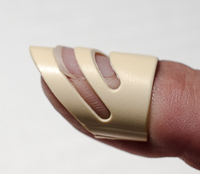
I’m afraid it’s a bit on hold for now, as I recently had a hard fall that screwed up my right arm and shoulder, including a heavily bruised tip of my ring finger, and that means no harping. I could probably start up again by now, but I’ll probably hold off for another week. The distal joint wasn’t damaged, but in case the tip itself could have been broken, I want to exercise some care, yet.
But I’ve worked out a backup for Leonard Cohen’s song Hallelujah, and I count it a bit of a triumph, because without sharping levers how do you field that one little bittersweet - and IMO absolutely essential - accidental in the original? What I did was to use a progression of certain notes from the accidental’s potential chord scheme to imply its existence. It’s an approach that won’t work every time in every case, but in this instance the result is convincing enough for me to be more than satisfied.
I might try scordatura, too, but that’s for another time. Right now it’s more important for me to become sure-fingered, and that’s the big hurdle.
Yes - although the chords actually rise by diatonic values, until the bolded part of the line, “the baffled king com**posinghalle**lujah”. That was the challenging part to be solved.
My version follows the usual tradition of arpeggios as backup to the tune. It’s bare-bones with no solid chords, but I might flesh it out later. But right now it seems to work well enough as-is, and in any case, at this point it’s more of a practicing exercise than anything else.
There’s a version out there - I forget whose - where that chromatic bit is abandoned altogether for a diatonic approach instead, and although it’s a logical enough variation, I was surprised because the accompaniment was piano, so there were no constraints to force such a change. I can’t speak to the performer’s motivations for it, but I found it disappointing and too bland for me ever to go there. For me it’s gotta be Cohen’s way, or not at all.
Ouch! However, bear in mind you dont have to use all your fingers…for “folk” playing, and all… Maybe you even have another digit or appendage somewhere to substitute.
I sprained my L wrist 2 weeks before Thanksgiving and couldnt play fiddle for 3 months. But I could play harp - as it doesnt necessarily require wrists. Ya win some and lose some..
Sharpen a note a half step by pushing down on the soundboard at the bottom of the string.