From a more gentle time?

The discussion on Grey Larsen and Tone, now spectacularly terminated, was causing me to think … (pauses, suddenly aware that everyone in the room is moving towards the door). Is it likely that Grey’s style is taking us back to a more gentle period of Irish flute playing that existed before the “Naked Power” period kicked in. Grey has done a lot of research into the older players (from disc and in person), and we know that he, like they, plays on a smaller holed flute.

I’m no expert on the development of Irish flute playing style, but I’m thinking that the style changed pretty dramatically around the 1960’s, with Tansey et al, now fitted out with well-restored large-holed flutes (by such as Paul Davies) sweeping everyone away with their power. I grew up in that tradition, and Matt Malloy and many others, it seems to me, follow in that general vein.

That’s been followed by a fashion of “Breathtaking Speed”, but it hasn’t succeeded in sweeping everyone away with it, whereas perhaps the Naked Power era did. It was certainly in the Naked Power era that we learned that “only a large-holed English flute was suitable for Irish music”, a notion since debunked.

(Interestingly, I noticed in the 32 sessions I attended during my 2002 Self-Indulgent Flutemakers Tour that, the more “capital” the city, the faster (and straighter) the music, with Belfast the clear international winner, Dublin and Washington not too far behind. A session in the city of London was fast, one on the outskirts was much more relaxed.)

So, what do we think? Are there three discernible eras - “A Gentler Time”, “Naked Power” and “Breathtaking Speed”? Are there more? Do they have more appropriate descriptors? Do they morph or switch at the edges? Can we identify the initiators?

And getting back to the Grey Larsen question, is it the case that Grey has tunnelled a way back into the endangered-if-not-extinct “Gentler Time” style? And does understanding help us accept that there was a range of ways this music was approached, and perhaps it’s still valid to approach the music in a variety of ways with a variety of instruments?

Terry

Well, I don’t have the longevity or breadth of experience that you do, Terry. But as far as I can tell from my collection of recordings, I don’t think people play faster, louder, or more aggressively than before… If anything, there was more variety and individuality in the pre-Molloy era. Certainly, McKenna and Tom Morrison don’t sound gentler to me than the “naked power” types. What about the guys on the “Flute geezer” tape? Jack Dolan, Eddie Moloney, etc…

Additionally: I much prefer stylistically pre-molloy flute playing (although I love Molloy’s playing) and listen to it most of the time. I just don’t hear that in Larsen’s playing. His ornamentation particularly seems quite modern to me.

Actually, I’d really like to hear some examples of the “gentler” older players. Other than Jack Coen and Mike Rafferty. Looking through my collection and finding Mick Flynn, Packie Dwyer, The McDonaghs, John Griffin, etc. The guys on the “irish music from cleveland” albums, whom I believe I was told were Larsen’s big influences. Frank Neylon, Martin Feeney, and Charlie Higgins can be found on archive.org thanks to Kevin Rietman… I just can’t find these players ‘gentler’ enough to be describes as such.

Well said, Terry! (Still love the flute, btw)

Pat

Interesting thoughts, Terry, as usual. I am delving into to small-holed fluting with the Ormiston small-hole Rudall I’m currently using.

Though you mention a “gentle[r] time”, you have well documented on your site what the likes of Nicholson (Gunn?) say on tone from the 19th century. They described their flute tone, i believe, as more like an oboe, i.e. reedy, big, commanding. Perhaps that was the exception and not the rule; perhaps more folks were playing small-holed flutes like the Firth or French models and getting a more “flutey” tone.

What I find interesting about the Ormiston small-hole is that I can get, I believe, a honking, classic Irish sound, more buzz and pop. Though it’s not as loud, it certainly seems capable of generating edginess and reediness.

Jason

My speaking as a relative newcomer to ITM, I think that Grey Larsen has done well, if only to help promote ITM.

After all, while there could be other, outstanding players, it seems that GL has done an overall fine job of helping to explain it all.

Bravo, Grey Larsen!

I’d agree with others: from what I’ve heard, I don’t think there was a gentler time. One of my favourite flute recordings is one that Peter Kennedy did, of Paddy Taylor, from Limerick, recorded some time in the 1950s. Pretty powerful playing there, right enough. Then there’s the old guys living and playing now (can’t think of any names at this time in the morning, but you meet them all over the place), who would have learnt to play flute in the 1950’s or before. Again, with the ones I’ve come across, they’re pretty powerul players.

Is there, in fact, evidence of a gentler tradition of Irish flute playing?

I’m also not sure about the breathtaking speed thing. Michael Coleman played pretty fast. Also, I picked up last summer some recordings made in the nieteenth century of players on a variety of instruments. Most were playing way way faster than anyone would dream of playing nowadays - and that’s after what appears to have been pretty careful research in restoring the recordings. Besides, you can hear that it really is the speed they were playing, from the style and also from the pitch (difficult for me to pick that up for the recordings of pipers, as the pitch on those recordings doesn’t make sense to me - not in any part of the modern scale, but there you go , it was a solo tradition back then, so they could have their pipes in whatever pitch they had them).

In fact, I’d go so far as to say that the music slowed down for a long period, and still hasn’t speeded back up to what it was originally.

But then, we’ll get into the whole ‘regional style’ thing, and someone will tell me that those players came from Sligo or something … shamefully, I can’t lay my hands on the recording at the moment, so I can’t check who’s on it … :blush:

The flute was taken up by Irish players for volume and power to play for dances. Any of the old players I ever met would not take prisoners on the issue : a soft player would not have been considered worth his salt.

Hmm. Most accounts of ITM in the wild stress the fact that this was dance music being played, usually, by a single musician in a house or kitchen party. Next in the tradition (the 30s) came ceili bands, and sessions became the dominant vector in about the 50s after fashion and the church squelched the dance halls.

In the first two contexts, volume is all. A solo fife or (better) piccolo player might be able to play softly and still be heard over a set being danced by men in hob-nailed boots on a flagstone floor, but a solo concert flute is likely to have been striving for as much honk as he could muster.

There being a lot more dancers in a dance hall (rather than a crossroads or farmhouse kitchen) so in a ceili band volume was again the object. Lots of musicians added muscle, as well as loud instruments like the piano, tenor banjo and snare drum. The Ballinakill Ceili band doubled up on flutes (Whelan & Maloney) to add power in the wind section. In scottish country dancing the piano accordion was another loud instrument that came to the fore.

In either of these settings, its difficult to imagine a flutist being especially concerned with playing ‘expressively’ if that meant ‘softly’.

In his Handbook, Hammy discusses the evidence of a parlour fluting tradition in Ireland, but remarks that there’s no evidence that this involved ITM rather than the popular sentimental ballads and light classical repertoire being played in genteel Victorian and Edwardian parlours all over the empire. At best, this might encompass Thom Moore songs and the famous derriere, but neither of these are strict ITM.

Just as the invention of the electric microphone made it possible for soft-voiced singers (crooners) to have a professional career, so too the arrival of amplification made it possible for flute players to play softly for any audience of more than a handful of people.

While I think that makee-learnee fluters have always had to learn how to practice quietly, I doubt that there was ever the kind of golden-age of gentle ITM fluting such as this thread posits.

Not off topic I hope. Are influences such as Grey’s style and book, new small-holed flutes and amplified performances encouraging a new group of parlour fluters with a gentler style ? There seem to be quite a few non-sessioning fluters and a lot of parlour whistlers posting here.

‘Gentle’ is a nice euphemism there.

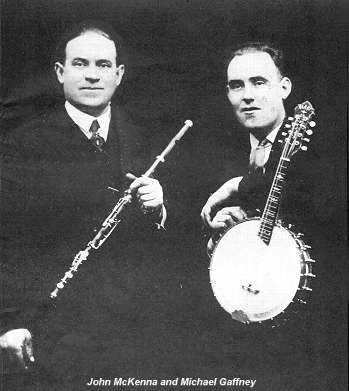
John McKenna played a run of the mill German flute, he had plenty of drive and power.

I guess the discs are not the place to look for a more gentle time - it’s likely that it’s always been the most up-front of players that make it to commercial release. As to any players alive now, they are most likely to have grown up like me in the naked power era. I’m remembering back to the 70’s in London where the oldest players played German flutes in very poor condition, and played in a much less forceful manner. But I’m no guide either - as I mentioned I was brought up (in flute terms) in the Tansey, Michael Hand, Paul Davies, etc era, when naked power was the go. It would be interesting to go back through field recordings made in Ireland of non-professional players before them to see what the average player was up to. And not just in Ireland of course; often the diaspora is a better window on earlier conditions than the homeland - it certainly is the case in the US where some of the islands off the east coast perpetuate Elizabethan era English useages. Perhaps that’s also so with Irish music.

Terry

It would be interesting to go back through field recordings made in Ireland of non-professional players before them to see what the average player was up to.

Those will invariably show powerful playing Terry, don’t make it sound like listening to old recordings is a new idea. It’s been done and it’s ongoing. I have never seen evidence of less than powerful playing.

Micho Russell?

Terry

Micho, during the sixties, hadn’t much embouchure or teeth left. Judging how he played in old age will not give you a reasonable representation of how he played for the sets during the forties.

Bill Ochs’ interviews with Micho, Gussie and contemporaries like Jimmy Hogan (or those done during the seventies and eighties by Muiris O Rochain and Harry Hughes for Dal gCais) provide some insight in the aesthetic these men applied to fluteplaying when they were in their prime.

I’ve heard John Skelton describe and demonstrate the flute playing by the “old gents” he heard growing up in London as “foot-stomping, spit-flying” – no gentleness there in when, probably the mid-to-late 60s?

I’ve also heard Kevin Henry talk about playing house dances in Ireland and describe how sometimes it was only him, which is partially why he took up the pipes – so he could be heard better.

I link back to this nice Henry YouTube video from the70s …

http://www.youtube.com/watch?v=8RumHRVZF7o

I think the dance-musician situations spawned that muscular style; you had to be strong, rhythmic and driving for the dancers to hear you! High-pitched flutes make perfect sense to me for this reason, too.

Not saying there mightn’t have been moments for pretty and reflective playing, but it was horses for courses, and I’d say solo playing for dancers is the ultimate steeplechase!

I’ve also heard Kevin Henry talk about playing house dances in Ireland and describe how sometimes it was only him, which is partially why he took up the pipes – so he could be heard better.

I would believe that playing the pipes would be less physically strenuous than playing the flute and many flute playing pipers would retreat to the pipes after a certain age. Flute however carries much much better in a noisy environment.

One can do just that at the ITMA in Dublin, as I did this past winter. I listened to lots of flute players I’d never heard of before or since, and didn’t come across any of these gentle players.

Aside from what Peter has said about Micho, I don’t think you could take his playing as being indicative of a supposedly widespread but undocumented style; he was unique in so many ways.

Johnny Doran also springs to mind. He played fast as hell while putting variations on the tunes that absolutely make your head spin. Wild playing that was.

Was it 2002 that you were in Washington, Terry? We were all hepped up here back then thanks to yer man that was living in the big house at the time and his sinister buddy that hung out in the secure undisclosed location. Shock and awe and all that. Even though us players are all much gentler folks, we had to get macho just to maintain a presence in this town. Ofttimes it wasn’t all that pretty, as you might’ve noticed.

Things have mellowed here now quite a bit, thanks to the new tenant in that big house who always keeps it cool. You should come back. Or for an even tastier groove, head up the road to Baltimore. Just don’t call it the “outskirts of Washington” if you do. They bristle at that kind of talk up there.