Hi
I’m an uilleann piper who has “dabbled” with the flute over the years. (Mostly standing on one leg in the 70’s pretending to be Ian Anderson) but I want to get serious.
I know there’s no one/right answer, but might there be a general rule of thumb for a novice re: R&R versus Pratten styles, etc…?
I’ve done quite a lot of reading, but any suggestions from experienced hands would be greatly appreciated.
Thank you
Séamus
Instead of P vs R&R consider whether you want a large or medium hole flute.
In general a large-hole flute with bigger bore will be louder, while a smaller holed flute will make it easier (quicker) to articulate the notes. A good embouchure and lots of practice mitigate these differences.
Thank you , TS…
Should have mentioned a couple of things:
I’ve played a Grinter D- Big sound- Big holes.Took lot’s of air. Beautiful flute, but, at least for me, a lot to manage. I’m a big guy with big hands, but thinking smaller holes might be better while I’m learning breathing/phrasing, etc…I’ve no plans to take my show on the road anytime soon.
Flutes also vary depending whether they are optimized for traditional tunes or for a wider repertoire. My vintage R&R really sings in the second and third registers, as it would have been designed for playing Beethoven. The large-holed Grinter would work well in a session; it probably has a huge volume on the low end.
You didn’t say whether you are looking for keyed or keyless. Quality keyless flutes come up all the time, for example at the Irish Flute Store. Keyed flutes tend to have a long or very long wait time from a modern craftsman, but antique keyed flutes are regularly available at a lower price than modern ones.
The American 19th century flutes (R&R style) are a particularly good value; you can get a coccus 8-key flute in the +/- $2,000 range. Their hole size is medium compared to English flutes and tend to play well at A440. The english antiques range from small to medium to large, and you need to watch carefully to see if they (1) don’t have many intonation issues, and (2) play at A440.
One other consideration between antique and modern is that the flute embouchure is typically a little larger and more forgiving on modern flutes. This matters more for beginners. As you develop your lips you can get a good tone out of a less generous embouchure.
I would echo what tstermitz said regarding large vs medium holed flutes (Not necessarily Rudall vs Pratten). I’ve found that medium holed flutes were slightly easier for improving and learning. I’d also repeat what tstermitz said about finding a flute optimized for ITM. Depending on your budget, Delrin flutes are less costly and perform well for the beginner or improving player. You will see Copley is well recommended by members of this forum; my experience with his wooden and Delrin flutes has been very positive–highly recommended. There are many other makers who build medium holed flutes optimized to ITM that also perform well. Another that comes to mind: Martin Doyle’s flutes are also, in my experience, fantasic and accessible to the learner.
Just great information! I didn’t realize how much I was leaving out in the “wish list” posting, but Yes..Irish music is really all I play and I am keyless (clueless?) all the way. Nothing against low/no maintenance poly, but I want a blackwood flute. As as Highland piper as well, there is Nothing like the tone and feel of a wooden chanter.
Thanks again lads.
Séamus
In general I’ve found that while the differences between flutes can feel significant to the player, the overall quality of tone when I record myself is fairly consistent no matter which flute I pick up. Advice I got when I was first learning was to just find a quality flute that was in good shape of any type (Pratten, R&R, etc.) and run with it. What I did personally was find a quality used flute, in my case it was a Casey Burns flute, and I waited until I had an intermediate-level embouchure before trying other flutes.
There are tons of differences that can influence how a flute feels to the player: style, wood, weight, hole size, keyed vs keyless, etc. I currently have both a pretty standard modern Pratten and a pretty standard modern R&R. The Pratten flute is blackwood, lined head, and keyless. And the R&R is boxwood, unlined head, and keyed. Between the two, the Pratten is definitely louder, heavier, and sounds more hollow. At the moment I prefer the R&R for myself, since the lighter weight is more comfortable, the keys are fun, and the tone is slightly woodsier.
Step 1 - get a flute. Keyless is fine. Get the best within reason that you can afford. Wood preferred. The Pratten/Rudall question will become relevant down the road when you’ve developed your playing skills to the point at which you are able to achieve a consistent playing, phrasing and good tone. Just avoid a bad instrument that will limit your development or passion (don’t take a risk on an antique or older keyed instrument unless you have somebody qualified to pick it out with you).
Step 2 - get going. If you buy sensibly you will sell well. If you stick with it, you will likely make a well informed later purchase which is better in tune with your playing style, preferences and development. It’s impossible to know for sure right now - even if you had quite a big budget to throw at it.
These are the kind of options you might be looking at:-
https://www.irishflutestore.com/collections/irish-flutes-previously-owned/products/ellis-ebonite-essential-d
https://www.irishflutestore.com/collections/irish-flutes-previously-owned/products/geert-lejeune-blackwood-keyless
Step 3: enjoy!
Hmmm, Grinter flutes don’t have large holes and don’t require lots of air…….
I understand what Noob is saying. I can see where a high quality instrument, with an embouchure cut that sounds wonderful when an experienced player with well focused airstream is playing, might feel like it takes “a lot” of air, to an inefficient beginner blower. I have flutes that once seemed to require huge efforts to play, that now play with much less effort for me because I have improved. (One can only hope.)
Loren,
The Grinter was a really nice flute and I did manage to grind out a few jigs, but Hmmmm…then I must be a pansy- 'cause it sucked the air outta this hombre.
OTOH- I had very little experience with other flutes at the time, so I must plead ignorance in comparison to other makers/models. Maybe it was the bore, as it sure seemed to take a lot air. Thanks
Yeah, I just think you’re going to need some calibration, and the reason I bring this up is so that you don’t end up surprised/unhappy with whatever flute you end up buying.
I’ve owned and/or played multiple flutes by most of the well known makers, and Grinter flutes fall squarely onto what most would consider the Rudall side of the line, not the Prattens large hole large bore side.
As far as running out of breath, that’s an embouchure thing more than a bore and hole size issue. That said, if you have an undeveloped embouchure, a large bore/large hole flute will make things tougher.
Point of all this being: In a general sense, it really doesn’t get much easier than a Grinter, so adjust your expectations accordingly. Some flutes -Olwells and Copleys for example - can have embouchure cuts that are easier for a beginner to start on, but the actual air requirements and finger stretches are not going to be significantly different from the Grinter.
Just wanted to write the same  . I don’t think anyone would claim a boehm flute takes more air because of the huge holes. An efficient embouchure cut and technique make all the difference. I think the main effect of larger tone holes is a “harder”, louder sound. And for a beginner it can be more difficult to efficiently cover larger holes, so the flute might be “leaking”, making it harder to play.
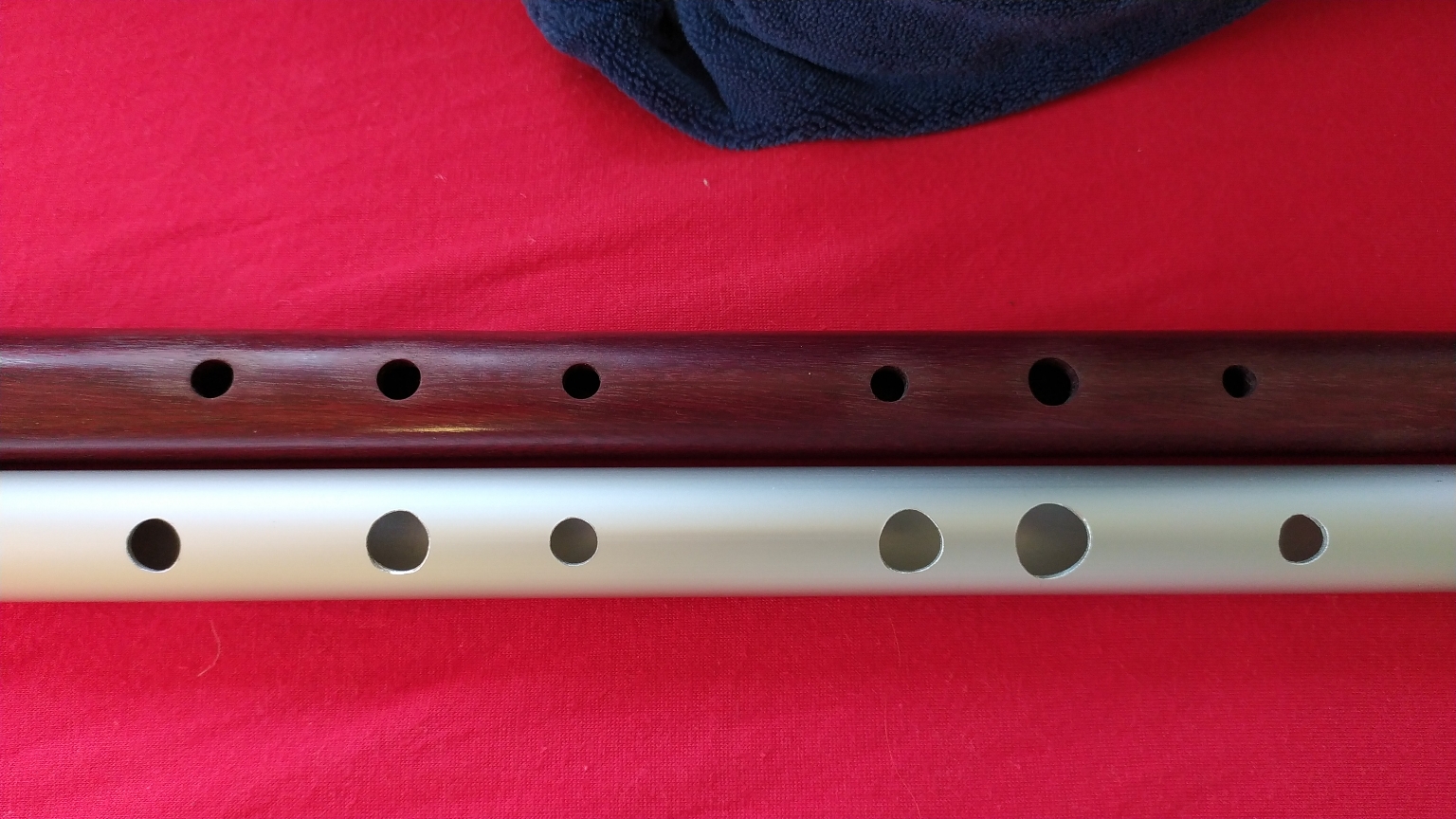
These are the two extremes of my small “collection”:
A David Angus flute with very small holes and one I made myself – the strange hole layout comes from the fact that I designed it so that it can be played chromatically with a half-holed Eb in the first octave - – to do that the lowest hole has to be far down the tube to be big enough. So all the other holes get bigger as well.
But the point it – there is not much difference in “air requirements” between those two despite the difference in hole size.