We all know about flat sets, C#, C, B, Bb and the like - and maybe some of us have even heard of some sets sharp of D. Eb possibly, and I recall there even being a children’s F chanter by Froment a while back on Uilleann Obsession.
I’m wondering about flatter than flat sets. Has anyone seen or heard any sets in A? Lower even?! The thought occurred to me tonight that there must be some kind of lower limit on pitch that the pipes can reach - assuming that one keeps the 8 open toneholes that are practically mandatory for articulating in Irish Music. What would that limit be? If someone had large enough hands - say Padraig McGovern - and the bore was small enough to bring the pitch down - would it be possible to see a set of bass pipes pitched an octave below concert D? Any pipe makers want to weigh in?
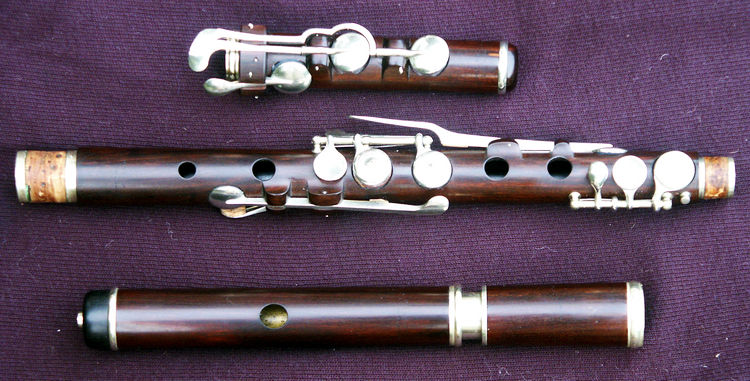
I’ve played a chanter in G - it stung - my flat set is in Bb too. Covering holes that wide apart isn’t fun. I’ve a tape of Ronan Browne playing the Hunter chanter and he talks about what a struggle it is to get a good seal. To make pipes that big feasible you’d want to add some helper keys for the right pinky and left ring fingers, ala Siccama flute keywork:
That, and crossbore the rest of the open holes, so they’d be closer on the surface and further apart in the bore, and it’d be workable by humans. The other problem you run into is that after a certain point you’d have to rest the bottom of the chanter on a box instead of your knee since the top of the chanter has to meet the bag somehow, eventually it’d all be just too unwieldy; and don’t forget the buildup in weight of this thing. A really tall gooseneck might be a fix for the first problem, maybe use fruitwood to keep the weight down. Also there are limits on what pipemakers are set to bore/ream out in the first place. The Hunter chanter breaks in two, I think because he used one of his existing reamers and it wasn’t long enough to ream out the the whole thing in one go.
So, yes, you could build sets in A on down, but not a great idea, there’s a reason the old makers stopped at Bb, and Bb is pretty rare, too.
Although not a flat ‘set’, I do sometimes put A bass and baritone drowns (B drones tuned down) on my D set. Played with my D chanter for tunes in A, or converted to A.
Hah! Those sound samples on the G and A chanters are amazing. The A actually sounds quite nice with the D drones, and I presume there were no G drones made to go with the G chanter. Electronic? Ronan sounds like he was really stretching to play that G.
The character of both chanters is just odd - the G especially. I realize only a handful have been made throughout history so it’s not like makers are masters of these things, but the upper octave sounds weird. What I appreciate about the upper octave is its finicky (I actually quite like sometimes when a piper will drop the octave, then pick it back up again), almost wild character to its sound and the way it plays.
That G chanter has an upper octave that for all its effort falls just short of the ‘wild’ label. It has that awkward stature of a person - who is normally quite reserved - trying their darndest to fit in with the rest of the hip crowd.
I just had a look myself, and oddly there is no recording of the G chanter that I made, which was much better to play than that one of Ronan’s. I will try to dig it out. It was fully in tune over 2 octaves (near enough) and the second octave was pretty nice. It is in Germany somewhere I think.
I didn’t find the stretch too bad really, and the tone was akin to the difference between a cello (the G) and a fiddle (a D chanter)
I was so enamoured of it that I was going to make myself a one reg G set, but time pressure soon scotched that plan.
The A chanters are pretty nice. I was trying to pick my favourite pitch just then, but it is impossible. I think it would have to be C or lower. B is great, Bb is like a souped up B. A and G tend to suggest playing tunes quite slowly…