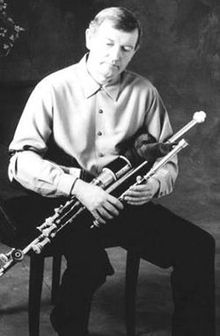
Today I took a long overdue step of lengthening the hose between my bag and bellows. It has made things a bit better, but I still feel cramped on my set. Mainly, I can’t seem to get the chanter and my hands where I want them, and I’m wondering if I need a longer bag. I’ve read recommendations to hold the bag towards the front, but even with the bag forward I still can’t get the chanter out front or horizontal enough. Maybe I need the kind of bag with the extra long neck on it?
Also, there is the issue of the belt on the bellows. It is on the short side for me and I have to have the bellows around my waist. Some pipers wear them higher, but I can’t try that because there is not enough belt length.
Maybe I should be considering a new bag and bellows?
The stuff that Kelleher makes looks great, but it’s hard to invest much more into this caper when I’m not 100% confident that my reed is in good shape. I know that it was in good shape at one point. I had it reeded, and then i heard it played by a piper who told me that it was playing well. It’s been sitting for about a year since then, and I’ve read that sometimes reeds will close up after a while in a new climate. It plays about the same now as it did then for me, meaning that I can get the first octave, a week upper E, and an F#. I can get a second octave G, A, and B, but only briefly and only with a whole lot of squeezing. I’m not sure what’s going on there, but I don’t suppose that a new bag and bellows is going to be any help with it.
You would hardly replace the bellows because the length of the straps. Buy a longer belt, take off the old one and see how you go with the new one. Also, experiment with the length of the bag/bellows connection. Take a piece of hose, start long, and cut it down until you find a comfortable position. You may find the chanter position falls into place once you have found right position for the bag (then again, you may not but worry about that when you get there. Experimenting with various length of chanter/bag connection may give you an indication if the problem lies there.)
Also consider your posture/playing position, find a way to sit straight,. relaxed and comfortable. Fit bag/bellows to suit that position.
I usually feel overwhelmed when a few things go wrong. Try break down the issues and deal with each one individually.
Before spending money on a new bag, try to jury-rig an extension between the chanter and the bag. You can often do this with plastic tubing from your local hardware store. The results may not be pretty but they’ll work.
Belts are usually attached to bellows either by loops on the inboard bellows cheek or are screwed directly into the inboard cheek. Just buy a longer belt and attach it. It’s cheaper than replacing the bellows. I’d only considering changing bellows if the leather gusset were leaking.
Reeds can collapse and die if they’re exposed to extremes of weather - cold/dry winters, hot/humid summers - even if you don’t play them. They need gentle adjustment to ease them through the change from summer to winter to summer. If you’re a beginner, get an experienced piper to adjust your reed for you from time to time. Also, if you’re a beginner, don’t worry about the second octave G, A and B. Hitting those notes is not about bag-pressure. There’s a special technique that you’ll have to learn.
Did the piper who tried your reed use your bag and bellows? Just curious.
And ditto on the posture comments. Look at the good pipers, and even if it feels awkward or mannered at first, sit like them.
I know I’ve banged on about this before, but you drop/lower that “chanter knee” for a reason – to let the chanter “hang” from the bag neck and balance on your knee so you can basically just let it fall into/float between your hands without clutching the thing. An All-Ireland player explained this to me and it was one of the best pieces of advice I’ve ever gotten (thanks, Torrin ).
Posture depends on your shape more than trying to copy the position of another piper, although it can be of help of course. People with long legs may want to lower their popping strap knee, or find a taller chair. Some people its all legs and arms and those may wish to strap the Bellows lower down around their waist… some pipers have no waist so they may have to decide to strap the bellows above or below the stomach bulge ( for comfort).
Small people will find it more comfortable to strap the bellows higher up so that the paddle is above the elbow and then find a chair which is low enough so that their thighs can be horizontal or just slightly going downhill towards their knees.
I use a stool, for preference, so that I can sit ‘off the back’ of it and spread out . I do not hold the Bag in a horizontal position but let the top of it form a straight line from under my armpit to the in feed tube of the chanter top.
I’ve known long pipers who wanted their bag neck shortened and the smallest (adult) piper I’ve known has the longest necked bag of all. Different strokes for different folks.
Keeping your back as vertical as possible looks and feels better. Experiment and Get Comfortable!
I am going to have a local piper take a look and help me get sorted out.
I neglected to mention that the piper who made my reed did some work on my bellows and recommended I replace them at some point, so I wasn’t coming completely out of left field with that idea. I did eventually rig up a new belt. (I guess I’m going to have to start getting good at rigging stuff up.)
Thank you for this. I’ll not worry about the G,A, and B for now.
No, he was already geared up and I just passed the chanter to him.
The way the chanter float’s in Mr. O’Flynn’s hands is exactly what I’m aiming for. That type of angle feels natural and tension free when I’ve practiced fingering the chanter away from the bag and bellows. Now to see if I can put it all together…
My set is now rigged up with stuff from the Home Depot, but I’ll see I can’t get everything dialed in better, based around correct posture and getting the chanter to float from the bag.
I’ll also meet up with my piper friend as soon as I can.
There is a piper in Austin, Larry Fortson, who used live in San Antonio. Whichever, as stated above, it is great idea to have a real piper provide help if you need it.
Well, I dare say that we all (in Texas anyway) know what it is like to learn and play without a local support system, and we all remember what those first difficult months were like when you are just starting out.
 ).
).