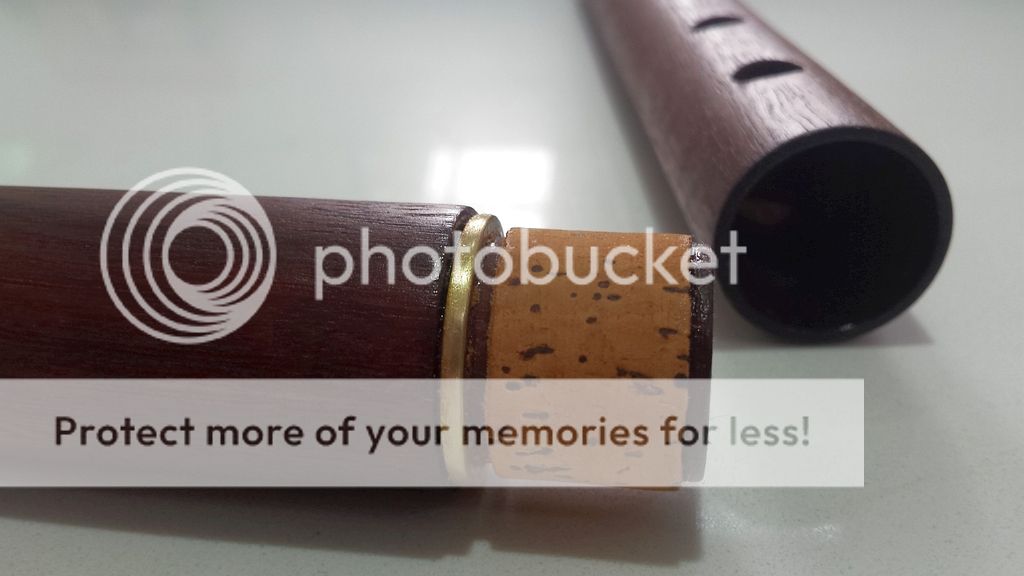
Finished my First Wood Flute!

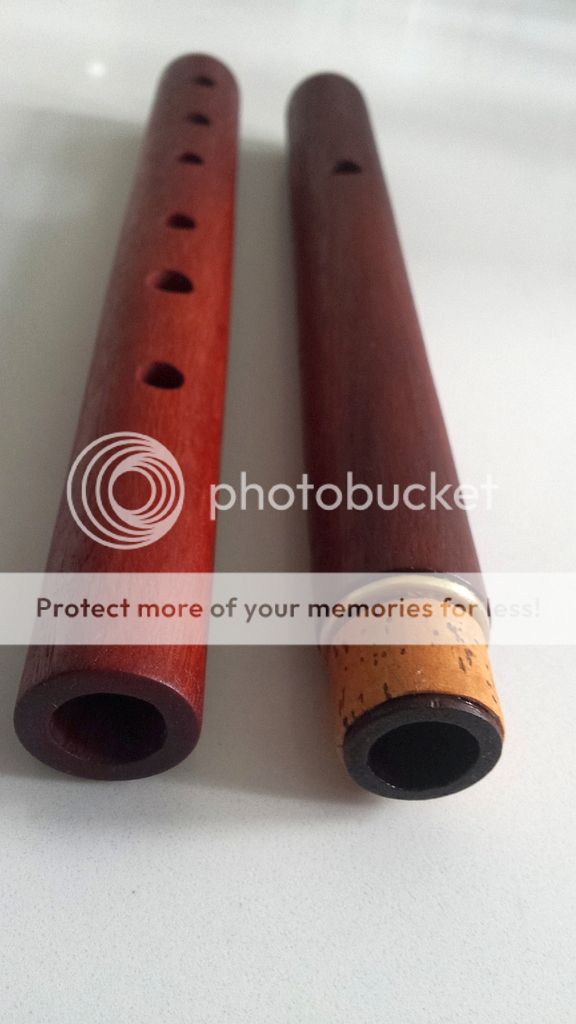
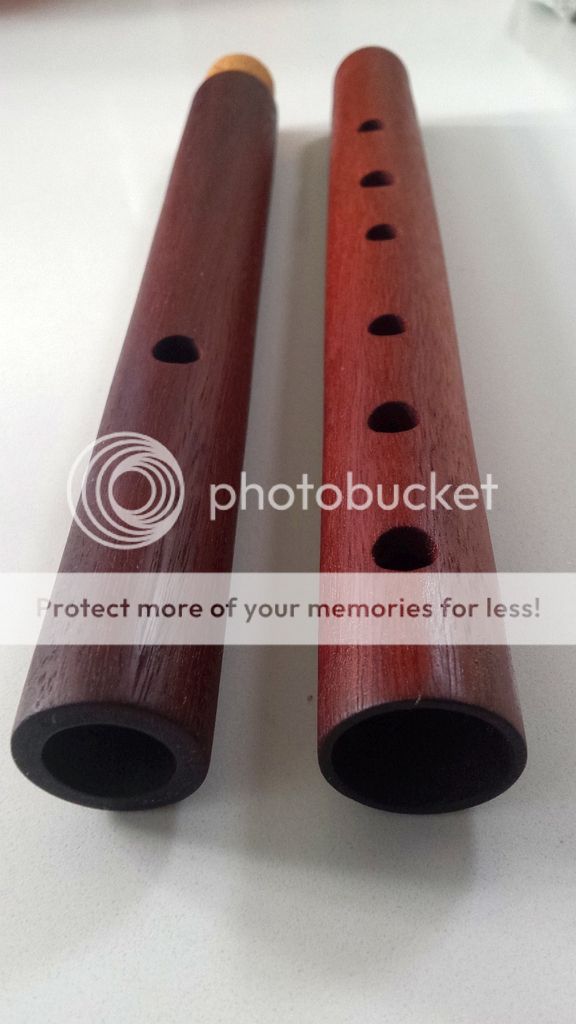
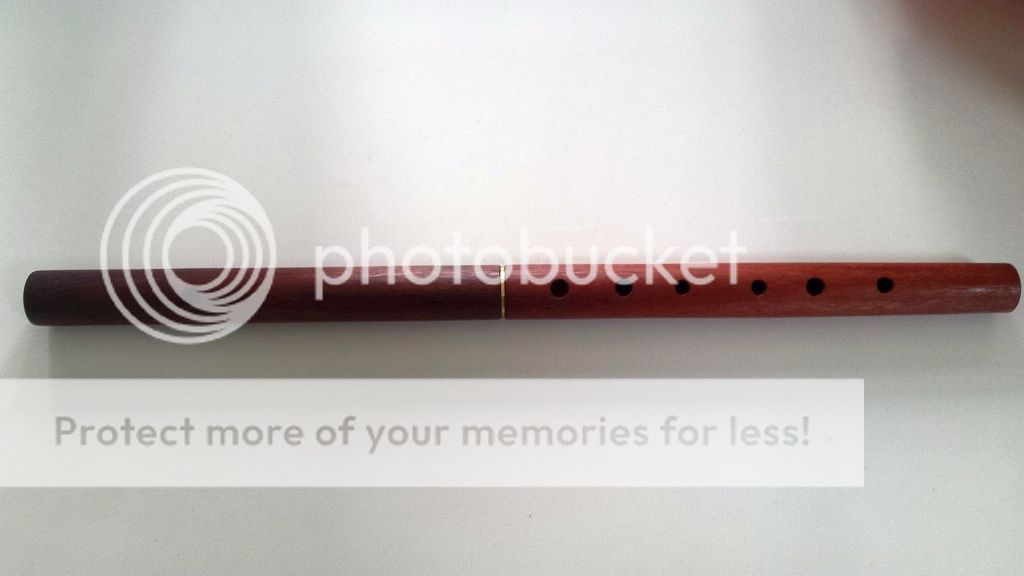
After lots of bamboo, PVC and a few aluminum flutes I started making wooden flutes about 3 months ago. Finally today, after re-learning woodturning, much trial and error with technique, tools and woods I finished my first G flute in Jarrah and brass. :party:

It’s a Renaissance flute (based in part on a C. Rafi tenor D copy I have in A=392) with a cylindrical bore of 14mm, sounding length is 380mm. It’s probably almost a Fife by exact definition, I suppose. Small bore, small embouchure and toneholes.

I’m certainly not an experienced woodworker in any way so I’m quite chuffed that it’s quite tidy looking and plays in tune and with an ‘easy’ embouchure (for me at least).
The wall thickness is quite hefty which means the next G flute I finish in Gidgee will be quite different dimensionally since it is slimmer overall (ie. thinner walls).
Jarrah is not by any means a good wood for flutes, not hard enough and probably won’t withstand the moisture attack, but it’s served me well as a half-decent cheap wood to trial and error upon, and it looks nice after linseed oil has been applied :slight_smile:

Vaughan

1 Like

Congratulations. That’s quite an accomplishment.

Good for you. I respect all makers, but particularly those who choose to tackle the ‘playable instrument’ mountain. Getting to the first axe you want to put your name on must be a triumph.

Looks to be a nice instrument and a good accomplishment (says one who is barely capable of relapping a joint with thread), but when you describe it as a “renaissance flute” based on a Rafi, does this mean it is tuned as such?
Original renaissance flutes - and modern replicas - are designed to play in D Dorian, with (using later terminology) D minor, A minor, C major and F major being the other most usable keys. The note F is played with a forked fingering, but the F sharp, played XXXX00 or XXX0XX - is exceptionally flat. Trying to play in G major or D major on a renaissance flute can be agonisingly difficult, requiring the instrument to be rolled so far away from the embouchure that it almost leaves the mouth. Original players would rarely have been required to do this and sharp keys are very rare in early music. But because we are conditioned to think of flutes having a home key of D major, the fact that this is one of the most difficult scales to play in tune on the renaissance flute comes as a major surprise. It did to me, anyway, many moons ago, although I then came to appreciate the virtues of the D Dorian tuning for most music of the XV-XVI centuries. Of course there is no reason why an instrument with a renaissance-like external profile should not be tuned to play the same scale as later flutes

Thanks for the kind words.

Will - you raise a valid point about the tuning of this flute and its true ‘Renaissance flute’ status.

To clarify this is really a copy of a Terry McGee copy of the C. Rafi tenor flute found in the Musée des Instruments de Musique, Brussels (no. 1066):
http://carmentis.kmkg-mrah.be/eMuseumPlus?service=ExternalInterface&module=collection&objectId=110606&viewType=detailView

After acquiring this beautiful tenor flute I met with Terry last year in his workshop and he showed me his copy of the A. M. Moonen technical drawings and Roderick Cameron bore trace he bought from the Museum in the late 1970s or early 1980s (approx. when my flute was made - his recollection was hazy unsurprisingly).

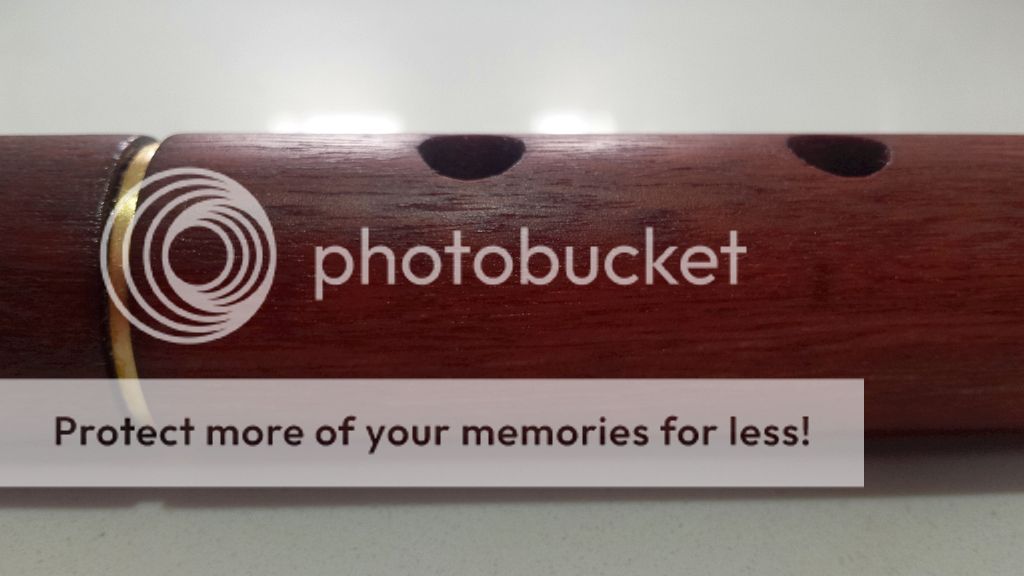
His copy of this flute is remarkably exact in its reproduction of the dimensions. I have my own digital copies of these Brussels Rafi drawings/traces but I must admit I copied the McGee flute copy rather than the technical drawings. Since my flute’s length and bore is reduced but the wall thickness is increased, I can safely say it is copied roughly. The toneholes on mine are clearly enlarged to cope with the thick walls:

I know from my research on the Rafi flute that its bore has at least one or two ‘chamber’ sections probably added much later for tuning the second octave (see ‘Geschichte, Bauweise und Spieltechnik der Querflote’(2008) p.293-295) and I can only assume this was not replicated by Terry McGee - but I am speculating here and I don’t have a electronic bore tracer at hand to measure!

Regardless, in terms of tuning and scale the McGee Rafi copy is in D major scale at A=382Hz. So it is not a D Dorian.

My copy in G is in a G major scale (at A=440Hz).

Both my and Tery’s copies exude all the shortcoming of cylindrical bores and yield similar Fnat and F# tuning quirks you describe with the normal and forked fingerings. Cnat/Fnat (in D major/G major) is only acceptable with a fingering OXX XXO. This is the most pronounced common trait between my flute and Terry’s.

So yes, it is ‘Renaissance’ in design and aesthetic but not in its tuning. Especially if, as you indicate and flutemaker/historian Boaz Berney state, a Renaissance flute is:
tuned in a d-Dorian (d minor with a lower 6th) mode. The temperament in which it is tuned in is closest to d just minor, with a pure fifths d-a and e-b.

If I had a flute in D Dorian I would’ve copied it in such, but the McGee is in D major. But perhaps if the Brussels no.1066 measurements are followed this is the correct tuning??? I don’t know.

I will try to make a G flute in Medieval/Renaissance Dorian tuning in the future. For now I rather like playing Van Eyck in G major :slight_smile:

Regards,
Vaughan
P.S. in my original post I said my McGee Rafi copy was A=392Hz it is actually A=382Hz)

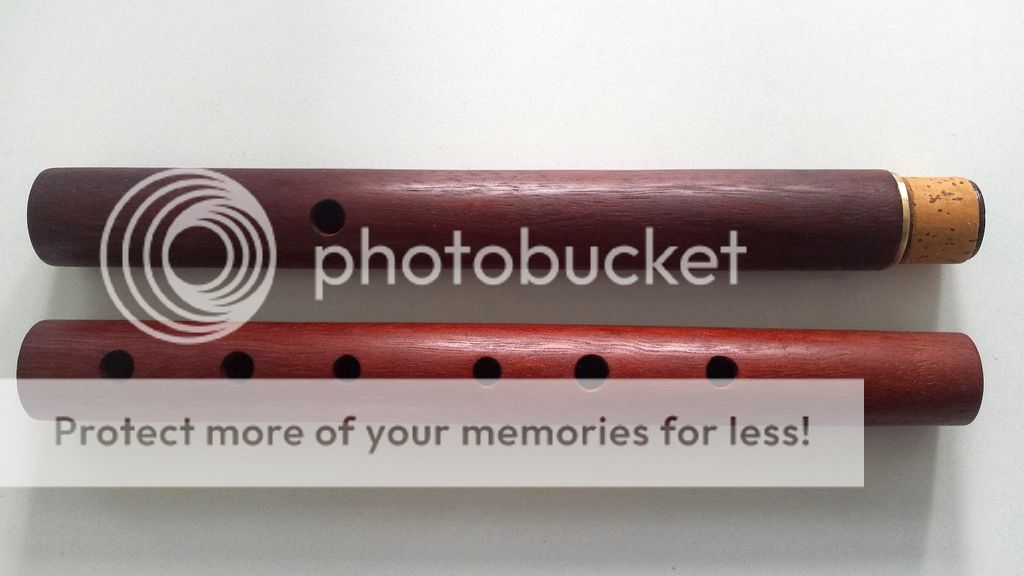
A quick rendition of ‘Daphne’ on the G Flute:
https://soundcloud.com/dubrosa22/daphne-g-flute-jarrah

V