Wheeee ! 


Very novel ! Would love to try it !
Anyone here do CFD ?
Wheeee !
Very novel ! Would love to try it !
Anyone here do CFD ?
Hmmm, CFD. As in Computational Fluid Dynamics? No, I don’t ever remember being accused of that….
But this is pretty much what happens with a flute embouchure, where the blade is parallel to the bore not perpendicular. The returning wave reaches one side of the embouchure, and one end of the splitting edge, before it reaches the other. And that doesn’t seem to do any harm in a flute.
Furthermore, Marat has demonstrated that you can have similar, diagonal, rectangular shaped, tone holes on a 3D printed flute, and they too have no problem forming a pressure node at the opposite end of the resonating air column.
The purpose of the blade in a whistle, or the splitting edge of an embouchure hole in a flute, or the rim or notch in an end-blown flute, is simply to induce the formation of an air reed. We have plenty of existing examples of that working fine with, for example, a straight perpendicular blade in whistles, a curved or notched blade whose sides are parallel to the bore in end blown flutes like quena or xiao, and a curved or straight blade that is parallel to the bore in transverse flutes.
You can also cut the embouchure hole at an angle on a transverse flute to aid ergonomics without ill effect, and many players do not blow their air stream exactly perpendicular to the flute when playing transverse flutes.
Also, I don’t really see why the octave tuning should be influenced by the angle of the blade. It is primarily influenced by the bore shape.
I’m curious about Marat’s design. In open air the wavelength of D6 @1175Hz is about 30cm. So if the span of the blade is about half a cm in the axial direction it covers about 1/60th of a wavelength at the top of the second octave. Rough numbers, but I think the wave should ‘see’ the blade more or less as a single point in space. I mean to say the pressure just inside one end of the blade should be very close to the pressure just inside the other end.
What about the time it takes for the velocity front airflow to get from one end of the blade to the other? say you are blowing about 30L/min (Q=5e-4m3/s) through a 1.3x8mm rectangle,
A=0.0013×0.008=1.04×10⁻⁵ m2
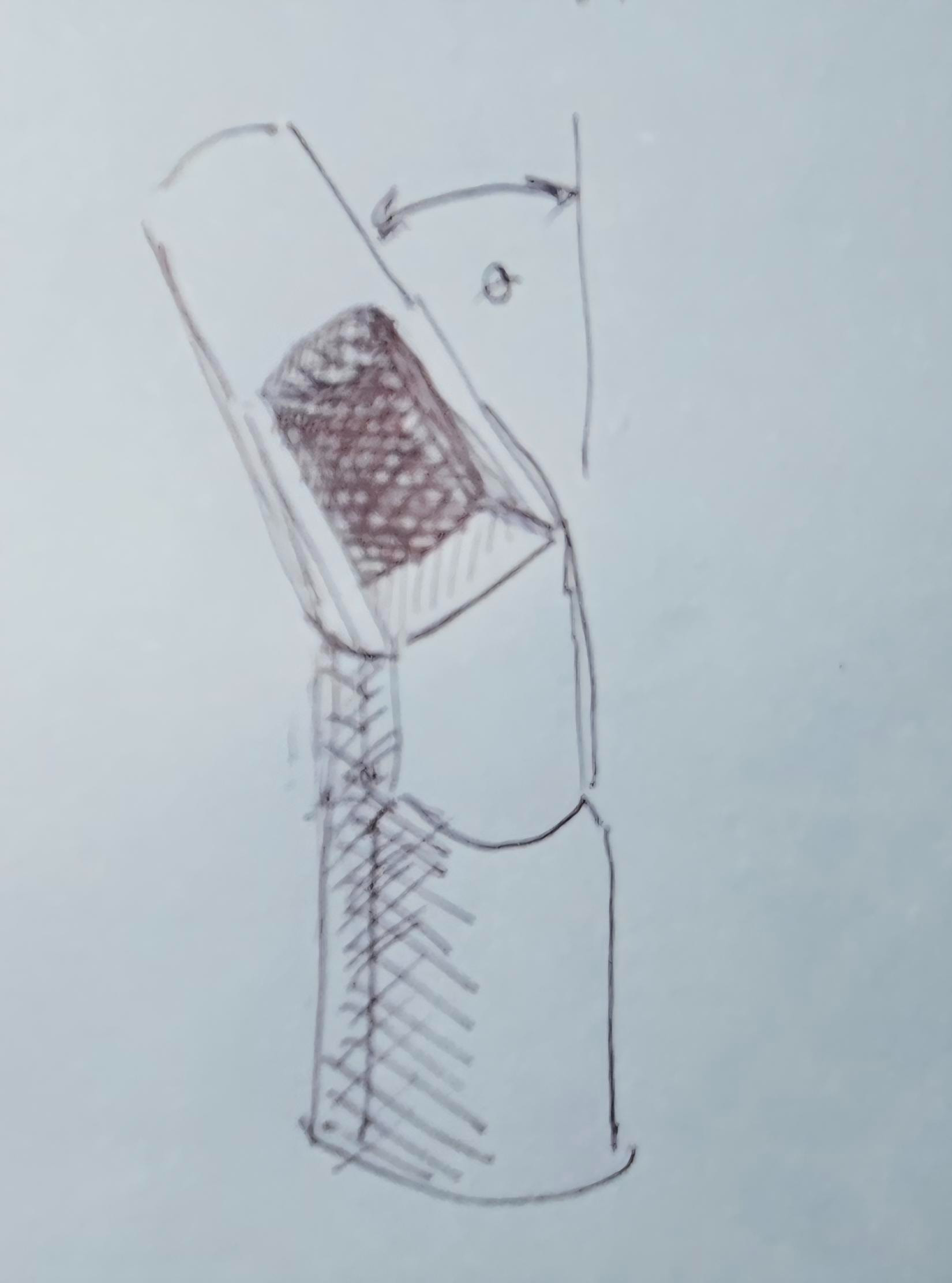
So, v = Q/A ~=50m/s, so it would take about about 0.1ms for the flow to travel down the edge of the blade, which is about 1/8th of the period of D6. I’m not sure if it matters or not, but you could eliminate the effect of the flow velocity by tilting the whole windway to one side at right angles to the blade in Marat’s design? Excuse the rough sketch
I just realised Marat’s design is for a low D and my rough calcs are for a standard D whistle, so I think the impact of the tilted blade would be less for the lower frequencies in Marat’s application
Woah, I was hoping my response might go under the radar. Not so, it appears.
I don’t have a definitive defence, but let me blunder forward, and perhaps Tunborough will chime in with something more scientific.
The question Paddler raises is how come the flute gets away with not being across the returning air wave.
I think robustness might be part of the answer. We don’t normally think of the flute as being robust, not at least when we compare it to the reed instruments - clarinet, oboe, sax etc. But compared to the whistle, it’s very robust. Compare the power of the hard-driven flute with the Low D whistle.
So I think that robustness is part of the answer. A lot more energy goes down that embouchure hole, and so we can expect the returning wave to have concomitantly increased energy. We are not running on near empty.
By comparison the whistle is a very feeble thing. The maker sets it up as best they can, and the player can do more than try to make the best of it. Whereas the flute player can take quite a bit of control.
Now let’s imagine the returning air pressure wave getting back to the flute embouchure. Let’s imagine it’s the trad oval hole, with a lip covering around half of it. So it’s a sort of D shape. And it’s across the tube, so the wave is coming up from the base of the D. And the embouchure hole is probably a bit deeper than the whistle window.
My feeling is that the whoosh of air coming back up the tube will distribute well in the narrow vertical space between lip and edge.
Just as I’d expect it to distribute well in the wide window of the typical trad whistle.
Whereas I feel it would not distribute well in Marat’s dramatically slanted window. I’d expect it to crowd towards the bottom left had corner.
I’m happy to be debunked!
I don’t do CFD either, although I have been tempted down that dark path.
I don’t think flutes, even end-blown flutes, are comparable. As Terry notes, the flute player has substantially more control. In a whistle, the window length, from the windway exit to the blade, is fixed, at 6 mm or 8 mm or whatever. A long window length favours the low register; a short window length favours higher registers. My limited experience with whistles where the window length varies across the blade suggests that tone suffers.
When the blade and windway exit are at an angle to the airstream, the effective window length might look constant across the width of the window when the airflow is lower. When the airflow and airspeed increase, as it would to reach the second register, I’d be afraid the effective window length might start to look longer, running more from the upper right corner of the windway exit down to the lower left corner of the blade. This is not an effect you want, and not what a flute player would do: the flute player shortens the “window length” to reach higher registers.
Apologies for contributing to the hijacking of Jayhawk’s original thread. I do feel the loss of Feadog will leave a big void in the market.
I used to do CFD but I’m on the wagon. If there is enough peer pressure I might slip
That is tempting, but I don’t know I’d want it on my conscience.
Getting back to the original topic, the statement from Feadog that they planned to finish up in January 26, I was taken by their reference to starting the business in 1978. I started making flutes in 1975, a few months after returning from my first trip to Ireland in 1974. I had been much moved by the situation with flutes I had found there. Everyone was playing old flutes, mostly in really poor shape.
Whistles were better, but not altogether good. They were at least being currently made, mostly by Generation in England as far as I could see. But Generation were just recovering from a period when things went very badly in the head casting department. So badly that most of the whistles they had exported to Australia in the year or so previously were unplayable.
So I wonder if that experience had affected Ireland equally. And did that have any influence in the setting up of Feadog?
I note that they have suffered the same curse as Generation at some point - a lapse of quality in the head casting area. I have a few Feadogs here that I have tweaked to overcome the problem. But I also have one in absolutely mint condition that demonstrates the need to tweak - some notes that just won’t play convincingly.
Should I tweak it to show what the Feadog was capable of? Or leave it untweaked to show what we poor whistle players have had to cope with over the period? It might become a collector’s piece!
“Vintage Feadog whistle - as new. No longer made. Bids welcome….”
My recently purchased box of whistles was 99% good with just a few with flashing I needed to clean up a bit in the head. All in all, nice whistles if you like feadogs.
Let me know if the market on eBay surges for feadogs. I may be able retire on them!
Imagine you are trying to print a treble D whistle head in the modern style where the windway isn’t flat across like in the Good Old Days, but curves to follow the bore of the main tube. And tapers down from say nearly 2mm high at the blowing end down to about 1.3mm at the opening into the window.
I have found that Feadog flat wind way is tapered from the blow end to the exit! This seems to make a more efficient air stream to the blade/ramp. I use a piece 1/16” round styrene cut angle on the end to measure.
Evergreen scale models item No. 222
A taper in the windway of the whistle head is normal. Generation, Walton, Dixon and many others (can’t be bothered to look at other whistles) do this.
You might be amused at these measurements I took of a Feadog windway height a few years back.
At 0mm, 2.08 high, 8.48 wide
@ 2.15, 1.82
@ 14, 1.7
@ 16.32, 1.61
@ 21.9, 1.53
@ 24.81 (windway exit), 1.5 high, 8.23 wide
Window 5.3 long, 8.23 wide
I used tiny twist drills backwards as feeler gauges to map out the height. As you can see, it tapers down from 2.15mm at the entry to the windway down to 1.5mm at the opening into the window.
Very good Terry! Fine measurements! I have measured and tweaked many whistles and found Generation to be inconsistent! Sometimes the exit being taller on one side than the other! Somewhere years ago there is a C&F thread describing how to heat a Generation head and lower the exit! Also instructions on laminating the windway.
I think all the plastic moulded head whistles I’m aware of have been inconsistent at some time or another. And yes I’ve seen all the issues you have mentioned, including some which were just downright unplayable, straight out of the packet! And others that really should not have made it out of the factory.
But easy for the likes of us to criticise them - how much quality control can you afford to put into a product that retails for around $10? I wonder how much of that gets back to the maker after the retailer, importer, wholesaler etc get their cuts? I think it’s a miracle that commercial whistle makers stay in the business at all!
And yes, the good news is that most whistles can be saved. I’ve really enjoyed working out a process for inserting a little chunk of credit card under the ramp to turn an unplayable whistle into a really good instrument. Probably hardly worth my time, but hey, I like a challenge, especially when the whistle then pleased me more than some expensive modern whistles!
Sad times about Feadog  . I would love to know where they got their whistle heads from. Perhaps the manufacturer of them stopped producing? I know Feadog never made them in house.
And $50 great-playing 3D printed uilleann chanters!!
Still waiting…
FEADOG rises from the dead!
New notice on their website indicates Feadog has been taken up by JC Walsh and Sons and they have every intention of continuing production of Feadog whistles.
They were always better than Generation, so GREAT to see this recovery. That makes Alba and Feadog as the only two whistle makers I know of who very briefly stopped production and then came back healthy, and both well worth it to the marketplace of whistle players!
Still, sad to see the now LONG list of whistle makers who have departed the market in the last few years. Post-Covid has been rough going waters.
That really is a matter of opinion.