Rudall 12 by 10.8
Wilkes 11.5 by 10
Doyle 11.5 by 9.5
all mm
I feel like I owe Jem a lunch or something for all that work of posting the various embouchures. Many thanks, my friend!
The type Treeshark posted are the ones I have trouble with. For me, I find that too much of my blow goes into the atmosphere, so I have to take more frequent breaths (on wooden flutes). On Boehm flutes the upper octaves sound more strident, and doesn’t respond as well to the attack.
So, now that we’re all on the same page, is this just me, and do the folks like Terry, Doug, and Jon C, who really know this stuff, have any conclusions to offer?
Not to bring this 'round (or whatever embouchure cut we’re talking) to the original post, I think the answer is that, yes, it’s an individual thing. Makers make, and have made, a variety of embouchure designs, all of which sound slightly differently, for different purposes, and even that will vary depending on the flute it’s driving and the style of music, or within a style, that is being played. All of them (the embouchure designs) work for someone, or each innovation would go belly up quickly - most designs have been around awhile, with a fringe of tweaking here and there for subtly different attacks. Ultimately, I think we, as players, respond differently to different embouchure designs, especially after we’ve developed an approach that works for us and our personal tastes. If the player’s approach doesn’t change with a new design, then the other cut will feel awkward, too hard, or easy, to focus as the player prefers. I haven’t found an embouchure that leaks more air for me than any other, if I hit it right, but I certainly have my preferences for what I’d rather work with. Still, even soundholes that look similar are each a bit different from each other, anyway, so every flute (by a different maker) takes a slightly different approach to best satisfy that individual player.
Sounds like you need to focus more, it should take no more air than your high d whistle. As a gauge you should be able to get through the first part of a reel 8 bars on a breath at a gentle pace and volume. I often can’t which shows I’ve still along way to go!
To add to Jem’s collection, here’s one of the neatest-looking embouchure holes I can remember seeing on an original era flute - from a Rudall & Rose Bb bass flute in the Bate collection:
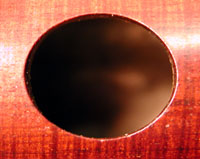
(More on RR Bb flutes at: http://www.mcgee-flutes.com/rudall_Bb.htm)
Terry
I suspect you’re blasting too much air at the flute, especially in the second octave. This would explain “On Boehm flutes the upper octaves sound more strident”. It shouldn’t, the second octave should be playable as quietly or even more quietly than the first.
In the whistle, we get to the second octave by blowing harder - it’s the only tool we have. In the flute, we have a range of tools we use together - we tighten the jet, pout more to shorten the jet, and only blow a little bit harder to speed up the jet. That’s why they say the flute is more expressive than the recorder.
That exercise of blowing harmonics is a good one to explore the use of the tools. Start with fingering low D, then without changing the fingers play D’, A’ and D’'. Do the same, starting on each note in the D scale. (It gets harder as you go up to reach the higher harmonics as the venting becomes inadequate to support them, though you can pull bits of the flute off to try!)
As you play the harmonics, work your embouchure around (particulalry pouting) to get each harmonic sounding at its best. After a while you should be able to automatically form the optimum embouchure for each note. Practice jumping around the harmonic series.
When you then go to playing music, play song tunes or something else slow so you have time to adjust your embouchure to get the best out of each note.
Now, all of the above is assuming that I’m right about blasting. If not, disregard!
Terry
That R&R embouchure is a beaut, isn’t it. Was that from a cylinder bore bass Bb, Terry?
I know it doesn’t make a huge amount of difference as embouchure shapes are a separate matter from bore types (though combinations do matter), but Cubitt’s OP was specifically about Boehm flutes, so I limited my selection above to Boehm flute embouchures. Treeshark’s posting is, of course, of cylinder head/conoid body flutes, perhaps in answer to Norcalbob’s request? Kind of a separate topic, really, which is one reason I didn’t follow it up here, though potentially any of the shapes already illustrated (and yet more) could turn up on simple system copies/derived flutes.
Thanks, Treeshark, for providing the flute specs above. That is helpful.
Cubbit, in addition to all of the good advice that Terry gave about improving your blowing technique on the flute, let me mention what probably has already been said by someone. Recently there was a link to a YouTube video of James Galway giving some instruction on how he blows the flute, in this case his concert flute. He held up the headjoint of his flute so that you could see a closeup of his lip plate. The lip impression showed that at least half of the embouchure hole had been covered by his lower lip as he was playing the evening before.
I have been experimenting with this technique on several different flutes that I own. It is interesting to see how less air is needed to blow a good flute tone when half of the embouchure hole is covered with you lip. This position kind of forces you to extend you upper lip so that more of the air is able to dive down into the flute. When I play this way, like I said before, I use less air and the flute tone is better, in my opinion. You may want to try this and see if it works for you.
Other types of flutes, such as the shakuhachi and the quena, require you to cover most of the end of the flute with you face and lips in order to form a good embouchure on the blowing edge. However, with sideblown flutes my first inclination is not to do this. Of course, if you blow this way without covering part of the hole with your lower lip, you will immediately sound very much like a beginner and run out of breath quite quickly.
While I appreciate the helpful advice, I’m not really trying to solve a problem. I am just making an observation and wondering if there are any blanket statements that can be made about the various embouchure hole dimensions. I definitely do better with a more eliptical shape, but perhaps others do better with hole that is round. Just wondered if one might start with one and eventually gravitate to the other, much as a clarinet or sax player eventually uses a stronger reed. From the pictures that have been posted, it seems that it my theory is wrong, given that the flutes that have round holes probably would not be considered “beginner’s” models.
We made a few round embouchure hole flutes, http://www.vonhuene.com/Default.aspx?tabid=152 http://www.vonhuene.com/Default.aspx?tabid=98 http://www.vonhuene.com/Default.aspx?tabid=99 and I’d certainly say none of the round embouchure hole instruments were beginner’s flutes, just the opposite, in fact.
Loren
My friend Chris McKenna has done some interesting experiments with embouchure hole shape: www.mckennaflutes.com/mat&exp.htm
There are so many variables to embouchure shape, size and cut as Terry and others have pointed out. IMHO, there really are no blanket statements one can make about these things. They are all nearly as individual as the players are.
Best wishes,
Elizabeth
Since it appears that embouchure design cannot rest on the concept that any one design is superior, how is it that Boehm flutes do not offer headjoint options the way Terry does? I’m talking about models in the $2,000 rather than $15,000 price range, btw, although I’m not sure that there are even options at the higher price. I know you can get a custom headjoint, but that shouldn’t be necessary except for the very elite player, IMHO.
Comments?
I just checked several they all offer different head joints…
Please refer to the earlier posts in this thread and also to the links provided, and you will find that, indeed, Boehm flute makers offer a variety of styles of headjoints in the $2,000 price range. For example, five or six different headjoints for Yamaha flutes were described. If you will refer to an online instrument catalogue, you will see the various listings for the different manufacturers and their prices.
With regard to you previous post about not really asking for advice to improve your playing, I sorry that I misunderstood what your intentions were. From your descriptions of your struggles with trying to make a good flute tone, it sounded to me like you needed a little advice, whether you were asking for it or not. That is why Terry and I took our time to try to offer some ideas of how to improve your flute playing. If not you, then perhaps someone else with open ears may benefit.
Thanks for the reply, Doug. It sounds like I offended you; if so, I apologize - such was not my intention. We can all always learn from each other, which is why I come here. For instance, I had no idea you could select from different headjoints when buying a flute. I always thought you simply got what you got with selection of the flute. It’s been some time (35 years) since I bought my silver Boehm. I am now a bit wiser with regard to what’s available.
I think I got what I set out to get with this thread, and I offer my sincerest thanks to all who contributed.
Cheers.
It’s weird but I guess the head joint IS the flute. I mean, the other parts are the ones considered more replaceable. In my mind it always seems like the part for my fingers is “the flute”, even though that’s not logical either, but maybe I just have a bias toward my fingers or something.
Doug: thank you for posting this. I went looking for the You Tube post and found it… along with many other Galway videos. They are great. And already helping.
thank you.
be well,
jim
This is said so beautifully I could pin it up on my board. 
It was the substantial point I was trying to make but I was trying to do several things in my earlier post. I did query the idea of some “standard”.
But, then of course, Elizabeth is a Boehm flute head maker, and her posts will have that masterful touch of succinct persuasion sweetly said. I, on the other hand don’t do justice to my insights on account of the pompous, argumentative and “ignore-able” nature of my style.
I blame it all on the fact that my first education in English language was by argumentative Irish Marist brothers.
There is a lot I could learn from the posting style of Elizabeth. Example is such a wonderful way of teaching.
I’m afraid I’m a bit too computer challenged to take on a project like that, Jem. I’d spend a week just figuring it out. I have been visiting the sites you have listed, and your photos are certainly the best. Thanks.