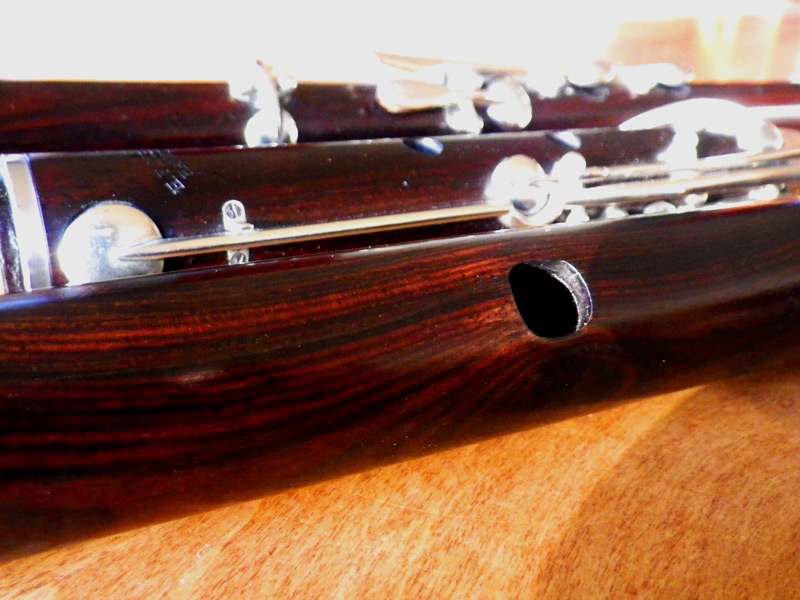
I’ve been studying embouchure shapes and sizes on various antique flutes with a goal to exploring some alternatives to the ellipse shape that I already use and that seems quite ubiquitous today.
One shape that I am particularly curious about is the large, almost round, embouchure that frequently occurs on the kind of English flutes from the early to mid 1800s that are popular in ITM. I used to think these were mostly just embouchures that had been hacked/enlarged after the fact, but I’m finding that they were very common among certain closely related flutes that were made within a close geographical area and over a fairly short time period, and that they almost never occur on flutes from different geographical areas or time periods, so I now think that it must have been intentional. I have some theories about what the motivation was, but I’m curious to hear from others, especially anyone who likes playing them.
So, if any of you have flutes with a large, almost round, embouchure, I’d like to hear what you think of it, especially if you really like it and if you feel it offers some capabilities that you find harder to achieve on the more common ellipse shaped embouchures.
To give an example of the kind of thing I’m talking about, here are a few examples of the large round embouchures I currently have on hand. The table gives the long and short axis of the embouchure hole in mm, a roundness factor, which is long divided by short (round would be 1), and the approximate area in square mm. Most of these are in decent shape, but the Imlay one does look like it may have been hacked. Most modern embouchures have a fairly similar area, but have a much shorter short axis and longer long axis, making them more elliptical than round.
		long axis	short axis	roundness	area

Blackman	11.65		11.15		1.04		102
Fentum		11.5		11.1		1.04		100
Imlay		12.5		11.9		1.05		117
Wylde		12.3		11.1		1.11		107
Bilton		11.9		11.1		1.07		104
So, do you think there are any merits to the large, round, embouchure? I know that smaller embouchures, and small, round, baroque style embouchures save a lot of breath and offer a very different tone, but that is something different. What about these large, round embouchures?