I’d like to thank Cubitt for starting this wonderful thread. 
hint: next time get 'em to agree that there should be one first
oh, dear…they look so alike 
I’d like to thank Cubitt for starting this wonderful thread.
hint: next time get 'em to agree that there should be one first
oh, dear…they look so alike
Where is Cork, anyway?
Tally Ho!
prob’ly slipped out the end 
i don’t know squat about embouchures… and since this thread appears to have been horribly hi-jacked …
while i don’t know squat about embouchures, i can see with little or no problem whatsoever that talasiga is not one who, as he asserted on another thread, enjoys discussion. talasiga blatantly and obviously is taking pleasure in taking shots at jem and, it seems, anybody else not in accord with him. you are not looking for pedantics or discussion from what i can see. you are yanking people trying to get arguments. you were rude in the extreme in another thread toward not only jem but other posters, and i see the same thing here…
simply rude, talasiga. rude.
btw… the rules governing the definitions of words and their usages strongly supports jem’s position regarding the issues you were “discussing” on the other thread… yank on that.
i apologize for further disrupting this thread… you can have it back now, cubitt… i beg your indulgence.
be well,
jim
H’mmmmph. I wanna fight. Anyone care to step outside? 
yeah! sure kid!
ah, I’ll be right there :roll:
My digestion is fine, thankyou, Talasiga, and I never regurgitate. Dyspepsia is not my problem.
I have re-read Cubitt’s original post as well as the one I responded to above, and I stand by what I said (oh, and I never told him or anyone else they were “wrong”). He referred to “round” and “oval” on Boehm - and my choice of wording did invite, though not explicitly, a clarification (that hasn’t been forthcoming). I think it is perfectly legitimate to refer to the rectangle with small rounded corners as “standard” (which word I actually and obviously used exactly in the sense you advocate above!) on Boehm as it is what the man himself used and, with subtle variations, has remained by far the most common shape on Boehm and Boehm derived flutes of all grades of production up to the present. The main exceptions I dealt with previously.
So, what did Cubitt mean by “round” - which most of us would understand as meaning “circular” or very close to that, as seen on Renaissance, Baroque and many ethnic flutes, but virtually never on Boehm ones of any period? I suspect, without wishing to put words into Cubitt’s mouth, that he uses “round” to signify “elliptical” (commonly termed “oval”) and “oval” for the commonest “rectangle with rounded corners”. Others have taken him to be using the terms in their more conventional usages.
My previous contribution was never about pedantry or “correctness” for its own sake - I had quite specifically perceived in this thread a highly probable mis-communication, with different posters meaning different things by the same terms, to the extent that the thread was ceasing to make sense and was at significantly crossed purposes: it was about clarification and functional communication.
I admit my sentence structures and syntax are often over-complicated, but I think their meaning is usually clear to the careful reader and can at least be worked out logically with a little patience. I suggest, Talasiga, you re-read my previous post as you have clearly failed to interpret me accurately in several respects and have also misunderstood or misrepresented things other posters have written. I do try not to look askance on people who not only persistently and wilfully misread carefully chosen words but also pervasively neologise and also mis-use extant vocabulary that they apparently do not understand.
Heh heh, what you guys would give for what’s sitting on my desk right now (pictured):
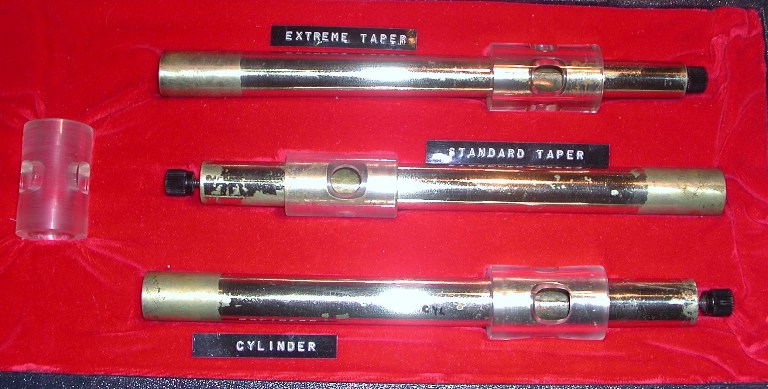
One of my acoustical gurus, Prof Neville Fletcher, had this made up some years ago for the edification of his students.
You can see three heads, made to fit a standard Boehm flute. One has the standard Boehm head bore, one is perfectly cylindrical and one has a more extreme taper. So, these illustrate to the player the need for the right taper - both the cylindrical head and the extreme taper head resulting in pretty sad tuning.
Secondly, the heads come with a rotating embouchure sleeve. All of the heads have the usual “rounded rectangle” embouchure holes available, in a range of sizes. The standard taper head also has a second embouchure sleeve offering circular holes. Neville was interested at the time (20 or 30 years ago) in modern rectangular holes and circular baroque holes - no-one in the world of acoustics then would have been interested in the 19th century elliptical hole. How times have changed!
So, ignoring the cylindrical and extreme taper heads for now, we have these options available for your delectation:
I guess some day I should get to and make a set of elliptical holes to complete the set for our purposes. I’d probably do it for a cylindrical head that could fit a conical body though.
I know it’s not as good as being here, but if anyone has a specific query about how any of these heads or embouchures work on a Boehm flute, I’ll try to answer it.
I’m interested though in the question that seems to be vexing some - what did Cubitt mean by round and oval holes? Is there a choice to be had anymore? I suspect that none are offering perfectly round holes. Are any makers still offering elliptical holes (as made by Rudall Carte, etc in the late 19th, eary 20th centuries)? I would have thought that all modern makers were using a rectangular hole, rounded to varying degrees. With perhaps a Two Semicircle approach being closest to round. But I’d be fascinated to find otherwise!
Getting back (at last, you say!) to Cubitt’s original question, the more area of the embouchure, the louder and brighter (all other things being equal). So a more rectangular hole will be louder and brighter than a circular hole of similar diameter. Too small a hole and the flute will be stifled. Too wide a hole and the player will have difficulty with focus. But as others have pointed out, there is as much happening below the surface as above. Undercutting serves different purposes on all the four surfaces of the chimney. The amount of the undercutting matters. The depth of the chimney matters. Whether the chimney wall is straight or curved matters. Both acoustics and aerodynamics are at play. It’s hell in there!
Terry
Thank you, Terry, for the photos and informative commentary.
If I can further generalize, embouchure holes with larger areas are ideal for the modern concert flute, where brightness of tone and maximum volume are desirable. Keep in mind that a few flutes players in an orchestra are surrounded by clarinets, oboes, bassoons, french horn, trombones, drums, to name a few. Being heard when the full orchestra is playing is no easy task.
Secondly, I think that embouchure holes with smaller areas are more desirable for Irish flutes. Smaller embouchure holes tend to produce a less bright and more complex tone, a desirable tonal quality of an Irish flute. Also, smaller embouchure holes take less air to fill, so it is possible to play longer passages with one breath, again an ideal quality for ITM players.
I recently did an experiment with my cylindrical-bore pvc flutes. I made two nearly identical flutes, one with a circular embouchure hole of about 10 mm in diameter, and the other with a larger oval embouchure. I was really excited about the larger oval hole, thinking that it was louder and an improvement over the circular hole that I had been using for years. Both of these flutes were taken to a session in California, and the reports back to me indicated that all of the good players who tried both flutes side-by-side actually preferred the smaller round embouchure hole.
On the other hand, just this month I made a flute for a musician to be used in a Broadway show. He returned it two me with the instructions that it needed to be louder. He also sent me a bamboo flute made by Patrick Olwell to indicate what kind of embouchure that he wanted. Patrick’s embouchure was a large oval of about 12 x 11 mm with significant undercutting on the sides and back of the embouchure hole for the E bamboo flute. I duplicated this embouchure on my pvc flute, and my customer was pleased with the increased volume of the flute. However, the flute took a lot of air to blow (partially because of the 20 mm bore diameter of my flutes), and I doubt that it would be desirable as an Irish flute, but I may be wrong about that.
Talasiga has been on my list of people to ignore since the years I browsed the forum before joining. Pompous, argumentative, and highly ignore-able. I don’t know why anyone would engage his posts and feed his narcissism in the first place.
Jem, on the other hand, is a gentleman.

Loren
One thing that I have wondered is if the rounded rectangular embouchure had less ability to bend a note sharp or flat less than the round embouchure (that has been my limited experience). I have also wondered how it changes the dynamics. Yes the bigger the blowing edge, the louder the flute, but how soft, while not going flat can one play it?
Or is undercutting a more important consideration?
Wow! Little did I know how much comment my humble thread would inspire!
Let me try this again - who knows, we might get another three screens out of this topic:
It seems to me that cheaper flutes often have embouchures that are at least approximating a circle if not exactly being one, whereas upscale flutes have a more eliptical shape that, to my eye anyway, appears more narrow from fore to aft (relative to the lip), thus requiring a more focused blow. The first is more like the experience of blowing across a bottle, which almost anyone can do, whereas the second requires a more directed airstream that takes some practice.
My theory is that, while it is initially easier to get a note from a more rounded hole, as the embouchure becomes more developed, the larger (seemingly, anyway) hole produces a less lovely tone, especially in the upper octaves. I don’t know if I’m right about any of this, so I wanted to hear from the rest of you on the subject. Perhaps my lip simply does better with a more eliptical blowhole.
Whattaya think?
OK. Let’s get concrete. Here are some pics of embouchure holes from assorted Boehm flutes across the market/quality range, some current or recent eBay items, some from the DCM collection, some from maker websites. They span the entire period since Boehm’s 1832 system. I’ve tried to get them roughly similar sizes, but they are not uniformly photographed nor to scale, so size comparison is not relevant - just shape.
I Lot - French, (1875), cocuswood. I’d describe this one as a fat ellipse, approaching circular, and I think it is reminiscent of Terry’s “two semicircles”.

Rudall Carte Rockstro model (1872-8) silver - classic RC ellipse.

Rudall Carte #1181 (1883), ebonite with silver lip-plate, - rectangle with rounded corners.

Rudall Carte #6837 (date?) cocuswood, - originally typical RC ellipse, modified to “standard” Boehm rectangle with rounded corners. Note more-or-less straight long edges.

Rudall Carte #7154 (1911) cocuswood - classic RC ellipse.

Rudall Carte #8763 (1960), solid sterling silver (surely a high-level bespoke flute as has pierced platters, open G# and in-line G - a very unusual configuration for 1960!) - rounded rectangle - no straight edges.

Rudall Carte “Sonata” (late C20th) silver plated nickel silver student model made for, not by RC – rounded rectangle.

Theobald Boehm 1832 system (1832-9) cocuswood, - rectangle with rounded corners.

Theobald Boehm (1847) ivory barrel on gilded brass, - rectangle with rounded corners (proportions distorted by crack and repair, but shows well enough what would have been like).

Theobald Boehm (1854-61) cocuswood, - ellipse - noticeably similar to the I Lot one. (Old Theo obviously catered to his customers despite his own preferences!)

Theobald Boehm #57 (1851) silver - rounded rectangle.

Grassi #1057 (prob 1950s-60s) Italian, nickel plated nickel silver, student model, (my first flute!) – rectangle with rounded corners (borderline rounded rectangle – obviously there’s some convergence between the two styles!)

Modern cheapo student Cibaili flute - rounded rectangle.

Murumatsu - modern - rounded rectangle.

Sankyo – modern, 18k gold, - rounded rectangle. (rather over-expanded photo clip, hence fuzzy, but can still be seen.)

Robert Bigio – modern, cocuswood, - rounded rectangle.

Robert Bigio – modern, blackwood with gold edge insert - rounded rectangle.

Abell – modern, blackwood, rectangle with rounded corners.

Mark Hoza – modern, Cooktown Ironwood, - rounded rectangle.

I could hunt out more current ones across the price range (EDIT 28:2:08 a.m. - have now added some), but I think the main point is made. I wanted to post, but couldn’t find an online picture of a flute in the Bate collection (The “Chrysostom” flute made for one James Matthews by RRC) that has a true, sharp-cornered rectangle…… ah well.
Unfortunately, I haven’t played any of these except my own old Grassi, so I can’t comment on how they might respond!
So, does that help at all? I’m (belatedly) off to bed!
Thanks for all of those embouchure hole pictures, Jem, they’re really interesting. I would love to see some close up pictures of the embouchure holes in a variety of modern Irish flutes from the popular makers like Olwell, Hammy, Wilkes, Grintner, McGee, Copley etc. But that is probably another topic.
Further to my previous post , to which I have added 5 more pics this-morning, here are some quotations from flute manufacturer’s websites about their embouchures which may help Cubitt’s OP query (read between the lines of the marketing spiel!):
Abell:
The Abell Flute Co. offers head-joints manufactured from African Blackwood and Sterling silver in two styles of embouchure design producing distinctly different tonal qualities. The Standard model has a rectangular shape and is modern in its design and response. It speaks easily through the full range of the flute and produces a bright, open sound. This style head-joint is designed primarily to play comfortably in large ensembles and orchestral work, though it is not limited only to those venues. The Oval model has a slightly smaller, elliptical shaped embouchure and is designed especially for small ensemble and chamber music where a more intimate sound is required. This style head-joint also plays easily through the full range of the flute and produces a very clear, centered tone with an especially dark and pungent quality in the lower registers. Though the two styles have different attributes of color and response, both the Standard and Oval models can be used in a variety of different settings for many types of music; and both models will exhibit a warm, wooden sound with a complex and intriguing tonal spectrum.
Yamaha:
Yamaha gold and sterling silver headjoints let players select an ideal combination of cut and taper to help create a flute with perfectly balanced tone and response.
• CUT (Affects attack, response and timbre)
A Cut
Emphasized curve on the front edge of the lip plate. Slightly squared hole and undercut. Excellent tonal balance, power, and high-range projection.
B Cut
Emphasized curve on the front edge of the lip plate. Slightly squared undercut. Rich tone with solid low end.
E Cut
High walls with a smaller undercut than the C Cut configuration. Rich tone with comfortable playing resistance.
H Cut
Slightly less undercut than the C Cut design. Rapid response and free tonal control.
C Cut
Large undercut for smooth breath flow. Ideal breath speed results in outstanding presence and solid lows.
S Cut
Less undercut than the C Cut type, and a slightly modified shape for greater comfort and playability.
Norcalbob - if you want to look at embouchure styles of current makers of simple system and ITM flutes, use my Makers List thread to follow links to their websites (those as have 'em) - you’ll find plenty to look at if you have the time! Also the flute lichen sticky thread has loads of pics including of flutes whose makers don’t have websites…
How’s about starting another thread and doing a picture copy, trim and paste job like the one I’ve just done? If you’ve time, I’m sure fellow members would appreciate the effort!
Cubitt, I think that you have the reasoning reversed in your idea about the type of embouchure that requires a more-focused embouchure. You used the terms “fore to aft (relative to the lip)” to express the dimension that would require a more focused embouchure, if this dimension were smaller. Actually, in my understanding, the nautical terms “port” and “starboard” would be the correct terms to use in this case. In other words, how wide an embouchure hole is determines to a major degree how focused your embouchure needs to be, since at least half of the fore to aft distance is covered with the lower lip. For example, embouchure holes that are oval or more rectangular have a greater distance port to starboard than they do fore to aft. This would make a very odd looking ship, but it seems to work well for embouchure holes. In general, embouchure holes cut this way have a wider blowing edge, take a less-focused embouchure, and are probably easier for the beginner, at least, to play. That is not to say that more-rounded holes, that would require a more-focused embouchure, wouldn’t also have their place in the world of flutes.
Top to bottom Rudall Rose, Wilkes, Doyle

Treeshark, all of these embouchure holes look nearly circular in the photos, although sometimes that is hard to tell from a photo of a curved surface. Would it be possible for you to also include the outer dimensions of the embouchure holes?
The well-know Baroque, Classical, and Early Romantic flute makers Folkers and Powell also make wooden Boehm headjoints, modeled after originals by Theobald Boehm and Louis Lot. Their website has photos, dimensions, descriptions of the playing characteristics, and even spectrograms. Quite interesting.