Me: Been playing flute about a year, concentrating on ITM, after more than a year of playing the whistle very intently. I’m a good musician but not a good flute player. I can play at speed but not in a flowing way way because of breath control issues. I’ve played relatively few flutes: a Ralph Sweet “shannon,” a no-name small-hole blackwood keyed flute bought on eBay, and an M&E keyless delrin/polymer flute. The M&E is the one I’ve played the most. These are a beginner’s observations.
Geoffrey Ellis makes a Pratten-styled “Irish flute” in Ebonite. If you don’t know “ebonite” is vulcanized rubber. It’s commonly used to make clarinet and sax mouthpieces and to make clarinets. It was once more common in flute making: Rockstro raves about it. But he’s dead, so there’s that. Ellis offer the flute unlined, in four pieces, or lined in five.
I wanted a flute that wasn’t made of rare or exotic wood—because of environmental concerns and because of maintenance. I’ve been playing an M&E keyless Delrin flute since January and there’s quite a lot to like about it. But I’d been increasingly frustrated by some aspects of it (see below) and also wondering about the difference between a $300 “irish flute" and a flute that was made with more attention to detail. Also I loved Ellis’ “essential flute.” So I decided, with my kind wife’s encouragement on my 60th birthday, to order one of Ellis’s Irish flutes in Ebonite. I bought an unlined flute.
At first I disliked it, but within a few hours I loved it.
Compared to the M&E:
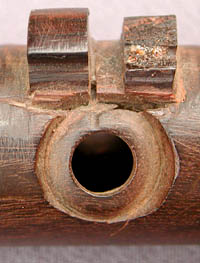
The M&E is said to be based on a Rudal and Rose and the Ellis on a Pratten. The Ellis has larger holes, and a larger larger bore at the small end: 9.90mm on the M&E vs 12.70 on the Ellis. Different embouchure cuts. The M&E has a lined head joint, my Ellis is unlined.
Ellis above, M&E below
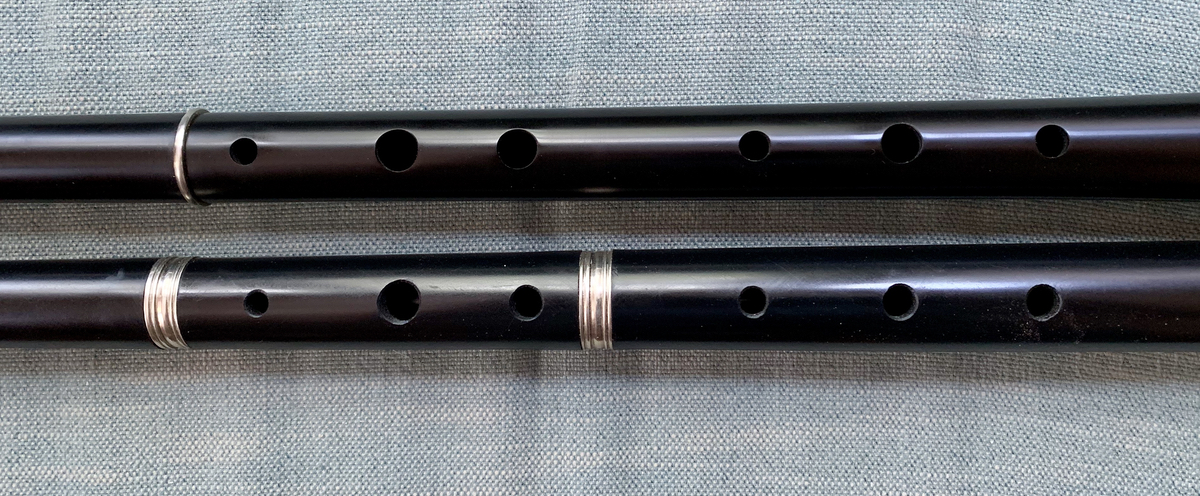
Same

The Ellis is very light, which I like—I don’t have a scale handy, but it feels like it might be half the weight of the M&E. A really big difference. That makes it easier to hold for a long time, and gives it a very lively feel in the hands.
The ebonite has a lovely finish, and the nickel silver rings are minimal and elegant.
The flute is loud, and powerful, with a very wide expressive range and an “open” feel. It’s actually harder to play than the M&E, in the sense that it takes more air and more work to get the “hard” sound. But it’s more rewarding—I can drive it harder or more gently equally well. The M&E has a kind of “damped" quality. The Ellis also notably less prone to “clogging.” I suppose that could be the larger bore, or maybe it has to do with the thermal properties of the ebonite compared to delrin.
On the con side: it takes more air, it’s slightly more difficult to get the cliche "hard sound,” and there’s a light smell of sulphur when you play it. It’s maybe slightly harder to cover the holes. The sulphur smell has maybe faded somewhat, or else I’ve gotten used to it.
In general like it’s like driving a sports car compared to driving, say, a honda civic. There’s just more possibilities on tap and it responds more dramatically. The M&E goes to “five" and stays there. The Ellis plays happily from 2-10
Let me be clear: again, I’m a beginner and have limited experience. The M&E flute is pretty great in itself, cheap and cheerful and indestructible in ordinary life: easy playing. There’s a lot to like there. I can’t compare the Ellis to other well known makers who so generously share their time and experience here.