As a kid, I just loved getting and poring through the Edmund Scientific catalogs. My shelves were populated by knick-knacks like prisms, lenses, magnets, Crookes radiometer, pocket sundial, star maps, abacus, gyroscope … thanks to Edmund Scientific.
Now that I’m all growed up (more or less) I’m glad to see that the online version of the Edmund catalog continues to meet my needs:
I share your fondness and memories of Edmund Scientific. The catalog was fun! But their retail outlet in Barrington, New Jersey was the best science and technology junk yard a kid could get lost in. It was the place to go when a science project was in the planning stage. Sadly that store closed some years back but I did get to introduce my oldest son to that place when he was young enough to experience it with the same wonder and promise I had in my childhood. It may have had an influence on him. He’s a lab rat now.
I could never convince my parents to make the drive from Long Island to Barrington. But I did live 20 minutes away from Lafayette Electronics, which was just about as good.
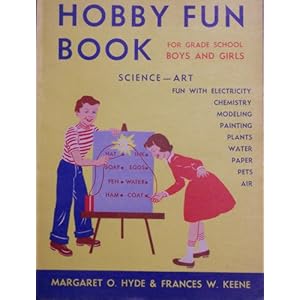
We didn’t live near such grand places but my four brothers and I had this book. We did every single thing in this book. I was surprised to find an image on the internet and it’s even for sale at amazon.com
I can relate. My dad was an avid hobby-astronomer. He went as far as making his own telescope, including grinding his own mirror by hand. Growing up, the Edmund catalog was usually opened up for perusing eyepieces. However, the pictures of prisms and other gear generated great conversations !
I remember they had all sorts of equipment for making psychedelic light shows, and they made it seem so wholesome and scientific. They also had more fun surplus than any other outfit out there. It was also the first place I learned of the continuously drinking bird evaporation engine. I still have some bimetal jumping disks somewhere.
Oh yeah, I had the bird! And I’m sure I lobbied my parents to convince them (unsuccessfully) that I absolutely needed … NEEDED … a giant surplus Fresnel lens for my death ray.
For me, it was still a go-to catalog for stocking stuffer odds & ends until recently. (I tend to stick with the practical and/or comestible these days, unless specifically solicited.)
As a kid I always imagined doing intelligent and scientific things, but was always too distractible and scattered. Well…cannot retroactively rewire the brain, must forgive.
Both Lafayette and Heathkit still exist. It’s possible that the names are the only connection they have to the companies they were in the 1950’s and 60’s. Just last year I sent a bunch of pamphlets and small paperbacks from both companies to the shredder. They were my education in electronics technology way back when. We’ve come a long way since then.
My warpped knowledge of electronics, preamplification and amplification led me as a 15 year old rocker to hack up multiple gain stages to my Magnatone guitar amplifier back in the mid 60s. Now I just wonder what I could have done if I had channeled those energies into something more constructive. Thank you Lafayette. Thank you Heathkit. Thank you Edmunds.
My first kit project (~ age 12) was a Lafayette shortwave receiver. A regenerative set that squealed and squawked, but let me listen to BBC and Radio Havana and pretend I was a spy like Napoleon Solo.
My second project was a Heathkit “Lunchbox” 2 meter AM transceiver. At 5 watts I could barely contact my ham buddy 2 miles away. But dang, it did work.
Knight Kit was another one - I remember building an SWR meter.
There was definitely something to be said for the old vacuum tube, discrete component days, when even a clumsy 12 year old could teach himself how to assemble cool equipment without mastering surface-mount techniques. Or just wire up some junk from a junk box to see what it did.
I built a Heathkit shortwave receiver and listened to stations all around the world. I also built an AM/FM portable radio from them. This was the size of a lunch box, but it worked very well and I had it for many years.
I had several of the electronics catalogs memorized. I built a Heathkit 50 watt CW transmitter and talked to hams mostly on 80 meters, using my long wire antenna that I hung up on pipe in the backyard. I also built stereo audio amplifiers for myself and friends. Yes, point-to-point wiring and easy instructions made it possible to build your own. I got my general class amateur radio license when I was a kid. My call letters were K9TAE (takes all easy), but there wasn’t much truth in that. When I went to college at Indiana University my amateur radio days came to an end, as I shifted focus to other areas of interest. However, my brothers still talk about having to listen to the click-click, click of my Morse code key in the small bedroom that we shared when we were going up.
 I share your fondness and memories of Edmund Scientific. The catalog was fun! But their retail outlet in Barrington, New Jersey was the best science and technology junk yard a kid could get lost in. It was