mighth be that I remember wrong, but was there chanter made silver or other metal owned by Doran..etc
Nice to get some info about it 
Yes he did (quite well discussed in the past).
It can be seen right at the end of this clip
http://www.youtube.com/watch?v=RWeImfHzibw&feature=channel
Jon
The ‘silver set’ belonged to Felix Doran (not to be confused with Johnny, of course). I’m pretty sure the chanter was timber on the inside (as it would nearly have to be). The regulators were metal-clad as well.
However, Johnny did apparently experiment with making a metal chanter himself - rolled from heavy brass:
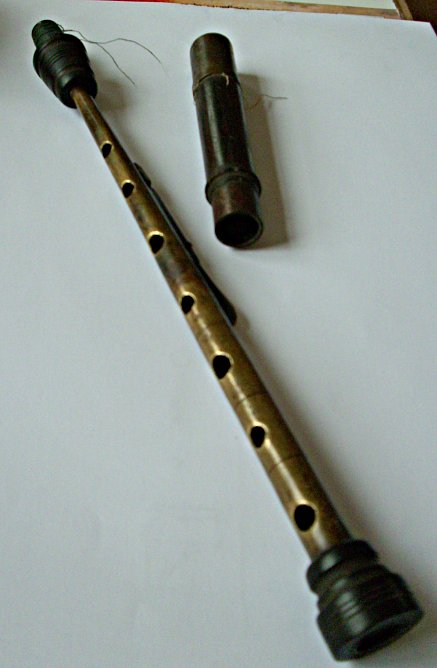
(chanter from the NPU collection)
regards,
Bill
any idea about the sound?
Bill,
The chanter that Felix is playing in the clip doesn’t look ‘wide’ enough to have a wooden core, neither do the regs. Seem to remember that the regs are described in detail somewhere but can’t recall where at the moment (Thomas Johnsen’s pages I think)
It is possible to have a metal ‘cone’ that will play in tune, I’ve got one that’s made out of a seat stay from an old bicycle frame that just happens to have a nice taper (although it’s a straight taper). The only problems are 1) it’s a swine to keep hold of due to being so thin and 2) being all metal is even more susceptible to temperature changes.
I can only describe the sound as ‘metallic’ !
Jon
They look plenty wide to me, but (blurry) photos can be deceptive. My understanding is that there are, or were, wooden cores.
Not an idea that caught on, really.
best regards,
Bill
Des Seery made a solid metal chanter about 10 years ago. He wrecked a couple of reamers in the process.The metal was some sort of alloy.The end result was a beautiful sounding chanter,very like Liam o flynns chanter.As far as I know the Doran pipes had wooden inserts.Steve
“Doran’s Metal Chanter” sounds like a great name for a tune!
I recall reading that Felix’s silver chanter (made by Leo Rowsome?) was irreparably damaged at his funeral. There’s mention of the Silver set on Neilligh Mulligan’s website.
Plated brass over ebony would seem to be begging for trouble, because wood expands and contracts with the humidity, and brass doesn’t. How expensive would using nothing but quarter-sawn ebony be? That might minimize the expansion, but not eliminate it. How could Rowsome have avoided problems, say, aligning holes in the wood and the brass, when the wooden part is of a constantly changing size?
Hello, did everyone forget that David Daye makes a very successful pipe chanter made entirely of metal??? 
Of course the reed has a wonderful tone as it is made of cane (can’t understand why metal reeds haven’t caught on - perhaps it’s because they don’t vibrate???)
Want to know how they look and sound like? Click here: http://www.daye1.com/pennychanter.html
I own a D chanter and a C chanter and both are very reliable and play well year round.
can’t understand why metal reeds haven’t caught on
When you try gouging a chunk of brass instead of arundo u will understand why 
John
I thougth David’s chanters were made of brass tubing somehow placed in a delrin tube.
Also, my guitar and bouzouki strings are metal, and they vibrate quite nicely, as does my metal tuning fork, the reeds in my harmonica, and the muffler on my '97 Subaru…
I heard that Doran said that the wood inside of his metal-clad regs was full of cracks.
I read somewhere that the reason Felix Doran sold the Rowsome silver regs was that they leaked too much air. I can’t remember where I read this though.
I thought the story was that Felix had Leo R build the set with boxwood inside nickel silver, which famously almost killed Paddy Moloney when he tried to play them, owing to the leaks; this is the set Néilidh’s brother plays now. Then later Felix had the German engineer make the all-silver set - no wood, pictured on the cover of Last of the Traveling Pipers. I believe you can tell that the metal body shows raised chimneys for the regulator holes, ala a silver flute.
Taylor Bros built a few bass and double bass regulators out of sheet metal in this fashion. At least one set has sliding toneholes as well, for overkill precision in tuning. Most bass reg extensions on old flat sets have chimneys for the toneholes, but a few don’t - I think the Egan in the Boston Museum doesn’t.