are there big differences in Uilleann and Highland Pipes? I know VERY little about the highland and close to nothing about the Uilleann.
 A newbie here myself, but…GHBs are mouth-blown, uilleann pipes are bellows blown. GHBs are Scottish, uilleann pipes are Irish.
  GHBs are louder, and played standing or marching. Uilleann pipes are played sitting down. A full set of uilleann pipes has regulators, which are unique to uilleann pipes. Oh wise ones on this forum with far more knowledge than I…is this a good start? Someone better at this forum should just post some links, I’m sure the differences have been explained before.
Check out the FAQ post on the UP forum… http://chiffboard.mati.ca/viewtopic.php?t=14466 … that should help a bit. 
Like you said, Uilleann: Bellows Blown - You pump a bellows with your right arm, moving air into a bag under your left. In Highland Pipes you blow air into a bag under your left. Both the GHB and UP have drones, GHB having three, two tenors and a bass, the tenors tuned one octave below the chanter’s low A, and the bass tuned an octave below the tenors. UPs have drones, as well as a rather innovative invention called regulators, which are usually played with the wrist while the chanter is being played. These regulators play simple chords and can even carry a melody, albeit a simplified one, and in some tunes are used in such a way as the chanter and regulators are used in equal abundance, and wouldn’t be the same wihout them, such as “The Fox Chase.”
The GHB chanter has a span of nine notes: Low G, Low A, B, C#, D, E, F#, High G, High A. The Uilleann chanter has a span of two octaves. This is made possible because of the bellows, which pump dry air (i.e. not permeated by saliva and moisture) into the bag and reeds. This allows for a much more delicate chanter reed to be made, one that is able to overblow into a second octave by increasing the pressure on the bag slightly.
The embellishments also differ. (UP players correct me if I’m wrong, as I play GHB, not Uilleann) Uilleann pipes use embellishments from those most commonly seen in the repetoire of Irish music. Rolls, Crans, Taps, and Cuts, respectively. There are also a few unique to the UPs, such as Soft D, Hard D, Hard E, Ghost D, and playing with the chanter off the knee. (coughhttp://www.uilleannobsession.com/faq.html*cough*)
The GHB embellishment repetoire is also slightly more, uh, intensive. We have Taps and Cuts as well, though they are known as Strikes and Grace Notes, respectively, and also Doublings, which are specialized rolls, and Grips, Taorluaths, Bubbly Notes, Edries, Crunluaths, and Crunluath a Machs, which are all related to Crans, though I’m told are slightly more difficult to master. There is also something completely Highland, as I have yet to see an embellishment like it in other Pipes, which is the birl. Basically, you tap your pinky twice, very fast, and snap it back, over the Low G hole, so it sounds like a low crackle. It is the most difficult to master, if you want to try for yourself, take a pencil, place your fingers over it so the tip of your pinky is touching and your other fingers laid horizontally across it. Now, tap your pinky twice on the pencil and snap it back, all without your other fingers moving. Hard?
Highland style playing also calls for a more “dot-cut” style, in which rhythms are more “daaa-dum daaa-dum” instead of “dum-dum dum-dum”. In short, Scottish is seen much more in a swinging, uneven style, while Irish music flows much more.
GHBs are also much more physically demanding than the UPs, with almost as much practice being devoted to developing the endurance necessary to play them as actually practicing playing them. The UPs also have a steep learning curve, though it is mainly in learning the coordination between the bellows and bag arm necessary to keep a steady tone.
As for similarities: They are both Bagpipes.
EditThese links may help you visualize:
Highland: http://youtube.com/watch?v=pFx4kuncZgE
the main difference between the two pipes is that with the ghb you can wear a kilt and sometimes you may get groped by young women but mainly you get groped by old women . with the ups you have so much trouble with your reeds that you wouldnt know if you were being groped.
Huh? …goes in search of his Queen Anne pistol… 
Sorry, yes, there are many big differences. The first of which is you have to stand up and blow real hard into an uncomfortable tube that’ll mutate the shape of your teeth and gums, in order to play the Highland pipes.
You get to sit down and have a liesurely smoke and a cuppa tea while you comfortably work the bellows with a spare arm in order to play the Uilleann Pipes. 

One requires rather an Apollonian approach…,  the other Dionysian…,
t’sall Greek to me. 
Lets see here, Apollo, the God of Music and the Sun, I believe? His domains include reason, hence the property of “A light shining down from the heavens granting knowledge.” And Dionysus, the Greek God of pleasure and wine. One is Highland and one is Uilleann.
Well seeing as it is a generally accepted fact that Highland players are at least one standard deviation above the UP players in terms of IQ (15 pts), I’d say that is the Apollonian part. And by elimination UPs are Dionysian because they spend all their time in bars playing sessions and getting sh*t-faced.
…but, which is which? Is there room for an Apodionollonianysian approach somewhere?
Highland pipes:
Uilleann pipes:
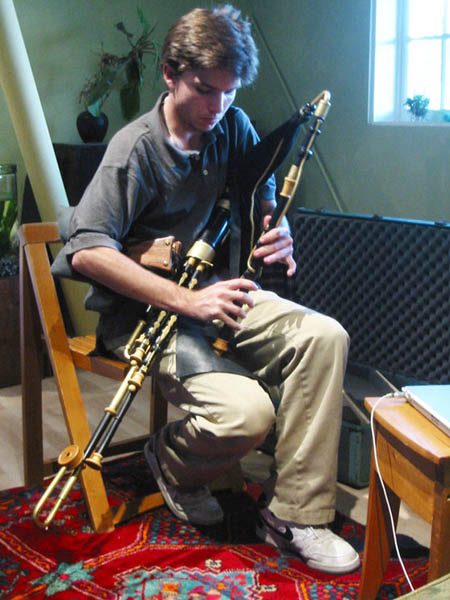
Going by attire options alone, I’m inclined to the latter. 
Nanohedron: "Is there room for an Apodionollonianysian approach somewhere? "
As he wouldve said…
there is always room, brother, Peace + Love 
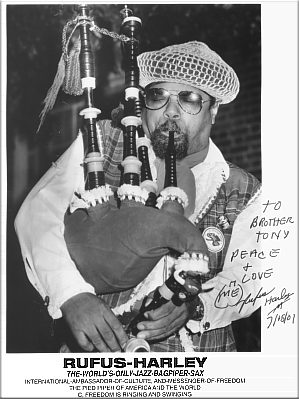
[/i]
& Well said, Lexxicos… (you know calculus, dontcha??)
But, being as this is the ‘other pipe’ part; let’s confuse the topic starter completely and bring up Meagher’s pipes:
A mouth blown, 3 drone (D, d, d’) switchable commonstock, held underarm like highland; chanter somehow configured (catch me if im incorrect  ) to give a 2 octave scale in D. Ive only ever seen pic’s + read about em. Anyone ever heard 'em?
RIP Rufus, you were the love dog of west coast soul piping!
With all due respect to our newbie, this thread makes me proud because, it’s the kind of question which would get a newbie eaten alive in a lot of forums. Answers were both patient and instructive and welcoming. You guys are great.
Although you guys had said alot, Dale said it best…
With the C and the F both being #, does that mean the GHP are in key of D? What Key is the UP in? And what is the lowest note playable on the UP?
I really appreciate your help with this, the links where especially helpful. I am going over the FAQ now taht the baby is sleeping. Please do expect to see me around here, I think I am going to see what I can do with a GHP practice chanter and “the green book”.
I do hope (although doubt it, given my skill level) that I will be able to pay back some of the help you have given me.
PS - I think it was the bit about getting groped explained by Mr. Spencer that helped with the decision. That and the fact that a practice chanter is only 50$
With the C and the F both being #, does that mean the GHP are in key of D?
Not exactly. Better to say the modes it uses are relative to D. It usually plays with A as the keynote, which means it’s in A mixolydian.
No. The GHB is not in D. I am not a music theorist, and I don’t have any backround in that, so the shortest and most concise answer I can give is this:
This is an ambiguous question since people mean different things by the “key” of an instrument. If you mean what is the natural scale of the instrument (the one with the key note at or near the bottom of the range and with simple fingering) then the actual key is approximately B-flat (notated as A in GHB music) with a flattened 7th (written high G). If you want to know what standard scale the instrument best apporoximates, then it is E-flat (notated as D). Remember that in GHB music, two sharps are understood. By “key” some people are referring to the relationship between the written and actual music. An instrument which plays as written is said to be in the key of C. In this sense the modern GHB is approximately in the key C-sharp.
(http://www.stanford.edu/~wrinnes/BagpipeFAQ/BPF_GHB.htm)
In terms of UP, the lowest note is Low D, played by lifting the chanter off the leg and covering all the holes. I’m told it’s a rather finicky note. In terms of key, I really don’t know. The best answer I can give you is that I repeatedly see UP sets being made in “Keys” of D, C#, C, and I even heard of a Bb. I’m not sure what keys they mean. Maybe someone else is better able to answer that.
And kudos to the GHB decision, if you stick with it. Kudos to a UP decision too. Both are exquisite sounding instruments, with a different sound, style, and mood about them. By this I mean that GHB tunes tend to sound much more crackly and disjointed. UP sounds much more wafty, sad, and at times, uh “jumpy”. (In my mind I relate the style of certain players to jumping up and down on a pogo stick.)
I would advise trying to find an instructor for whichever you choose. That way you tend not to gain as many bad habits, and be less confused, which is a big deal with these instruments. Also, as with any music: LISTEN to recordings. They help you not only to hear the style, but help you internalize it if you listen to it enough. My favorites from both being:
Highland: Gordon Duncan. Period. If you listen to any Highland Pipers, just promise me it’ll be him.
Uilleann: David Power (a bit obscure, but you can find him), Paddy Keenan (Again obscure, though iTunes has him).
And LOUD. GHBs are field instruments, properly. Play 'em indoors to antagonise your guests. You get nine notes, and that’s the limit. If some players can get more, I’m unaware of it.
Uilleann pipes are indoor-friendly instruments, loudness-wise. You get 2 octaves (sometimes a bit more) from them, so there are a lot more melodic options going on, esp. with keys for the accidentals. Standard pitches for sets are D, C#, C, B, and Bb.
If you really want to play a GHB-type instrument but don’t want the volume issues, you might look into border pipes or Scottish smallpipes. Both can be bellows or mouth blown depending on the setup you want. But go with the bellows. Trust me.
Yeah, GHB are warpipes. You play them in a pub, you start a war. UP are pub pipes. You play them on the battlefield, everybody stops and goes to the pub.
If some players can get more, I’m unaware of it.
I’ve heard some can overblow a high B. Used to be standard border pipe technique too, I think? Anyone know any better?
Border pipes are not the same as GHB, you can’t start a war. You just get kicked out of the pub.
As to overblowing, Spanish gaidas, in spite of all the differences still the closest to GHBs, are overblown as a matter of course. They also have partly cromatic fingering, so a bigger range. They also take much less air.
No, I don’t play them, and don’t sell them, either.
Depends on where you and the pub are. A couple of our pipers fired up in one, the two bass drummers hit the floor, and within seconds others joined them-folks started coming in off the street and a very loud good time was had by all.