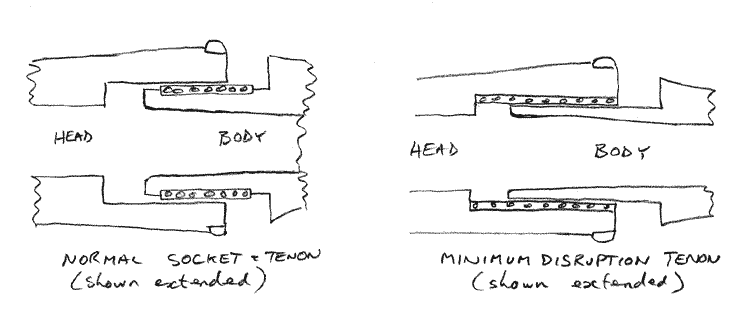
I’m currently in the R&D phase of whistle making. A handicap I face is that living in North Queensland, I don’t have access to just looking at a lot of whistles, and it’s too expensive to buy lots of whistles to investigate various subtle issues.
I have studied this website voraciously and gratefully! I don’t think I would be brave enough to start making whistles without the knowledge here.
I’m looking at making wooden whistles with an aluminium sleeve for a tuning slide (not popular I know, but it just appeals to me as you get all the sound enclosed in wood, plus the smooth sliding of metal). The detail I haven’t found in searches here on or the internet is, in whistles where wood meets metal in the slide - such as the old Reyburn maple head - what material is used in between?
In my aluminium Chieftain it seems to be teflon tape in the slide, but would that be too thin for a wood/metal combo, given the differential rates of expansion & contraction in response to temperature, moisture and time? Cork would give some leeway, but would it be too grabby compared to teflon? If I use cork, how thick; natural, compounded or rubberised? Is there a significant difference here in managing the sliding and the gap in designs where metal slides into wood (such as the maple head Reyburn), as opposed to the design I’m planning where wood slides into metal?
Might I even be better using a slide sleeve made from the same wood as the body, rather than aluminium, for a constant rate of expansion & contraction over time, or is wood just not smooth enough compared to aluminium, more prone to locking up etc over time? Though there are probably going to be times where I have boards thick enough for the body, but not thick enough for the sleeve.
I note that in referring to the maple head Reyburn, I’m taking into account that it’s no longer being made. I would feel a bit uncomfortable asking such detailed technical questions about a whistle currently in production - I would fully understand the maker saying “if you want to know, buy one!” And if anyone feels this question is still too rude, please let me know! It’s important to me to approach this process of information sharing respectfully.
My understanding from a fair bit of reading is that there are drawbacks to putting wood around metal. For example, here is Terry McGee’s view (from his website):
“…inevitably (or at least 99% inevitably) any wooden flute head and barrel with an internal metal lining will split. Wood shrinks with age and metal doesn’t. Bang! Almost every old lined flute I’ve seen (and an increasing number of recent ones) has cracks in the head and/or barrel. These are also cracks that are difficult to repair reliably and nicely.”
It’s also an aesthetic choice that just feels right to me (and it’s largely the “feeling right” of the whole thing that is getting me to make whistles at all) to have the air column entirely enclosed in wood.
The maple head Reyburn (I believe) shows that a metal into wood design can work, so it seems reasonable to me to ask if a wood into metal design can work.
But still your advice is welcome kkrell, thank you! If I’m setting out to do something completely hare-brained and fruitlessly knuckle-skinning, I do want to know!
Terry McGee has his cork-buffered tuning slide idea that he incorporates, if you’re overly worried about metal & wood shrinkage. http://www.mcgee-flutes.com/fluteslide.html
Thanks, I’m aware of that excellent piece of design from Terry McGee. Something like that will probably be my fallback if I can’t work out how to get the air column completely enclosed in wood. Another issue is that I don’t have a metal lathe, which I’d probably need for that design, and I’d like to try to get by without one.
Thanks, I hadn’t seen that wood into wood design from Terry McGee. Minimising the gap created by the slide expansion seems important acoustically, and this way indeed does it just with wood. Maybe using a really fine-grained, temperature and moisture stable wood like Gidgee or other dry climate Acacias would work with this design as a slide.
Not really interested in Delrin, as one of my motivations is to use beautiful North Queensland timber, but that Ron Forbes flute does look nice.
My original maple head used Teflon tape for the interface between the brass body tube and the maple socket cut into the head. It worked well but was a bit cumbersome so I chose to put double o’rings in the maple head which worked very well except in cases where the player forgot to lubricate the rings. The lube dries out over time so once or twice a year it was necessary to wipe the rings and reapply the silicon lube which made for an excellent slide.
Be advised that a brass on brass tuning slide can get stuck if the player has acidic saliva which will, over time, corrode the slide and make it stick. If the slide is periodically moved and wiped clean it will resolve the problem. I wouldn’t advise using aluminum on aluminum for the slide as that can gall and bind up.
Thanks so much Ronaldo for your kind reply. That’s incredibly interesting and useful. I’m assuming you mean rubber “o’rings” that slotted into grooves turned inside the head? That sounds like something that could really take up any differential shrinkage between the aluminium and the wood, or could work between wood and wood, in a very elegant way. So generous of you to share this! Many thanks!
You’re welcome Matt, yes the o-rings are rubber and they do allow for some expansion and contraction of the fit. The challenge is cutting the gland (groove) for the o-rings to sit in to get the right fit. I had a special cutter made that would do that using a router.
Here is an all wood whistle I made of curly maple. https://www.snapagogo.com/image/ptUQR
Yes a whistle can be made of all wood including the tuning slide. The air column is entirely enclosed in wood. The tennon is about 1/32’’ thick and coated with super glue to give strength. The plug is also maple with super glue to keep the wood from moisture swelling.
The whistle you want to make is posible.
Thanks Tommy! What size whistle is that? Interesting way to get the slide to work by making the tenon so thin! I was thinking of 2mm and I thought that was pushing it. Do you use any tape or cork in the slide, or does the superglue coating help it slide smoothly?
It is a soprano D. There is no tape or cork, just super gule to reinforce the thin tenon. I wanted as you do all the air column passing through wood with as small a step of resistance as possible.
For a soprano whistle I believe a tuning slide with a wall thickness of 2 mm would work.
I’m intending to make low & alto whistles, so might need a bit thicker.
BTW Tommy, I clicked on the link in your signature to have a look at some of your other whistles, but most of the photos there have disappeared. What happened? I notice the same thing in the “Photos of your collection!” thread. Why have so many photos disappeared on C&F?
For many years I was using Photobucket to host my pictures for free. Then they started wanting a fee. I opted to look for other free hosting and my pictures from Photobucket have been disappearing. You can find a few mixed in with other makers by searching on Google ''Tommy Dion whistles of wood.
After reading your thread again it seems you want to find out if a metal tuning sleeve will change the whistle sound of a wood whistle. Metal V wood whistles has been debated several times here on C&F? They both will make music. Which is better is for the player to decide.
As a research project, I made several all-wood tunable whistles from a piece of crepe myrtle my father-in-law cut for me. It’s low density (maybe around 0.5-0.55), but hard and fine-grained, albeit very hairy. My standard design has a 2 mm wall, so I split the difference and made the slide with a 1 mm wall, male and female. I have a reinforcing ring around the female part that’s, I think, dogwood, maybe walnut or cherry (also all cut down by me or friends/relatives). None has had any problems, although they’re all still in the garage, so haven’t been subjected to, say, a wood stove-heated living room. I keep meaning to finish them up and list them for cheap.
It’s just wood against wood, total length about 1 cm, usable sliding distance maybe 4 mm, which is around 30 cents. I haven’t picked one up in ages; will see if any still work this weekend.
Just happened to be wandering by, keeping an eye on what you whistle players and makers are up to, and noticed a mention of my stuff on wood-encased metal tuning slides. Those comments were made in the flute context, where the slides are around 19-21mm in diameter (3/4" - 13/16"), and whereas the same principles apply at smaller diameters (e.g. a treble d whistle), the degree isn’t as severe. But, since I note you are also thinking larger whistles, it’s still worth doing what you can to avoid the issue.
All the more important if your part of the Sunny North is a high humidity area. You send a whistle to Arizona and you should be just about able to hear it crack from home!
Great to hear you’re gearing up to make whistles. When I first made Irish flutes back in the seventies, I had trouble finding anyone who wanted one, and they of course had trouble finding me. Nowadays, providing you have access to the Internet and a Post Office, you’re set!
Drop in if you’re in our area. It’s only 3 to 4 days driving…