As a beginner on the low whistle I’ve seen different diagrams of piper’s grip which has confused me, the differences being in the first finger of each hand. One suggestion is to use the middle pad of the finger, same as with the middle finger. But I’ve also seen a diagram suggesting the use of the joint between the second and third bones as in http://www.thewhistleshop.com/beginners/lowd/lowd.htm.
What are people’s opinions on this?
I’d say never mind exactly what it’s called but use whatever works comfortably for your size/shape of hand and relative lengths of fingers… which in my case seems to be somewhere about first joint/middle pad of RH1, middle pad of RH2, end pad/first joint of RH3 and no further up than first joint on any of my LH fingers (but YMMV!).
(Edited for typo: ‘seems to somewhere’.)
What he said. I was surprised that on some low whistles I am using the ‘crease’ of the joint over the tone hole with no bad effects. Find what works for you, but realise it may change from whistle to whistle… in my case without full awareness of the exact positioning.
Yes, the hole may be large enough that your knuckle joint (or part of it) sort of drops down into the hole to seal it like a plug. And there’s enough flesh around the joint/crease to make a good seal anyway.
As Peter says, don’t worry about the exact position as described by someone else’s diagram.
Start with the pad of your ring finger on the T3/B3 hole, and your other two fingers resting gently on their respective holes. Then, using the T3/B3 hole as a pivot, rotate your hand downward until you get a good seal on all 3 fingers. Voilà, that’s the right position for you.
You may also find my old post “Piper’s Grip Step-By-Step” helpful:
https://forums.chiffandfipple.com/t/pipers-grip-step-by-step/63881/1
This describes piper’s grip on the bottom hand only, which is what many people use (myself included). But the rotation trick works equally well for the top hand, mutatis mutandis.
Thanks for the tips. Very helpful.
Just to throw things off in a new direction, I’ll share how I hold my low whistle. I use what I assume is a fairly standard Piper’s grip for my left (top) hand, but with my right hand I use the pad of my pinky for the bottom hole and let the middle of my first and middle fingers cover the upper two holes for that hand. That way my right hand is strait instead of at an angle and I find it to be much more comfortable considering the rather long stretch between my d and e holes. I don’t know if anybody else does that or if it might work for you but I certainly like it.
I guess you missed the recent discussion about pinkie grip, starting here:
https://forums.chiffandfipple.com/t/i-could-use-some-advice/78509/11
Thanks. I’ll have to give that a try.
I agree that whatever works for you to be able to play your low D, go with it!
That being said, I’m gonna give some of my observations. FWTW. The “norm” for piper’s grip, as it relates to low whistle, seems to be a pivot of the lower hand upwards towards the chest. Putting the hand at somewhere around 45 degrees or so. I’ve seen lotsa pipe playing, both live and on the net. Everyone seems to play with the lower hand PERPENDICULAR to the chanter. The true piper’s grip! I guess. I can understand why one would need to pivot the lower hand, but I find it very uncomfortable and slightly unnatural. IMVHO. I have average sized hands and have played and tried many low D’s. Copeland and Grinter being the ones that I play the heck out of. My first was a Susato. I recorded lots with it and I found it awesome! It did take awhile to get used to the stretch and alot of pain and such, but the effort is well worth it!
I’m currently trying a Tipple flute and LOVE it. ( great job Doug!  o). That being said, the spacing between the tone wholes seems to be more or less the same as the low D’s that I have yet I don’t see the hand pivot being discussed at all when it relates to flute playing. Any thoughts?
In closing, yes, whatever works, go with it but for all you aspiring flute and pipers out there, I would suggest that you aspire to play with the lower hand perpendicular to the whistle. INMVHO. Oh yeah, that pinkie thing, I would NEVER suggest that. But like I said, whatever gets you playing!
First off, I wouldn’t compare the use of the Super Super EZ grip on a whistle with the grip of a piper aside from the use of the middle joints of the fingers to extend the reach between holes. Playing uilleann pipes seated versus playing whistle seated or otherwise presents a whole different set of ergonomic opportunities.
The angle at which the wrist will approach the whistle is dependent on the length of the arms, the length of the torso and how near or close to the body the player holds the whistle. In other words, the angle can be altered by moving the arms to find a comfortable position. One size does not fit all. Shorter players, particularly, can hold the whistle to one side or another to relax or straighten the wrists.
Physics determines hole placement on the flute and the whistle. The low D whistle plays at the same pitch as a D flute, the bore diameters will be similar on both and the “tone wholes” should be in similar positions. Doug does size his holes a little differently than many whistle designers but the same rules of physics do apply. The Tipple is a cylindrical flute and most flutes are conical bore instruments so the hole layout is a bit more comfortable on timber flutes. Still the "grip"on the flute is discussed at great length over on the flute board. Hand angle is one aspect of the grip that is frequently talked about. Many flute players use a flat fingered approach to playing the flute, myself included. Some refer to it as the “Irish” hold. It offers a less cramped and more relaxed option to playing, similar to the Super Duper Easy Grip on the whistle - flat fingers and straight wrists. Since the flute is held horizontally and to one side of the body, unlike the whistle, the angle of the wrists can be quite different compared to the whistle. Let’s not talk about shoulder stress here though. It is all very much a subject of discussion among flute players.
Feadoggie
Thanks for the info Feadoggie! I guess that I’m confusing piper’s grip with the “Irish hold”. That’s how I play whistle, low Whistles and now flute. Flat fingers and straight wrists. I play with more of the fingertip pad nearer to the top joint rather than the middle joint and middle pad. I realise that there are many variations according to different players. That’s just what works for me however most players seem to play the bottom wholes with flat fingers and straight wrists as do all the piper’s I’ve seen! Is the difference between piper’s and Irish hold the fact that piper’s play more towards the middle pad? That unnatural angle often described seems only to relate to low whistles. That’s the point I’m trying to make.
I sit and stand to play so I don’t get the comparison to seated pipers. Also, I can hold a whistle vertical, horizontal and all angles in between and I don’t have to pivot my lower hand to do so. That pivot seems solely low whistle related. I could see how shorter players would need to play, off to the side, while seated but defo not standing. Also I think one would need awfully short arms to not be able to reach the bottom wholes. The stretch between B5 And B6 seems to be the only reason to pivot the bottom hand. But like I said, whatever works for the individual player.
I realise that this is discussed often but l’m Sure it always will. I apologise for " beating a dead horse " !
Yes, I understood that was your point. My point is that you can relieve that angle in several ways. Not knowing your height, I can’t begin to imagine the particular angle at which your wrists now approach the whistle but If you move the whistle to the right side of your body it will straighten out the lower hand angle. And moving the whistle to the left would perhaps straighten the angle of the left wrist. And many low whistle allow adjustment between the top and bottom hand sections to help flatten the wrist position as well. The holes don’t have to be centered along the face of the whistle body. So I’m merely suggesting that all is not lost, there are many options you can employ to counteract discomfort in the the angle of the wrists.
No, I do not think so. I play the flute and low whistles using the middle joint pads of the fingers for the TH1, TH2, BH1 and BH2 holes in a simmilar manner as a piper would. Try it. It’s quite comfortable.

The seated piping position comments I made refer to the inescapable fact that the pipe chanter is played with the distal end on the thigh. That limits the movement of the arms (oh and the fact that the wrists are playing keys on the drones, and the arms are balancing the whole tangle of pipes, etc.). My point is that the whistler isn’t held captive by the design of the instrument. They can move their arms around to find a comfortable position - even to the iconic “wailing” position favored by rock-and-roll sax players, if desired. Of course pipers don’t have to sit upright in a straight-backed chair either. Some bend their leg to lower the end of the chanter, etc. to achieve a comfortable playing position.
We should all be able to play our instruments with some degree of comfort and relaxation. Wouldn’t you agree?
Feadoggie
I absolutely agree! I see your point about the seated piper. It would be difficult to pivot that lower hand. I meant that one could certainly play with straight wrists while seated and no need for the pivot. I’ll experiment with the middle pad but I’m fairly comfortable with the upper pad. How about the high whistle? Do you play with the middle pad or more top pad?
It depends entirely on the particular whistle but generally I play high whistles with the typical pads of the first joint on each finger. I generally play whistles pitched at Bb and lower with the full Super Duper Easy Grip (the grip formerly known as the piper’s grip). I never employ the conventional grip with the top hand and piper’s on the bottom hand but I do see quite a few players that do.
The pinky grip just amazes me. My little fingers are bent inwards on each hand (as were my mother’s fingers) so they don’t help as much with reach as they might for some others. And my pinkys are slim and probably wouldn’t seal the hole anyway. We’re all different and what works for one may not be optimal for another player.
Feadoggie
Oy. W1000, I’m not sure what you mean by pivot, but it sure ain’t what I was describing. Did you read my linked post? And now I’m afraid that the OP Mikethebook is going to be terribly confused. sigh
What I described is an easy way to position your bottom hand fingers for piper’s grip. Like this
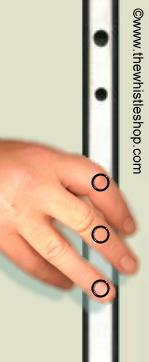
Or this

Or this

Or this

Or this

Once you have your hand in position, you play by, you know, kind of wiggling your figers up and down. To cover and uncover those hole thingies. 
Hey guru. Yes I did read your link. You actually use the word pivot in that post! That’s the only reason that I’ve used it in order to stay with your “theme”. It’s certainly not my intention to confuse anybody.
FWIW, I find that being addressed , "Oy " is slightly disrespectful! I doubt that is your intention and certainly hope not. I’m not familiar with it’s usage and only hear it in films and such. It always seems to be used negatively in such contexts. Perhaps our British users could enlighten us.
Back to the topic.
And what do you think was being described?
There’s no thinking. You said that one should use B3 as a PIVOT. So when you further go on to explain the slight turn towards ones chest, I just substituted TURN for PIVOT. The same thing really. Like I said, I was trying to follow the same " theme" that you set. If that is not how you intended to use the pivot/turn/rotation /etc then I apologise. I’m not posting to confuse people.
OK, fair enough, and thanks. So let me try again.
If you look at the photos in my previous post, you see that that fingers of the lower hand are not perpendicular to the whistle, but are pointed downward toward the floor at about a 45 degree angle. In order to achieve that position, if you start from a standard grip, you need to rotate the hand counter-clockwise with respect to your body, until your fingers are in the proper position. Exactly as I describe in my linked post, [u]“Piper’s Grip Step-By-Step”[/u].
As you do this rotation, with your ring finger pad firmly on the B3 hole, the B3 hole acts as a fixed pivot point, with the rest of your hand rotating around it. That’s the pivot.
Once your hand is in position, you proceed to play with normal finger movement. There is no pivoting involved. You seem to be confusing the above procedure to put the hand into position prior to playing the instrument, with the movement of the hand while playing the instrument. Two different things entirely.
Oh my! Of course you don’t pivot the hand while playing! I am not confused st all! And that is certainly not I was trying to explain! I was trying to explain exactly what you just explained. I don’t understand the confusion  . I’ll re-read my posts to see where it lies.
I’ve played low D’s professionally for many years at a very high level. I am certainly not confused.
Pivot can be used as a noun and a verb.
Sorry if I seem confusing. I thought that my posts were valid and I did Learn something as I hope do others on this topic.