I’m curious that there has been no mention of the Fajardo wedge solution for cylindrical bores in this thread. What’s the latest thinking on its advantages & disadvantages?
Most Tipples are sold with wedges.
Bob
I did a lot of experimenting with variations on the Fajardo wedge. They certainly worked to a point, but I didn’t completely love the way they affected the flute. They definitely helped with the intonation issues, but getting them just right was tricky, and I found that the flutes that had them felt somewhat less “free blowing”. Also there were difficulties with introducing them into the bore in a permanent way. For a flute that I intended to be a single piece of wood with a permanently fixed stopper, the conventional wedge design would not work. I actually evolved into doing them from poured epoxy. I would put a measured amount of clear epoxy against the stopper in the headjoint and then tilt the flute just the right amount and leave it to cure. This caused the epoxy to pool at the head and form a natural wedge. Once I dialed it in it worked pretty well in terms of reproducing the wedge, but I never loved it. Much better than having nothing, for sure.
When I started reaming out the headjoint area with a parabolic tapered reamer, the improvement was subtle but noticeable. Plus it was a lot more reliable and consistent. Despite that, if I did not have access to a parabolic reamer I would absolutely use this method over leaving the bore a straight cylinder. The wedge was a clever invention, but for any maker who has the ability to ream the headjoint of the flute I’m not sure why they would bother with the wedge. But if I were making flutes from PVC then I’d put a wedge in them.
Thanks, yes, I was happy with it. Note the thickened sections at the joints. I’ve noticed a lot of 19th century cylindrical flutes show cracking at these points because the bore is so big and they wanted to keep the outside diameter comfortable. So keep an eye on that issue.
And as Paddler mentioned, the average hole size is a bit bigger than on conical bore flutes of the same key. This became necessary in order to get the intonation balanced. I’m working on tweaking a couple of holes just a trifle smaller, but if I go too small then suddenly the first and second octave tuning begins to drift apart…
And if that tuning drifts too much, not only does tuning of the instrument suffer, but so does response. So important to attend to it.
You might want to experiment with a different head taper as an alternative to making the tone holes uncomfortably big. I have no reason to believe that Boehm’s head taper is magical. I’d guess is that it worked for him with the size of holes he chose. We know that no taper (i.e. simple cylinder) makes for very flat harmonics. So more taper would presumably give sharper harmonics, and permit smaller holes.
Indeed. But why stop at the number of joints per finger? What about more fingers? Suddenly the perennial flutemakers’ dream of a keyless chromatic flute is within grasp…
But with which of your four hands should you grasp it?

I have a little bronze of Shiva in my office given to me many years ago by a friend. She said “I thought you could probably do with a hand in the workshop”.
I think you are spot on there, Geoffrey, and I suspect I know the reason (but could be wrong!).
For those unfamiliar with the Fajardo wedge, it’s a wedge cut out of a cylinder, inserted into the top end of the flute head. The idea is that it takes up some of the airspace in a cylindrical head, more at the stopper end and fading out as you approach the bottom of the head, thus making it look like a tapered head. As Geoffrey says, this helps the intonation in the same way as a tapered head helps the intonation in a Boehm flute.
But, consider a cross-section cut through at the embouchure hole. The bore won’t be round, it will be D-shaped. And remember our flute is side-blown, so the top end of the vibrating air column has some spiral elements. I’m guessing that our D-shaped bore is introducing some aerodynamic inelegance.
Not convinced? Try this simple test. Drop a bamboo kebab skewer into the foot of your flute so it ends up resting against the stopper. Now try to play it…
I did think of another work-around for those not wanting to go to reaming. You could make a tapered former, grease it well with release agent, poke it up the cylindrical head, and pour epoxy or something similar into the stopper end. After the potting agent dries, you remove the former, leaving a nicely formed tapered bore.
But hey, Geoffrey is right. Reaming is no big deal and much less mucking about!
And if that tuning drifts too much, not only does tuning of the instrument suffer, but so does response. So important to attend to it.
Yes, the cylindrical bore flutes seem to want slightly bigger holes in general to play well and in tune. Plus it gives the flutes a big voice, which might be desirable in some instances. Blayne described one of these as a potential “session cannon” because the voice was so strong and could be pushed. But I suspect most ITM players who play in sessions are going to lean toward the conical bore versions, simply because it’s familiar and traditional.
You might want to experiment with a different head taper as an alternative to making the tone holes uncomfortably big. I have no reason to believe that Boehm’s head taper is magical. I’d guess is that it worked for him with the size of holes he chose. We know that no taper (i.e. simple cylinder) makes for very flat harmonics. So more taper would presumably give sharper harmonics, and permit smaller holes.
It’s funny you should mention this, because I have at times pondered on the subject along the way as I messed about with different ways to introduce the taper. It was that bamboo flute that got me thinking because I’m quite confident that the natural taper in that piece of bamboo does not follow the ideal as outlined by Theobald Boehm. And yet it works beautifully. So it would make for an interesting experiment to try variations on the taper. The thing that would inhibit this experiment (and most makers who create their own tooling will appreciate this) is that making reamers is a lot of work! To experiment with a bunch of taper variations means manufacturing a bunch of reamers which is not an easy thing to fit into a busy schedule, especially when there is no certainty of an improvement.
But, consider a cross-section cut through at the embouchure hole. The bore won’t be round, it will be D-shaped. And remember our flute is side-blown, so the top end of the vibrating air column has some spiral elements. I’m guessing that our D-shaped bore is introducing some aerodynamic inelegance.
Exactly! My feeling was that by introducing the taper and creating that D-shape it introduced some type of turbulence or resistance to the easy flow of air. I tried to counter this by moving the taper around a big in relation to the embouchure hole, but it didn’t change anything much. Again, it was not so bad as to be a deal breaker, but when I compared it to a reamed head I could tell the difference.
I did think of another work-around for those not wanting to go to reaming. You could make a tapered former, grease it well with release agent, poke it up the cylindrical head, and pour epoxy or something similar into the stopper end. After the potting agent dries, you remove the former, leaving a nicely formed tapered bore.
Definitely a workable solution. You’d have to come up with a reasonable method of centering the former in the bore in a way that would still allow you to introduce the epoxy, but that is do-able.
WIDesigner, available on GitHub, can model the effect of a tapered head joint on the tuning of a cylindrical flute. While the flute model is still a prototype, it may help you identify general trends without the need for a pile of reamers and trial head joints.
The current taper optimizer solves the opposite problem to yours: optimizing the conical bore of the body for a cylindrical (or at least fixed taper) head joint. If you find the flute model useful, I can add a head joint optimizer for you, or even a full-on bore diameter optimizer like the one in the reed study model.
I applaud the experimentation you’re doing. I’m glad you’ve landed on a model you’re happy with.
Thanks Terry and Geoffrey for your most illuminating comments on the Fajardo wedge. Still interested myself as I don’t have the tools or ability to make reamers (and I probably should disclose I’m setting out to make whistles not flutes). I’m curious about the “D-shaped” cross section after wedging that both of you have talked about (the pouring epoxy method you mention Geoffrey would produce a flat topped wedge and thus a D cross section). My understanding is that the normal Fajardo wedge is cut out of a hollow cylinder, which presents a curved with flat edges profile toward the embrouchure hole in a flute or the window of a whistle, not a D shape. I’m curious that you found the flat topped wedge (with the poured epoxy) worked best, Geoffrey, despite that it would seem logical that a flat topped wedge is further from a parabolic reaming and likely to create more “aerodynamic inelegance” than the curved with flat edges profile of a tapering wedge cut diagonally from a hollow cylinder? Or perhaps I’ve misunderstood something here? 
Hi Tunborough
Forgive me if we’ve been here before (I am old enough to have a Papal Dispensation to pull this concession!), but tell (or remind!) me what the philosophic basis of your app is. Does it derive from Paul Dickens’ work at UNSW, based on their acoustic impedance spectrometer, or drawn from some other source?
Interesting, Matt. I’ve always assumed the Wedge to be a flat-faced wedge cut off a cylinder, but I’d be happy to be disabused. A quick look on Google shows us what Doug Tipple does:
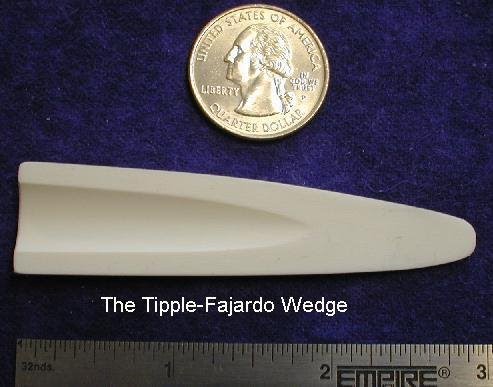
but I don’t know if that’s what Raoul Fajardo had in mind.
But even Doug’s wedge presents issues to the circulatory air stream, doesn’t it. Those flats either side of the central hollow.
What would be better would be a fully-hollow wedge-shaped segment of a cylinder, curved on the outside to meet the cylindrical bore, fully curved on the inside to smooth the flow of air. But it’s surely all getting too hard. Easier to put in a well-greased former and pour in some potting compound, or simply ream the thing in the first place? Reamers are easy to make, or there’s that chap in the village…
Great to hear you are planning to make whistles, incidentally. I’ve made one myself. One. Bit sad really, eh? I have some thoughts on a second…
I’ve done variations on both types of wedges: the poured epoxy “flat topped” wedge as well as the type made from a section of tubing like the original patent version put out by Raoul Fajardo. I ended up doing the flat-topped epoxy version because I didn’t perceive any noticeable difference between the two and it was easier to implement. That doesn’t mean that there is no difference, and a better player might find differences that escaped my notice. But I didn’t like the effect of either of them.
How about something like a hollow cone, possibly with a rounded rather than pointy tip, tapering to the nearly the full width of the bore? Or a truncated, lopped off tip? The cross-section would be circular, not a ‘D’ as with a wedge as has been discussed. I guess you need some way to place/adjust a stopper, particularly if a flat disk stopper end is a requirement to manage the air stream. Or, hey, a flat disk at the point of the cone, and the whole cone moves to adjust the length of the air column (moving the taper along as well).
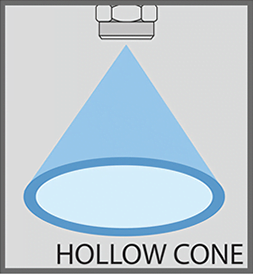


Yes, that’s a bullet, but I can’t draw, and tried to find something to visualize the shape. Imagine this being hollow.
The Bibliography lists the sources for our modelling algorithms. The tonehole model, in particular, is the work of Antoine Lefebvre. For modelling the mouthpiece and the effect of the player, we took a somewhat different approach than Dickens. Rather than predicting a playing frequency directly, we predict the minimum and maximum frequencies at which a note will sound, on the assumption that these bounds are less dependent on the player (at least for whistles). “To predict the nominal playing frequency, the whistle model assumes that you will steadily increase the air velocity in the windway as you go from the lowest note on the instrument to the highest.”
I’ve made cylindrical-bore whistles with a wedge under the window. To form the wedge, I carved a tail into the bottom of the fipple block extending a cm or two down the tube. The top of the tail is flat, the bottom is curved to match the inside diameter of the tube. The wedge does help balance the tuning of the octaves, to a limited extent, so it is worth trying out. If the tail is too big, big enough to really bring the octave tuning in line, it starts to interfere with the tone of the whistle. I haven’t done enough experimentation to work out the best compromise.
I’ve always assumed the Wedge to be a flat-faced wedge cut off a cylinder, but I’d be happy to be disabused. A quick look on Google shows us what Doug Tipple does:
but I don’t know if that’s what Raoul Fajardo had in mind.
But even Doug’s wedge presents issues to the circulatory air stream, doesn’t it. Those flats either side of the central hollow.
What would be better would be a fully-hollow wedge-shaped segment of a cylinder, curved on the outside to meet the cylindrical bore, fully curved on the inside to smooth the flow of air. But it’s surely all getting too hard. Easier to put in a well-greased former and pour in some potting compound, or simply ream the thing in the first place? Reamers are easy to make, or there’s that chap in the village…
Yes, it does get too hard to fuss so much! I made wedges like the one pictured on Doug’s website, only I took the trouble to remove the flat top by “blending” the inner curve of the hollow wedge so that it matched the curvature of the flute bore more elegantly. My assessment is that it’s a pain in the neck without any profound difference in performance. If one is going to fuss to that degree, it truly is easier to make (or have made) a reamer. Though the poured epoxy idea you had would be a great in-between solution (probably fairly easy to implement with some practice). I’ve done a lot of work with mold-making and casting in pursuit of some highly experimental cast-bore xiao (long, long story), and there is a lot of potential in casting portions of a flute bore to affect some acoustic change. But I’ll also add that it’s a messy process and one needs a pretty good motivation (commercially) to take that approach. Your mileage may vary. I spent thousands of dollars and dozens of hours of R&D trying to master aspects of mold-making/casting, and while it was highly educational, in the end I’d opt out in most cases where there might be another solution.
Here’s another question based on the original question.
What are your thoughts on the differences between straight cone bores and complex cone bores?
In references to the musical aspect rather than manufacturing.
Thank,
Tommy
I’m far from being an expert on the mathematical part of woodwind design, but there is certainly a difference. When I made my very first Irish flute, I had to manufacture a reamer. This was years ago, and I was working from some blueprints that I got from Terry McGee (a Pratten flute). When I set about making the reamer, I noticed that the variations in the bore measurements did not create a straight taper. However, the perturbations were very subtle, and in my ignorance I assumed that it resulted from either shrinkage of the original bore or simply human error in measuring the bore. So to save time and hassle, I just smoothed them out and made a straight taper.
The results were good. The flutes sounded just fine and a few more experienced players tried them and said “These are good!”. No one said “These are great!”. When I began working with Jon Walpole (aka Paddler) he was the first person to say, “These tiny perturbations are really important”. So I made new reamers that included the tiny irregularities that I had smoothed out of the first version. There was a noticeable improvement. It took the flute “to the next level” if you will, and with a few more tweaks here and there, finally resulted in the “These are great!” reaction that I was going for.
So clearly these things matter.
Just as a matter of interest, speaking of the effects of bore manipulation, I’ll share a bit.
I did a project last year where I attempted to create an “optimized” xiao (Chinese end-blown flute). A researcher at the University of British Columbia who was a xiao enthusiast did his master’s thesis on the xiao and his attempt to take the traditional folk design (which is a cylindrical bore instrument) and improve it’s harmonic balance and tuning.
His research and process was very impressive, involving complex mathematical models and sophisticated microphone arrays for measuring acoustical impedance, etc.. In the end, he succeeded. But the nature of his success was totally outside of the box.
He created a flute whose bore was neither conical nor cylindrical. It was, in fact, totally unlike anything anyone has done before (to my knowledge). The inner bore resembled a couple of sine waves running in parallel. Or to use a more earthy description, the bore resembled a snake that had swallowed a series of rodents, causing it to bulge out in places along it’s length!
This was a flute that was impossible to manufacture using conventional means, since it could not be bored our reamed. In the end, I decided to make this flute (another collaborator had gotten the specs directly from the researcher and had gotten me permission to use them). This was what I referred to earlier when I spoke of mold making and casting, because the only way to make this flute bore was to cast it from resin. This is because I wanted the outside of the flute to be wood, you understand. I suspect someone could use a 3D printer to make the flute if they don’t mind a plastic flute. However, I won’t go into what a long, difficult and messy process this was (it involved casting wax mandrels that could be melted out after the resin had cured, etc.). But it made me appreciate the trial and error that went into perfecting the bore profiles of early flutes from the Baroque period forward. I’m told that they did a lot of modification of bore profiles, including “chambering” in places to optimize the tuning and harmonics.
In the case of this optimized xiao, the researcher succeeded beautifully. The tuning balance was excellent–easier to achieve than on the conventional design. And the harmonic spectrum of the instrument was also balanced, giving it a uniformly strong and reedy tone. But here’s the surprise that came at the end of it: xiao players didn’t really like it! The xiao as a folk instrument has a characteristic timbre and certain idiosyncrasies that make it what it is, and the music it is used for has evolved along with it over centuries. This man had engineered the character right out of the flute! So he improved it on one hand, and erased it’s identity on the other hand.
I made a few prototypes of this flute, and they are really cool. Insanely difficult to make, and I spent a ton of time and energy only to discover that the Chinese, in their wisdom, had already made an amazing flute that did not require any improvement or optimization at all. They had worked out all of the bugs in the last couple of millennia, and had created a flute with a unique character. Changing that was not an improvement. It merely made something that was different.
I think the silver flute is basically an “optimized” orchestral instrument that was an improvement (in some ways) over the wooden, conical bore instruments of the time. But it also lost a lot of the character of it’s predecessors.
I make Uilleann pipes, and the appropriate reamers too, I’m aware of the importance of the tiny humps and bumps in a bore.
I kinda remember reading that some makers of the Pratten style flute used a straight taper in most of the bore. I mean from the head joint to the foot joint.
Could this be true?
Tommy
Can somebody clarify about these bore perturbations? Are they just places with no taper (or less taper)? Or are they more involved?