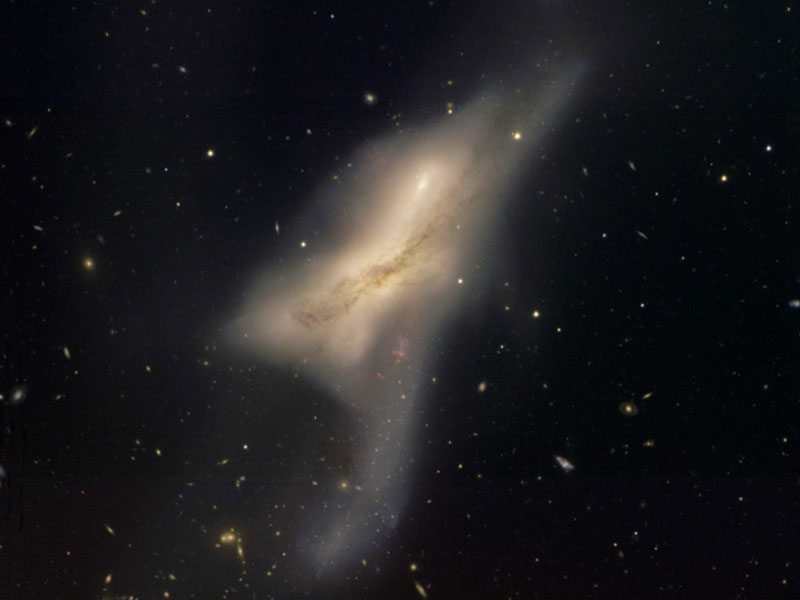
What a lot of dust!
Here’s some galaxies like ours (as seen through Hubble) before colliding. Sleep well, Denny.

Has to make one wonder as to how many sentient beings are living in those two galaxies who are just about to wiped out forever as all those solar systems colid.
Maybe none would be wiped out at all. These collisions are not like a quick car crash-- they take place over thousands (millions?) of years. Also, although they look dense, galaxies are mostly empty space so the odds of suns colliding may actually be pretty small. The galaxies would sort of pass through each other, although I’d imagine there would be gravitaional effects which would deform them.
WOW! I’ve seen that pic mebey a hundred times, and it never ceases to amaze and inspire me! I wonder what we might find if we were able to venture forth and explore those galaxies…
Probably not much. Just a few devils, dust devils ie, and a few leprechauns
eating aquamarine berries on their waffles, like this picture from Mars.

I’ve read that mineral berries like these (Moqui Marbles) can be found in Utah also…
which leads me to believe there’s some interplanetary transferals taking place.
http://dsc.discovery.com/news/briefs/20040614/marsberry.html
I’ve found those in southern Utah. They catch your eye immediately and I’ve wondered what they were. Thanks for the link, Lorenzo.
Susan
Now, It is my understanding that light from distant gaxalies, stars, etc.. take a LONG…LONG time to reach our little corner of the universe. So, if any sentient beings were going to be obliterated, or witness their “apocalypse”, it would have happened by the time we see it.
Poor little guys…
I hope you saved them. They’re very cool. A good friend of mine was the
head archaeologist for the state of Utah, up until just a few years ago, and
he showed me some he’d found. He gave me one, but I’ve misplaced it in moving.

Circumstellar Disk Cradles Young Massive Star
http://www.naoj.org/Pressrelease/index_2005.html#050912
- An international group of astronomers has used the Coronagraphic
Imager for Adaptive Optics (CIAO) on the Subaru telescope in Hawai’i to
obtain very sharp near-infrared polarized-light images of the birthplace of
a massive proto-star known as the Becklin-Neugebauer (BN) object at a
distance of 1500 light years from the Sun. The group’s images led to the
discovery of a disk surrounding this newly forming star. This finding,
described in detail in the September 1 issue of Nature, deepens our
understanding of how massive stars form.
APOD: 2005 September 14
The Boomerang Nebula in Polarized Light
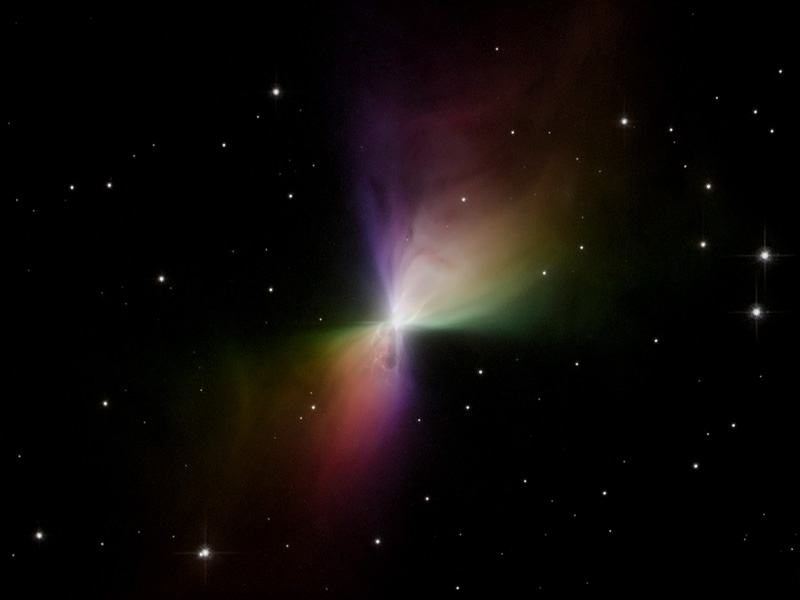
(click da pic)
Lorenzo That’s got to be one of the coolest pics I’ve seen in awhile.
Denny It looks like a bow tie to me. I’ll call them and see if they’ll rename it.