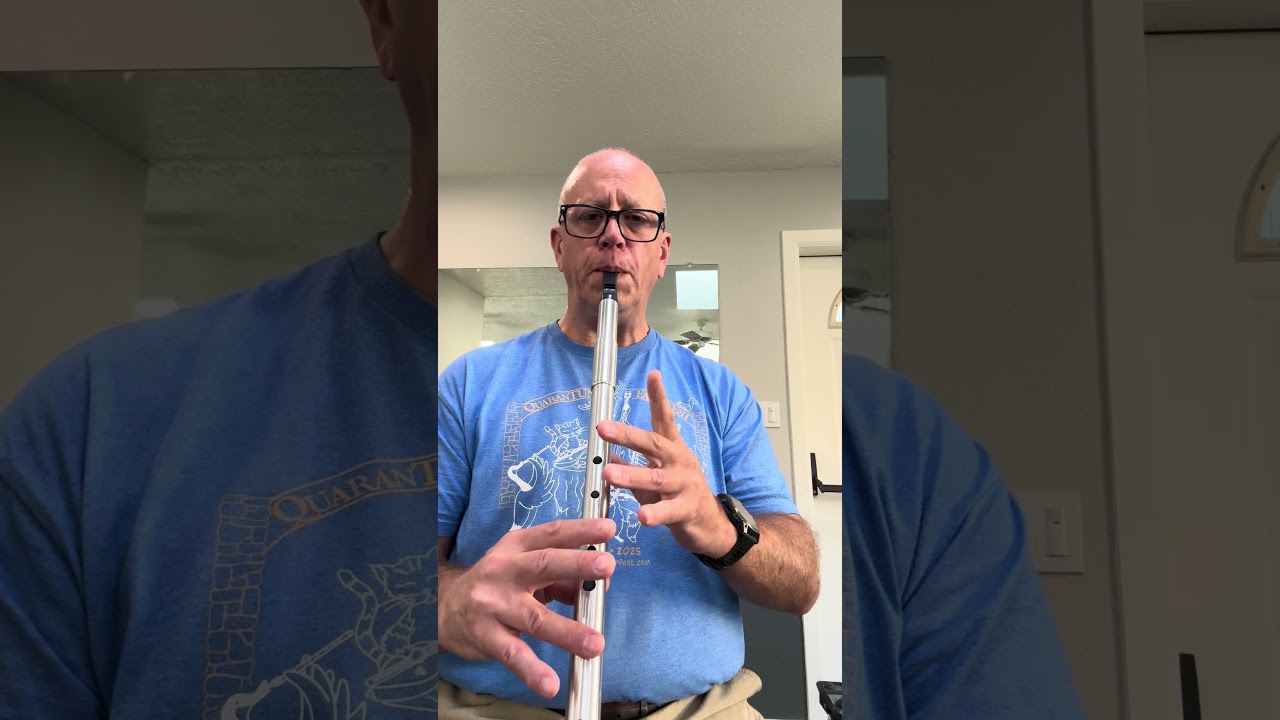
"Chompf" versus "Chiff" transient on Low D whistles

Hey folks,

I’m hoping to get some insight into a specific phenomenon I’ve been running into on a few Low D whistles.

I’m still relatively new to the whistle and to the tradition, and part of what I’m doing right now is simply learning to hear and feel the differences between instruments as I go.

I’m about to head out on a three-week road trip with my wife, and I’m bringing along a handful of flute/whistle-making and organ pipe physics books to dig into this more deeply. But before I disappear into that rabbit hole, I thought I’d ask here—there’s a lot of practical and maker experience in this group.

My wife and I have been exploring a range of Low D whistles from different makers, and it’s been a really enjoyable project.

Every so often, I run into a sound that I can only describe as “chompf!”

It’s not the typical “chiff”—the brief attack transient at the start of a note—but something more pronounced. It happens at that same moment, but instead of a light edge, it feels like a heavier, more disruptive transient—almost as if the air column momentarily fails to settle cleanly onto the new speaking length before locking in.

At times, I wonder if this is just an extreme version of chiff—but it feels qualitatively different when it happens.

What makes it noticeable to me is that it’s not evenly distributed. If it were happening across all notes more or less consistently, I probably wouldn’t think much of it. Instead, it tends to show up only in specific transitions, so I’ll hear it clearly in certain moments while playing a tune and not at all in others.

Here’s when I notice it most:

  • When moving between notes that involve a large effective change in acoustic (fingered) length

    • for example, from the highest notes of the first octave

    • to the lowest notes just above the octave break (the next notes above low D)

  • And also in the reverse direction, across that same boundary

So my working assumption is that this may involve a large, rapid disturbance in the standing wave as the air column reconfigures.

A few additional observations:

  • I experience it more on certain whistles than others

  • It seems to show up more on thicker-walled aluminum Low D whistles

  • On some whistles, it diminishes after ~10 minutes of playing (as the instrument warms up)

  • My wife can minimize it on at least one of the same whistles, which suggests finger sealing and/or transition control are part of it

  • As I’ve backed off from overblowing (coming from a didgeridoo background…), the issue has improved somewhat

What really brought this into focus was an accidental experiment:

I recently cleaned four of our Reyburn Low D whistles (aluminum bodies with Delrin heads), and in the process, I mixed up two heads and bores.

The result was immediate and obvious:
the “chompf” became much more pronounced on the mismatched combinations.

Those same whistles, when correctly paired, only showed a mild version of the effect—and only in transitions across that octave boundary—and even that would usually settle down after warming up.

So that really got my attention.

At this point, I’m wondering:

  • Is this primarily a voicing / head–bore interaction issue?

  • A transient instability during rapid effective length change?

  • A finger sealing / timing artifact that some whistles are more sensitive to?

  • Or some combination of all three?

I’ll be digging into the physics side over the next few weeks and experimenting further, but I’d really appreciate hearing from players—especially makers—who may have run into this before.

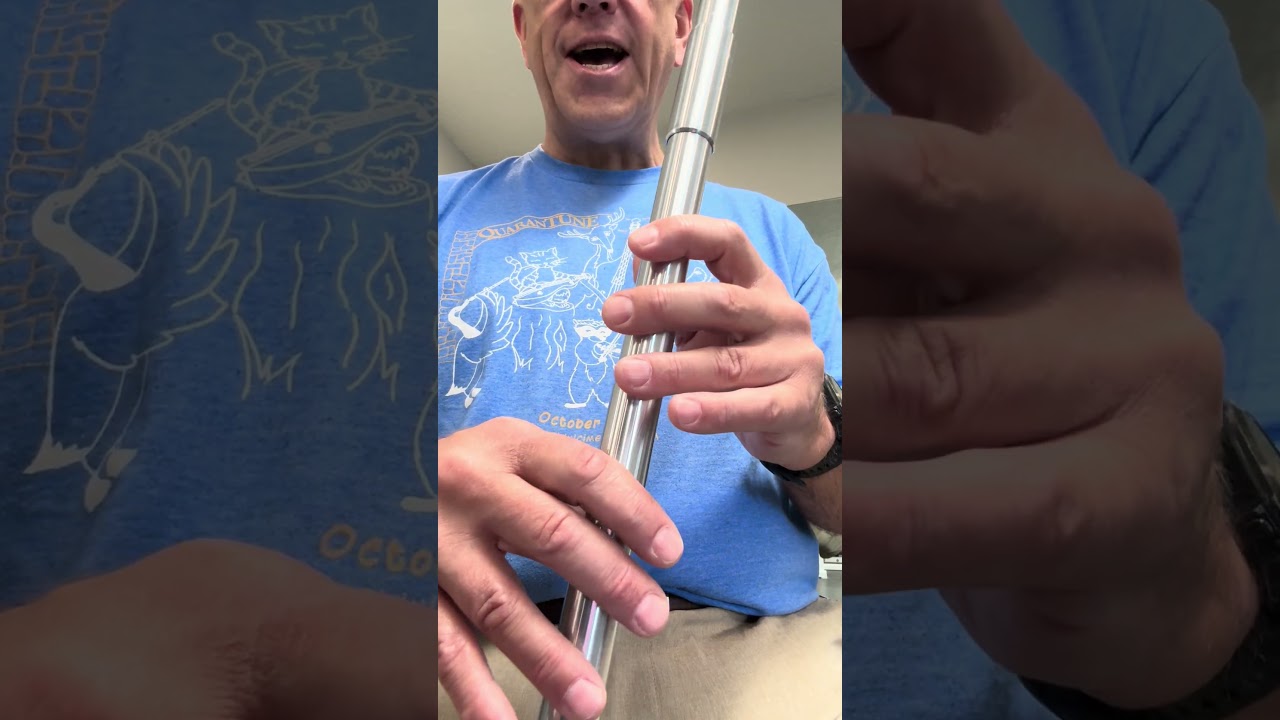
Edited (4/28/26): Others have asked me to add a short video demonstrating what I have been talking about:
It would help to have a recording to be sure, but it sounds fairly normal. Every slight transition noise on a high whistle gets amplified ten-fold on a low one.

When I first started I needed to make various adaptations to avoid noisy transitions: changing where I took breaths, tonguing or glottal stopping, rephrasing the bar – and in a few cases, changing what I was playing. I couldn’t find a way to voice the high Bs in the second part of the Tarbolton, for instance, so I swapped them for low Bs. (The people I played with still imagined they heard high Bs anyway.)

Then I put my low whistle away for a couple of years, as I was playing in sessions and it’s inaudible against four fiddles, a piper, and varying numbers of flutes, boxes or banjos. When I went back to it, 90% of the issues had mysteriously vanished. I’d got better at playing, so I could manage them better.

PS: I don’t know whether the Tarbolton thing was still there. The tune seems to have gone out of favour in the repertoire, and anyway who’d play it on a low whistle if they’d got a high one in their bag?!

1 Like

Thanks for the response. I just left for a seventeen-day trip with my wife, but plan to practice every day either in a unused hotel gym or park bench along the way.

I reposted the question in a private Tinwhistle resource group on Facebook. Someone else suggested a short video clip would be a tremendous help. So, tonight or tomorrow I can add that.

I appreciate your response and have enjoyed Chiff & Fipple as a resource. Cheers!

I have never practiced any music in a hotel gym or pool area, but the reverb must be incredible! Anyway, to your question, I have no idea. But I am wondering if three design factors may be involved in the variable responses:

  1. bore diameter as matched to whistle key: the variable bore sizes of any particular key will affect how notes and their harmonics are responding, and on a low whistle, this effect will be experienced at it’s maximum. Perhaps the speed of wind wave dynamics responding to a change in note and the air wave reforming, is affected by the matching of the key to bore size. Perhaps the harmonics/overtones will be mostly affected, vs the lesser impact on the fundamental?

  2. The wall thickness. Thicker walls mean taller chimneys for the tone holes, which when varied in open/close status when you change notes, may cause more or less disruption to the sound, vs whistles of thinner/thicker walls?

  3. Mouthpiece design as affecting the tendency of the general response of the whistle to make the lower, midrange or higher octave notes respond easiest. Perhaps a mouthpiece allowing lower octave response to be the easiest would have lowest evidence of the variation you’re talking about, and a mouthpiece designed to achieve easiest response of the higher range of notes having less evidence of it in the higher range? or the opposite? this would need testing out.

Maybe you could find two or three whistles that do and don’t show this extra chiff response and chart out the responses as compared to note range, bore, whistle key (low D for example), wall thickness and possible mouthpiece design impact.

1 Like

JohnF,

Very interesting topic.

In my experience, when I run into a transition that is too fuzzy, I work on it at low speed. The two factors I focus on are: 1) accurate finger movements, and 2) accurate breath control. The usual culprit for me is that my breath-change isn’t nearly as fast as my finger-change.

For me, the hardest part is changing the breath quickly AND accurately.

By “accurately”, I mean recognizing that the two notes (starting + ending) need different breath (pressure + flow).

Both fingers and breath are governed by muscular coordination, and so are often amenable to slow, focused practice. :slightly_smiling_face: Though, I must confess, on some whistles and for some transitions, I just can’t make it clean and give up. :frowning:.

Also, I’d like to add my vote requesting sound samples.

trill

2 Likes

Lifelong organbuilder and voicer here. The ‘chiff’ sound in organ pipes is something that, if not kept in check becomes very obtrusive and unmusical. Various voicing techniques eliminate or control it, generally, but you have to keep in mind that you are working with constant pressure in such a case, and windchest design has a lot to do with speech, too. You are putting a lot of thought into this, and I get it, but just be aware you really can’t regulate the pressure of your breath, and an attack noise is likely to be related to that. Every whistle is likely to be different, even the same model from the same builder as voicing adjustments are often to small to be seen. Prob not any help, but it’s an interesting thread.

1 Like

Thank you for such a thoughtful response. I have been reading a number of organpipe and flute-making books because, as a retired science teacher, I am fascinated by the topic. So, I don’t think this is a defect of any of my whistles that exhibit this. I think it is a mixture of me learning breath pressure control and finger articulation, and simply the nature of the instrument itself. I just found it interesting that it happens more frequently when moving from second-octave D (OXX XXX) to C# across any of the possible fingerings. I need to use OOO OOX because my pinky does not reach to stabilize the whistle without adjusting my hand and breaking the seal.
Others have asked me to make a short video:

I think you have to keep in mind you are working with a tube with holes in it. I know that overstates the obvious, but it will only do so much and respond so well. An orchestral flute is very carefully engineered to do what it does and be as consistent as possible but that’s not the case here . A whistle’s is really at its best playing the bell note (all holes covered). Anything else relies on the location of the holes/vents, etc. An organ pipe plays one note only, so it can be very carefully voiced, regulated and tuned. Even a harmonic organ pipe, with a vent hole around the middle (many locations for that) to cause it to overblow an octave is carefully controlled. I’ve said many times that my hat is off to whistle makers for the ability to make them do what they do, and as well as they do! Fortunately, alot of the music we play on these whistles doesn’t linger or rely on pitch or articulation but for a very brief moment and moves on. I guess that’s the character that makes me love the whistle.

1 Like

If careful with your breath going from OOOOOO to OXXXXX can you sustain the unwanted sound? Do you get the sound (or get a different sound) going from OOOOOO to the high D fingered XXXXXX ?

On flute I most often get the crossing noise going from C fingered OXOXXX to D OXXXXX. With proper breath control I can avoid it but in many situations fingering the D XXXXXX is the easiest option. I often to use XXXXXX in passages of second octave notes in any case as it has a similar sound quality and breath requirement.

Maybe more relevant to the physics is that with careful breathing I can sustain the unwanted rough sounding note when coming from either C or C#. I can’t check at the moment but I think it’s an out of tune B or Bb. Which is the sort of pitch one might expect from a OXXXXX cross-fingering - something somewhat flat of C.

Thinking physics rather than music try OOO OOO, OXO OOO, OXX OOO, OXX XOO, OXX XXO, OXX XXX - what can you get at the end?

1 Like

Thank you for such a detailed response. I will try to make myself as clear as possible. Please, bear with me.

Just to be clear, I am not talking about a tone or an unwanted sound within the tone. I am talking about what I call the attack transient, which is that momentary start of the note when the air column is settling in. In organ pipe terms, it seems to be described as a temporary “ch” sound as in the word “chiff”.

In fact, it seems that most whistle players within the tradition want or desire that “chiff” sound at the moment the note starts. I believe that is separate from an airness that continues on throughout the note, which again, is a quality some whistle players seem to really enjoy.

What I am describing is that, in that moment of the attack transient, I hear a bit more than just “chiff”, and it begins to take on a “chompf” sound. Mind you, I am not getting any noticeable “chiff” when I start to sound any note beyond the transitions from C# to D and from D to C#.

I can limit that “Chompf” sound down to a “chiff” with less breath pressure, better breath control, and good finger placement on the tone holes. Yet, it is only in that one transition that I get the distinct sound, not at the start of any of the other notes.

Let me show you this video example:

So, I hope that helps identify the phenomenon in question as not really related to a sustained part of the note or tone. Again. I get this on a number of my whistles. I don’t see this as a defect. If anything, I see it as something I will learn to manage and reduce with more experience. Yet, I want to review the literature I have been reading on the physics of organ pipes and whistles and to ask others.

I should add that I get the same phenomenon when slurring from C# to E. You might have noticed I am playing the scale legato (slurring). The phenomenon persists between C# and D when I “tongue” the scale. It is just covered by the addition of the “chiff” sound (attack transient) at the start of each note. Yet, you can still distinctly hear the addition of the phenomena I am describing beyond the attack transient or chiff sound.

I added this last part as an edit for clarification.

I think the phenomenon you described/illustrated occurs as a result of some variation in the timing of when each of the tone holes are closing or opening when you transition from C# (all open) to D (all, or all but one, closed) and vice versa.

In an ideal world, your fingers would close all the tone holes in the same instant, resulting in a single transition, with no intermediate states. In the real world, especially when you are starting out and getting used to the location and size of all the tone holes and the finger placement needed to close them, each of your fingers will arrive at their tone hole at different times, and may take some time to settle and completely close the hole. This means that there are many possible intermediate states in which one or more tone holes are temporarily open, or partially open, while others are closed. Each of these states will have its own resonance (or none) in the bore, and you’ll hear the transition through these states before reaching the final state.

This phenomenon seems to be more problematic the larger the tone holes (because they are harder to completely close in an instant) and the larger the reach between tone holes (because that affects your accuracy and requires more flexibility in your hands, which may be limited already).

To make it easier to reach the optimal goal of a single, sharp transition to the final state, it helps to experiment a bit to see which fingers matter the most for each transition. For example, when playing C#, you may find that you can place several fingers on your lower hand over their tone holes (closing them) without disturbing the C# note. This leaves fewer fingers to coordinate in order to get that final clean transition to d. In other words, you can place some of the fingers early and make your life easier. Eventually, this kind of coordination during transitions becomes hard wired. Pancelticpiper has posted some very useful videos regarding anchor fingers and patterns of fingering etc which I think speak to this point too.

1 Like

I was aware of that. I was trying to address your earlier “almost as if the air column momentarily fails to settle cleanly onto the new speaking length before locking in.” with some science.

My point was that on some instruments OXX XXX supports other notes than D. One is a note somewhat flatter than the cross fingered C natural you get by opening various holes below the second one down. The breath pressure to get it is closer to that for C# than for the D. It is not supported very well and this may well be a design aim.

I had looked at the spectrum of your transient before posting. It doesn’t last long enough to get a clear picture with what I have to hand but there are some clear peaks close to Bb in there. On flute I managed to hold the ‘transient’ long enough to measure it on a tuner.

Or it could be what paddler is suggesting. One reason for me asking if you could sustain the transient was that your fingers should then all be down.

1 Like

My point was that on some instruments, OXX XXX supports other notes than D. One is a note somewhat flatter than the cross-fingered C natural you get by opening various holes below the second one down. The breath pressure to get it is closer to that for C# than for the D. It is not supported very well, and this may well be a design aim.

Thank you for sticking with me on this and for taking the time to restate your idea—I really do appreciate it.

Between your response and paddler’s, this is exactly the kind of input I was hoping for when I posted. It’s a great reminder of the value of the Chiff & Fipple forum—there’s a depth of experience here that’s hard to find anywhere else.

Let me try to restate what I think you’re getting at, just to make sure I’m following you correctly.

Rather than the transient being a kind of “failure to settle,” the idea is that the air column may actually be briefly locking onto a different, weakly supported resonance—something that exists within the instrument, but isn’t normally sustained or even noticed.

In that sense, the “chompf” wouldn’t just be noise or instability, but a very short-lived, real acoustic state—potentially tied to an intermediate fingering or a configuration that momentarily supports a different pitch.

The fact that you were seeing peaks near B♭ in the spectrum is especially interesting to me, because it suggests there really is something pitch-like happening in that instant, even if it’s too brief to identify clearly by ear.

And your point about finger timing makes a lot of sense as well—during those larger transitions, it’s very likely that I’m passing through intermediate states where the whistle is effectively “seeing” a different fingering for a split second.

That also seems consistent with what I observed when I mismatched heads and bores—the effect became much more pronounced, which would fit with making those alternate resonances easier to excite.

I’m going to explore this further, especially by slowing things down and seeing if I can deliberately catch or exaggerate that intermediate state.

Thanks again—this gives me a very clear direction to investigate.

I might have made my response in the wrong spot. I am still learning how to use the threads properly

Thank you for sticking with me on this and for taking the time to restate your idea—I really do appreciate it.

Between your response and paddler’s, this is exactly the kind of input I was hoping for when I posted. It’s a great reminder of the value of the Chiff & Fipple forum—there’s a depth of experience here that’s hard to find anywhere else.

Let me try to restate what I think you’re getting at, just to make sure I’m following you correctly.

Rather than the transient being a kind of “failure to settle,” the idea is that the air column may actually be briefly locking onto a different, weakly supported resonance—something that exists within the instrument, but isn’t normally sustained or even noticed.

In that sense, the “chompf” wouldn’t just be noise or instability, but a very short-lived, real acoustic state—potentially tied to an intermediate fingering or a configuration that momentarily supports a different pitch.

The fact that you were seeing peaks near B♭ in the spectrum is especially interesting to me, because it suggests there really is something pitch-like happening in that instant, even if it’s too brief to identify clearly by ear.

And your point about finger timing makes a lot of sense as well—during those larger transitions, it’s very likely that I’m passing through intermediate states where the whistle is effectively “seeing” a different fingering for a split second.

That also seems consistent with what I observed when I mismatched heads and bores—the effect became much more pronounced, which would fit with making those alternate resonances easier to excite.

I’m going to explore this further, especially by slowing things down and seeing if I can deliberately catch or exaggerate that intermediate state.

Thanks again—this gives me a very clear direction to investigate.


1d

Thank you! I’ll be keeping these ideas in mind as I dig back into my flute and organ pipe books on the trip. You’re speaking fluent retired science teacher geek.

" . . . you really can’t regulate the pressure of your breath . . ."

Why not ?

Try it with a pressure gauge, it isn’t easy. Attack tends to be a bit higher pressure than steady-state.

I think I can hear what you mean, the byproduct of certain note-changes.

Just now I experimented going to (closed) Middle D from various notes, legato, and it’s most audible on my Goldie Low D doing this:

xxx|xxo (low E)

xxx|xxx (closed Middle D)

Closed Middle D, and Bottom D, want to “honk” naturally, I suppose because the entire length of tubing is sounding.

In my opinion getting this “bark” is a very good thing.

For example in The Morning Dew the “rocking phrase” written in ABC notation as

| B2eB fBeB |

which I would finger

xoo|xxo (Low B, leaving anchor finger(s) down for the entire phrase)

xxx|xxo (High E)

xoo|xoo (Low B)

xxx|xoo (High F#)

xoo|xoo (Low B)

xxx|xxo (High E)

xoo|xxo (Low B)

those high E and F# notes sort of “pop” naturally, but you can really “bark” the High E’s by attacking them with very short Closed Middle D gracenotes

xoo|xxo (Low B)

xxx|xxx (Closed Middle D gracenote)

xxx|xxo (High E)

xoo|xxo (Low B)

I suppose it’s taking an acoustic quirk of the instrument and turning it into an expressive device.

BTW for me playing Vented Middle D gets rid of the “bark” attack. I nearly always play Middle D closed.

1 Like

When I spent a couple years trying a bunch of different makes of Low D Whistles I found out that my playing style would naturally change according to how powerful Bottom D was.

With the Susato and Burke, which had big fat Bottom D’s, I’d morph to playing a more honky style.

With the MK, where Bottom D had the same voicing/strength as the other low notes and couldn’t sustain pushing, I’d morph into a smoother style.

Flute of course is far honkier than the honkiest Low D Whistle.

And I should add that I am completely new to the whistle and traditional music. So, I really want to point out that this might just be me needing to immerse myself in it all.

However, I plan on giving what just shared a good look over tomorrow. Thank you.