Hey folks,
I’m hoping to get some insight into a specific phenomenon I’ve been running into on a few Low D whistles.
I’m still relatively new to the whistle and to the tradition, and part of what I’m doing right now is simply learning to hear and feel the differences between instruments as I go.
I’m about to head out on a three-week road trip with my wife, and I’m bringing along a handful of flute/whistle-making and organ pipe physics books to dig into this more deeply. But before I disappear into that rabbit hole, I thought I’d ask here—there’s a lot of practical and maker experience in this group.
My wife and I have been exploring a range of Low D whistles from different makers, and it’s been a really enjoyable project.
Every so often, I run into a sound that I can only describe as “chompf!”
It’s not the typical “chiff”—the brief attack transient at the start of a note—but something more pronounced. It happens at that same moment, but instead of a light edge, it feels like a heavier, more disruptive transient—almost as if the air column momentarily fails to settle cleanly onto the new speaking length before locking in.
At times, I wonder if this is just an extreme version of chiff—but it feels qualitatively different when it happens.
What makes it noticeable to me is that it’s not evenly distributed. If it were happening across all notes more or less consistently, I probably wouldn’t think much of it. Instead, it tends to show up only in specific transitions, so I’ll hear it clearly in certain moments while playing a tune and not at all in others.
Here’s when I notice it most:
-
When moving between notes that involve a large effective change in acoustic (fingered) length
-
for example, from the highest notes of the first octave
-
to the lowest notes just above the octave break (the next notes above low D)
-
-
And also in the reverse direction, across that same boundary
So my working assumption is that this may involve a large, rapid disturbance in the standing wave as the air column reconfigures.
A few additional observations:
-
I experience it more on certain whistles than others
-
It seems to show up more on thicker-walled aluminum Low D whistles
-
On some whistles, it diminishes after ~10 minutes of playing (as the instrument warms up)
-
My wife can minimize it on at least one of the same whistles, which suggests finger sealing and/or transition control are part of it
-
As I’ve backed off from overblowing (coming from a didgeridoo background…), the issue has improved somewhat
What really brought this into focus was an accidental experiment:
I recently cleaned four of our Reyburn Low D whistles (aluminum bodies with Delrin heads), and in the process, I mixed up two heads and bores.
The result was immediate and obvious:
the “chompf” became much more pronounced on the mismatched combinations.
Those same whistles, when correctly paired, only showed a mild version of the effect—and only in transitions across that octave boundary—and even that would usually settle down after warming up.
So that really got my attention.
At this point, I’m wondering:
-
Is this primarily a voicing / head–bore interaction issue?
-
A transient instability during rapid effective length change?
-
A finger sealing / timing artifact that some whistles are more sensitive to?
-
Or some combination of all three?
I’ll be digging into the physics side over the next few weeks and experimenting further, but I’d really appreciate hearing from players—especially makers—who may have run into this before.
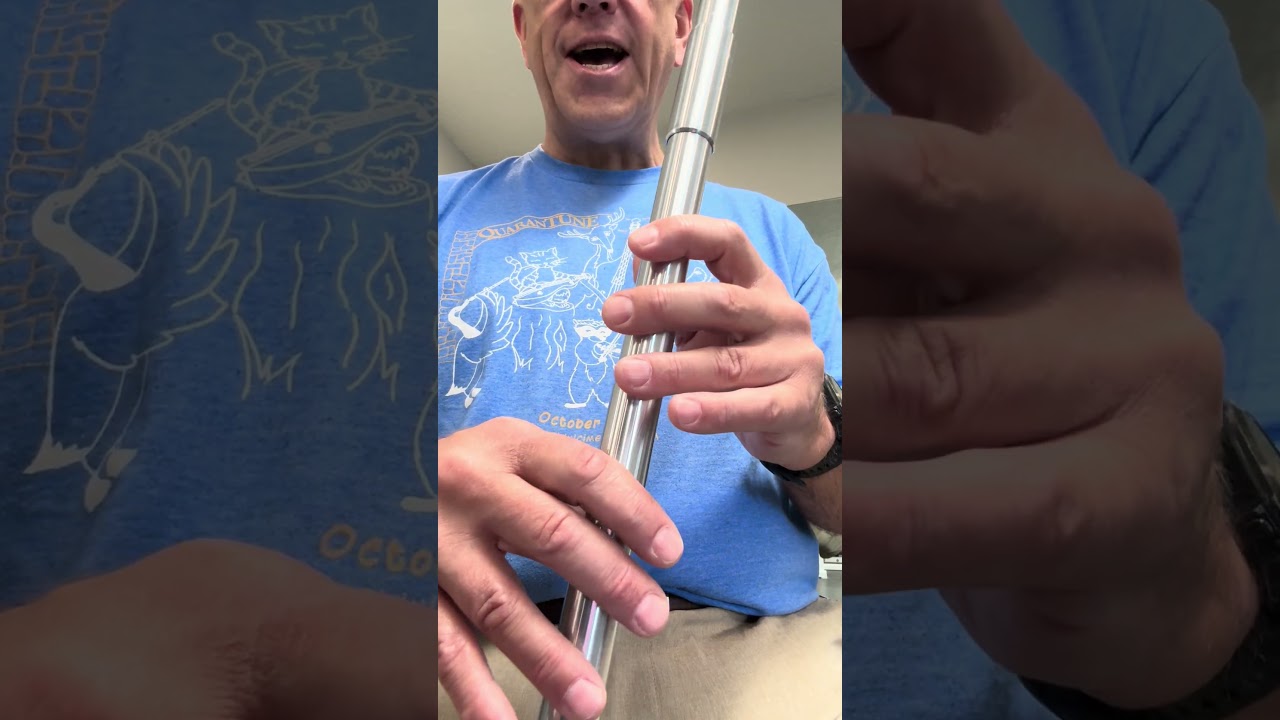
Edited (4/28/26): Others have asked me to add a short video demonstrating what I have been talking about: