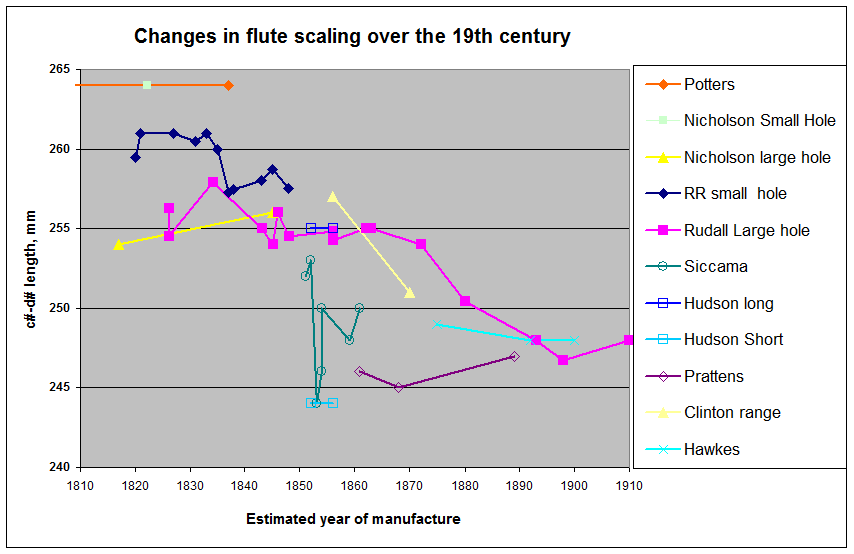
Here’s the results of a new analysis of the changes in flute scaling we observe in the 19th century. I’m still hoping for more data, but it gives us something to go on with. I think you’ll agree that, now that we have it laid out in front of us, it can’t be ignored. Those changes are big!
As you will see in the article, there are still many questions we have to answer about the validity of the c#-d# flute scale method. But even if it is dramatically flawed, we have to find alternative reasons for the changes documented (as well as a better indicator!).
I apologise it’s a bit rough, but we’d better get some work done around here. And your comments will help tighten it up! Fire away!
Thanks, Terry, for dogging the data. I have some questions:
First, doesn’t the profile of the bore interact with hole size and placement to a significant degree? Is there evidence of intermediate changes in bore size or rate of taper? (Ditto for size of embouchure.) Does this help explain the short scale of the Prattens?
Also, it was the practice for much of the period to make heads with long tuning slides. Is there any hope of tracing that development alongside the scale length?
I agree that the small hole Rudalls are “strangely appropriate.” My #3283 has a patent head with a tuning range of more than a half step. It may be my imagination, but the small hole scale seems to be a bit less perturbed by the large changes in head extension than larger holed flutes. Could this be a reason why R&R were a little slower to react to the changes in prevailing pitch?
Like Herb (say hello to Peaches for me), I have some questions about the measurements used.
I’m not sure what sense it makes to isolate this one linear measurement from the other critical, internal dimensions and expect it to tell us anything definitive. All of the various dimensions of the area of space defined by the wooden husk of the flute interact to produce the musical phenomena we know and love, and are interdependent in the extreme. No one external measurement can definitively tell you what’s inside. To me the graph is interesting but not particularly instructive by itself.
Here’s a simplistic question, on the face of it anyway: where exactly is the C# hole?
We see a roughly round aperture and can find the center easy enough, but what were really seeing is just the rim. The undercutting (and size) of the hole changes its relationship with the bore so that the location of the external aperture can be quite different from where the chimney intersects the bore, with a corresponding effect on pitch. We see the hole in one place, but undercutting may mean we hear it elsewhere.
What is a measurement to the center of the C# external aperture supposed to tell us? I think it’s arbitrary.
It would be interesting to correlate this with tone hole size as well as bore, for sure. But I suspect that Rudall and other makers were conservative about changing overall bore profiles given the costs of making reamers. And once they find a bore profile that worked, they probably adjusted it to fit the higher pitches. Except going from the small holed Rudall to the large holed Rudall, which was a significant change.
Similarly, there is a sweet spot for the C# hole scale-wise. Put it in the wrong place and you get a heterodyning middle D. There is the sizing issue - too big vs. too small, and what this does for the location of the A. Rudalls seem pretty conservative on this element.
I like the simplicity of simply using that scale length correlated with time.
Certainly all these flutes have different hole sizes, placement, bore size and taper, which we conveniently overlook when adopting the C#-D# indicator (perhaps to our peril). And it’s certainly suspicious that that small hole & bore flutes come in at the top of the graph, with the big hole and bore flutes at the bottom. The logic of course is that length is the primary determinant of pitch and all these others are second-order effects. It’s quite possible that the indicator is exaggerating the differences, but it does at least seem to be making some sense of them.
The long slow drift of the Large holed Rudall curve from 255mm at 1860 to 247mm at 1898 and back to 248 seems to show the indicator works well for any specific flute style.
It occurs to me we should have the graph conveniently to hand when talking about it:
Also, it was the practice for much of the period to make heads with long tuning slides. Is there any hope of tracing that development alongside the scale length?
Certainly seems to be some interest in that topic. Jem is championing that cause, so let’s see where that goes. If Jem’s trial data shows promise, it won’t be hard to augment the stuff I’ve just done, now that we have worked out a useful format for displaying it.
I agree that the small hole Rudalls are “strangely appropriate.” My #3283 has a patent head with a tuning range of more than a half step. It may be my imagination, but the small hole scale seems to be a bit less perturbed by the large changes in head extension than larger holed flutes. Could this be a reason why R&R were a little slower to react to the changes in prevailing pitch?
I haven’t done any thinking on that question. Indeed, it was only in the analysis of the data shown that I became aware that the small hole Rudalls formed such a clearly separate data set. I think that’s been a long time problem for us - the data is so confusing when viewed as a lump. We need to find ways to look at in bite-sized chunks.
As others have pointed out, we should be careful not to read too much into the changes that have occurred in the C# to Eb measure over time. An increase in that measurement does not necessarily indicate a change in target pitch. Consider two flutes that are identical in every way except for the size of their six open tone holes: one has small tone holes and the other has larger tone holes. The keyed Eb holes would be the same size, as would the distance from the embouchure to the center of those holes. However, for the C# hole of the larger holed flute to play the same pitch as the C# hole of the smaller holed flute, the larger C# hole would need to be further from the embouchure than the smaller one. Hence, the C# to Eb distance would be reduced for the larger holed flute, even though the target pitch is the same. If this were not the case, then to tune the C# correctly the slide would need to be extended and the notes near the foot would become progressively flatter.
So, one might expect that as tone holes get larger the C# to Eb distance would get smaller. I’m curious to what extent this argument is sufficient to explain the changes observed?
I don’t think it goes anywhere near enough to explain the differences. If we play the extreme cases, eg the Small Hole Nicholson and the Prattens (264mm and 245mm) …
There can be no doubt that they are pitched differently. The Small Hole Nicholson has an impossibly flat bottom end - D ends up reading closer to C# at 440Hz. The Prattens by comparison is a doddle at 440. The only argument with the Pratten is perhaps it was intended to play somewhat sharper than 440. I’d be interested to hear from Pratten original players - do any of you feel that your bottom notes are too sharp? (That would suggest it was designed for a higher pitch.)
As Casey points out somewhere above, the top c# hole doesn’t have all that much freedom to roam, or indeed to expand in size. There are a number of reasons for this, including that it has to be the vent hole for middle d, and not to big also to allow a cross-fingered c natural. Make the vent hole too big, and middle d sounds a rather sad B, or a bit of both.
So I don’t think we can knock c#-d# right out of the ring. But we are certainly entitled to question how accurately it represents best pitch, and perhaps derate it accordingly.