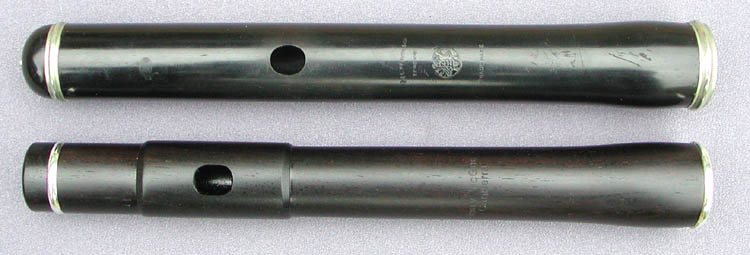
There are several complications in trying to determine a flute’s target pitch from it’s sounding length, and when you
combine them and try to generalize across a wide range of flutes with different designs, that renders the measurement
almost useless. Within a family of flutes that share common design characteristics, the measurement can tell you quite
a lot, though.
The first major problem is how to deal with the tuning slide. Some flutes were designed to play in tune with themselves
with the tuning slide almost closed, while others were designed to play in tune with themselves with it open almost 20 mm.
If you measure the sounding length of one of the latter flutes with the slide closed then you are going to be 20 mm off,
which represents a massive change in your estimated target pitch. For the measurement to make any sense you need to adjust
the tuning slide so that the flute is in tune with itself (not with an A=440 hz tuner) across the full range, and then do your
measurements.
The second major problem is that flutes with identical pitch targets can vary a lot in the length of the foot section below the
bottom vent hole. On a keyless, long foot, flute with two vent holes, the section below the bottom hole is acoustically irrelevant,
at least as far as pitch target is concerned. Even among flutes from modern makers targeting A=440hz, this measurement can
vary by over 10 mm.
Scale length measurements, such as Terry’s C#-D# measurement make a lot more sense, but even these have a very large
variation when applied to flutes with different bore shapes and tone hole sizes. To see this, take a look at some of the
American flutes in my here.
My Antique Flute Collection
On this page I’ve started to document some of the relevant details of flutes in my collection. You will see that the information
is not complete for the flutes lower down the page, and, in fact, I still have a lot of flutes to add to the site. But take a look at
the following flutes. These flutes are fully restored and playable, and I have been able to accurately determine the target pitch
by playing them in controlled conditons.
Geib: target pitch 430 hz, C#-D# length 263 mm
Firth Son & Co: target pitch 440 hz, C#-D# 260 mm
William Hall & Son: target pitch 440 hz, C#-D# 263
Cloos: target pitch 425 hz, C#-D# 257mm
Pfaff: target pitch 440 hz, C#-D# 256 mm
There is a large tuning difference between an A=440 hz flute and an A=425 hz flute, but the C# to D# measurements can
be almost identical, or in the case of the Cloos, it has the lowest target pitch and the shortest C#-D# measurement. Crazy,
eh?
The tuning difference is attributable to differences in the bore size and shape, and the tone and embouchure hole sizes.
This is why I think these measurement are really only useful when applied to flutes that are members of a narrower family
that share common design characteristics. It is not that the physics is wrong. Its just that accurately modeling real world
flutes is more complicated than most models, or simple metrics derived from them, acknowledge.