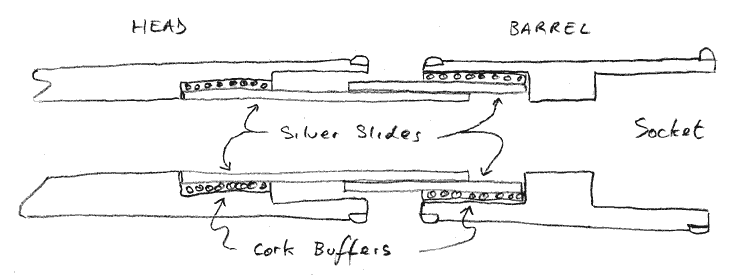
Having gotten over (at least for the time being) the trauma of getting that slide out, I thought to investigate what condition the head and barrel were in, so ran my usual leakage tests on them, using the Magnahelic Flute Leakage Detector.
As a reminder, the Magnahelic has a big meter marked 0-10. The meter registers 8.0 when completely open to the air, and 0 for completely sealed. A complete flute should show leakage less than 2.0, and preferably a lot less.
So visualise the head, now just a tube of wood with an embouchure hole in it. Plugging the slide end with a bung, and covering the embouchure hole with the palm of my hand yielded a reading of 0.4. That’s very good!
Removing the bung and inserting the nice shiny end of the slide (the wrong end!), yielded 5.4. Bad!
Swapping the slide around and putting the scored and dirty end in the head, 6.4. Even worse!
Wondering if I’d broken something, repeated the first test, still 0.4.
Then thought, aha, is the air sneaking along the outside of the slide/inside of the wood, because I haven’t any glue in there to fill that space? So I taped the outside end of the slide down onto the slide to block that exit. 2.4. Still too much leakage.
Remember the alcohol that I saw oozing out of two cracks in the head earlier on? I reckon one of those is opening up when forced apart by the slide. So, if I go on to fix it, I’m going to have to find and deal with those cracks, as well as getting the slide in securely.
And turning to the barrel, I get a dismal 7.6! That’s almost open air (8)!
Aha, the 6 cracks I mentioned. But taping up the outside of the barrel tightly only gets it down to 6!
Is it also leaking out around the protruding slide? Tape that down tightly, 1.5. So it’s still getting out somewhere.
This flute, being French, has one of those French metal-lined sockets which I seem to remember someone like Rockstro liking. I hate them! You’ll remember that cracks in heads and barrels are caused by the wood shrinking in dry weather, the metal liner not shrinking, so the wood splits. These metal-lined sockets add 3 additional places for such stresses to form. And they are really hard to get out to allow you to work on the cracks. So, I’m guessing that the lined socket is somehow leaking the air. There isn’t any where else, I have the whole barrel tightly taped up!
So, you can see the dilemmas that face the flute repairer/restorer, and cause us to wonder is this flute worth fixing? A glance at the body shows up a number of cracks (at each of the lined sockets!), a missing spring, a very bent key, new tenon corks needed, new pads ditto. And would need the tuning worked on.
And it will never be a work of art. The LH section in particular has a number of poorly patched bark inclusions, and a flash of sapwood.
But hey, what else can you do with an old flute? You’re not going to put it in the rubbish bin!
A retirement project, maybe?