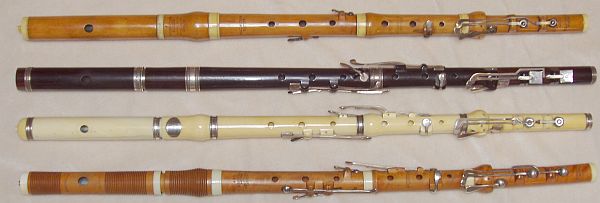
I’m about to order a new keyed flute and I’m sorely tempted by boxwood, because it’s lighter and just gorgeous. However, I’ve read on this forum and on a couple of flutemakers’ website that it is less stable and requires much more care, and that can be particularly problematic for keyed flutes. I know that Solen Lesouef stopped making boxwood flutes because of its instability.
I don’t mind putting in the extra care if needed, but I’d like to hear about other players’ experience with boxwood keyed flutes? Is it that bad? Am I just looking for trouble?
I heat treat the boxwood in the microwave which makes it much less prone to warping. This technique works on the same method as pre-shrinking fabric. It also helps to store the boxwood in a warm place and allow it to do all of its movement while still in the square form. For that reason I store most of the squares I get from Octopus in Turkey under the front hall bench of my house that hides one of the Radiant Floor manifolds as well as distribution lines running underneath it with water at about 105F running through it all winter. The pieces that eventually warp get cut into smaller sections like foot joints whereas the ones that stay straight as an arrow get used for the longer sections. I am almost out of pieces that allow for a one piece middle joint, so I will be doing mostly 2 piece soon. Once made, I am sealing the wood inside and out with a fine polyurethane sealer that inhibits any more type of movement. Thus if your maker uses these techniques and precautions, the boxwood should be fine.
I’ve read that others boil the wood. The 19th century and earlier makers would sometimes bury them under animal bedding from barns to cure. I haven’t tried that though I was tempted when we had a flock of sheep here. Apparently the ammonia in the bedding relaxes the wood. However, one sees many severely warped older instruments. I suspect these were commonly by makers who were simply less careful with the curing process. The issues we discuss here and alternatives such as Delrin are similar to ones the makers faced in the early 19th century. The Glass flutes by Laurent emerged because he didn’t trust wood, for instance.
The worst case scenario was a flute that I consigned at a fine woodworking shop downtown Portland that sold Krenov-inspired end tables etc. They stuck the flute in a spot where the forced air furnace grate blew onto it 24/7. The wood itself was probably not that well cured and this was before I learned about heat treating from Rod Cameron.
The flute turned into a banana with about that much curvature!
However, it still played. The sockets and tenons remained round and required no re-machining, even though the bore was ovalized in most places. The torture actually improved the tone. I took the flute back and gave it to someone who reports 35 years later that the flute still plays well.
Some minor warping is to be expected on all woods - even Blackwood. The trick is to use a padding strategy that allows for some dynamic changes over time. I essentially use a flat pad, filling the key cups up with resin if necessary and then placing a disk of some 2-3mm thick closed cell Neoprene that I cut from a larger block and carefully sand to proper thickness, leaving it just enough so that when it packs down, the key is level. Even if a key gets bent the pad will reassert itself to the new finger hole position. Blocks of Neoprene can be found at places that sell supplies for kayaking. I have one just up the road in Port Gamble conveniently - reminds me I need to restock there for all the keyed flutes I am sending out in February.
I too have a boxwood Burns that has been reliably stable. That is saying alot living here in Vermont with humid summers and dry woodstove heat in the winter. Thank you Casey for sharing your expertise in curing this wood. Of course, doing what you would do with any wood flute is a prerequisite, oil and humidify…
I think it depends on how the wood is treated and where you live. I have owned three boxwood flutes, the last one for years, and it has never warped. All three were made in very different climates.
Thanks everyone for your input. I live in South Korea, where winters are dry and summers are humid. I’ve never had any problem with blackwood flutes so far.
Besides warping, I’m concerned that the wood might swell and shrink as the humidity changes, and that the keys might not seal well as a result. I hear this is a common problem. I know that the maker I’ll get the flute from treats boxwood but I don’t think he seals the bore as Casey does. I guess I should just ask him and see.
I have had a Cochran 6 key boxwood flute for about 5 years in New York, with humid summers and dry winters. It is straight as can be with no warping of any kind and the keys all work perfectly. Terrific flute. I keep it in a plactic covered hamper with a small damp sponge inside when not in use.
I own a 6 Keyed San Murray in boxwood since 2010 and I have to say that it is completely stable wood.
No cracks, no bending or other issues.
I live in the South of Spain, a rather dry climate, and all I do is to oil the flute from time to time.
So my experience is pretty good with boxwood.
Regards.
S.
Theobald Boehm himself said that boxwood is more suitable as a material for building hygrometers than flutes.
I can easily believe a simple flute that still plays when taking the form of a banana, but when combined with the seal of the pad seats and the keys in their slots, this sounds like a gamble to me.
I love my 4-key boxwood flute in Bb (by Chris Wilkes), but I would hesitate to buy another boxwood flute.
It has never warped in the “banana” sense, but the tenons do go out of round and turn oval in the dry months of the year, and some of the keys get pinched in their blocks. I keep it in a Tupperware container with my other flutes to maintain some humidity–around 45-50%, which has worked fine for all my flutes for the past 25 years or so. I once lent it to a friend for a week during winter, which was a mistake: she left in a cabin that was heated by a wood stove and when I got it back I couldn’t put it together – the tenons had gone completely out of round. After a day in my Tupperware container everything was back to normal.
Post mounted keys such as what I use don’t get pinched in blocks and remain functional. As long as the wood at the sockets and tenons is sealed, and pre-compressed, these stay nice and round as much as Blackwood. Pre-compression is something I sometimes do to avoid tenon shrinkage which is a problem on Boxwood flutes sometimes, thread wrapped or cork wrapped.
There is a famous Sam Murray boxwood flute, known affectionately as ‘The Banana.’ On the other hand I have a Casey B boxwood C flute that remains straight as an arrow, after 15 years.
I live in the mid-atlantic US, which is pretty much the same. I’ve had quite a few boxwood flutes. I have one that ovalled, but the others, including a low-flute set from Casey and a keyed Olwell have been fine. The long-F on the Olwell was just a little sticky after a few months, but I consulted with them, and sanded the keyway a little (really little), and it’s been fine. I’ve had several keyed antiques, a one-key Cameron, etc., and not a problem. The one that ovalled was not from one of the highly regarded makers, although it’s a flute that I absolutely love.
ETA: it’s really simple to keep a flute humidified in the winter with a plastic container and cigar humidifier, so that really should be a non-issue.
I have a very old boxwood flute which hasn’t been played for some time now. I would appreciate any advice on bringing it back to “playing condition”, and especially as to which oil it might be best to use. Thanks.
I had a Murray 8 key in boxwood. I wouldn’t say banana but definitely took a bit of a curve in winter. I have never had any sort of issue with blackwood.


 .
.