I was just practicing just now and it occurred to me that something I saw in an earlier post was bothering me. I read, if I am right about this, that all of the air that comes through your lips goes down the hole and you should be able to put your hand out beyond the flute and feel no air blowing across. I am paraphrasing of course…but if I put my right hand out near the flute I can feel some air hitting my hand when I play for example a second octave G.
I think what was meant was that MOST of the air goes into the flute…is that right? I could sure be wrong about this. If I make all the air go into the flute I can’t make any sound but the sound of rushing air. I have tried to get 90 percent of the air to go in and I think I pretty much get that much…it is just a guess after all, but it is something that I have worked on and still do and I wonder what you guys have to say about this whole subject. I am still searching and searching for “that sound” you know…that one…
Jim
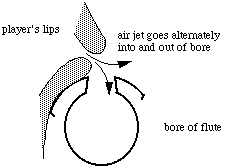
Yes, “some” is right. The far wall of the embouchure hole splits your windstream so some will go each way. Varying the angle will alter the sounds you can achieve.
(whoops, a collision! What he said).
He wins. He included a nifty pic and a link. 

John
…to more than you wanted to know
In a Scoiltrad lesson with Conal Ó Gráda he said he sends the majority of his airstream into the flute and only splits the top most portion on the edge of the hole. So if you want big, barking tone there is one way to get it. Whatever tone you aim for I would imagine you’ll always split your airstream more-or-less in that range.
seamusL, the advice should be, as I’ve seen it before, to try to tighten
your embouchure to focus the stream, minimizing the wasted air you
can feel going past the embouchure hole. You don’t want a bunch of
air going so far above the edge of the hole that it is not affecting the
sound. That’s a waste of breath, which causes you to run out of air
faster than necessary.
This is true. However, since I may well be the one who said earlier on that you should be putting all your air INTO the flute rather than evenly splitting your airstream on the far edge of the embouchure hole (as you would on a silver flute), let me point out that obviously that statement cannot be taken literally. Why? Because the only way you could put ALL of your air into the flute would be to place your lips entirely around the hole and blow into it, and of course then you’ll get no sound at all. What is meant by saying you should “put all your air into the flute” is that this is how you should direct your airstream - into the flute, not across the edge. Of course the stream will still be split across the far edge to produce the sound, but most of the air will actually be going into the flute. The test of putting your hand out in front of the flute is a good one, because if you’re doing it right you really should not be able to feel much if any air on that hand.
Keep in mind that there are two aspects of the airstream that need to be developed in order to get the best sound: direction and focus. You want a tight stream of air, not a wide-splaying one. Think of the opening in your lips as the nozzle at the end of a water hose. If you’re feeling air on your hand, it could be because you have a good tight stream but your direction is off. Or it could be that you have good direction, but your stream is not focused and therefore air is splaying out over the top. Figure out which of those is your problem, and then work to fix it. Remember your goal, which is to place a tightly focused stream of air into the flute, as much as is humanly possible without surrounding the hole and blowing directly into it. Use the sound you get as your primary guide, and the hand test as a secondary guide to fine-tune it.
Denny, that really is a good link! I went up there and read some and then put it on my favorites list so that I can go back later for more.
Fearfaoin you are right, I know because I can play longer passages now than I could eight months ago…has it been that long? Wow, I am getting to be an old timer. The most important thing for me now is the focus of the airstream that is why I needed clarification of the idea of all the air going down the pipe so to speak. Johnkerr I know that what you were saying meant that ya gotta have some air going over the top just not much I mean that only makes sense. I have used your idea of putting your hand out in front of the flute to good advantage and it has helped me get a more focused airstream for sure. Some days the tone isn’t as good as it was maybe yesterday and each time by putting my hand out in front I have discovered that sure enough the airstream is not right. Sometimes I can fix that right away and sometimes I have to wait for another day. Aaron, the tone I am looking and looking for is the tone that is me…It is who I am, or perhaps, at this point in my playing it is more like…Who am I? Today was a great practice…I don’t know why but I heard hints of what I am looking for, strong hints…I have hope!! Of course there is always tomorrow when I will sound like you know what! Ha. It is the journey that is the thing right and I keep saying that over and over and over…
With the understanding that I am about to open a can of worms, here, let me say, here, on a Chiff & Fipple thread, that chiff is very much optional, on a cross-blown embouchure.

well…that’s more than you can say about the fipple

Anyway, when the air is directed “down” into the flute, you are realy trying to get a perfect split…it only seems like it is all going down into the flute but half of the active jet is curling around the outside of the head…you just don’t have any more “wasted” air going straight out. (Of course, you might have “wasted” air going down the barrel of the flute, but this seems to be less of a concern and tends to modulate the sound and add some energy)
Blowing down is the way to make the tone flatter.
Chiff, moreover, can be optionally produced, as an airspeed attack, as to blow downwards at a faster airspeed while tonguing, all while remaining in tune.
Please, on this thread, however, say nothing to the whistle players, as apparently their chiff is more or less built in.
Did you mean “optionally” or “optimally” ? (sorta like my spelling)
I suspect that the tone is flatter because the air stream curves more deeply into the bore…longer path to the edge. Chiff increases because of the now shorter direct path to the edge (I think..in any event I see stronger harmonic content on the spectrometer…Syaku8)
Yes, as an embochure secret, one can increase tonal strength, or volume, provided one both blows harder AND directs the airstream further downwards, all while remaining in tune, no less! Conversely, a softer volume can be had by blowing more softly, while directing the airstream more upwards.
Shhh…Once again, please do not speak of just what whistle players could be missing.

Oooooo! Hadn’t thought about the second secret ! (Secret secret ??)
OK, let me also admit, please, that such technique does take some practise.
OK, let me also admit, please, that such technique does take some practise.
Worthwhile, I think…
PS: let me put in a plug for M. Eskin on YouTube…I’m practicing Garret Barry’s w/ him in the other half of the brain as we converse…