Hey  So i just recieved my first penny whistle from Jerry Freeman, a beginners to start on. (btw, thank you again a thousand times)
And now comes to what music would you rec for a beginner? I obviously can already read music, going to have to learn fingerings.
Ideas Thanks
Emm
How about The Mirepoix Polka?
T:The Mirepoix Polka
T:Polka de Mirepoix
C:Traditional
O:France
M:2/4
L:1/8
K:G
DG FE|DB B/A/B|cA AG/2A/2|Bc d2|DG FE|DB B/A/B|cA AG/2A/|BA G2:|]
|:dB Bc|dB BA/B/|cB AG/2A/2|Bc d2|dB Bc|dB BA/B/|cB AG/2A/2|BA G2:|]

Um, this may sound really stupid… I get the first line, but what does the rest of it mean starting with O:France…??? I don’t understand 
Ah. Sorry! It is a tune in ABC Notation - the short lines set parameters for the notation - if you’re going to get involved with this scene, it is well worth finding out about ABC - lots of old posts on it here on C&F and plenty on the internet in general - just Google it! Or go here - which will give the answers to your question far better than I could if I tried to set about an explanation. There are vast internet resources of tunes in ABC, so it is worth finding out about.
Meantime, do you read standard music staff notation? If so, I can post the “dots” as an image for you. Or you can find out about ABC and paste the notation I gave above into an ABC programme to see the conventional notation… &/or hear a MIDI “performance”. If you don’t read any music notation, although it is perfectly possible and very desirable to learn as much as possible by ear, some form of notation (and the ability to use it) is really very useful as it opens up those vast resources I mentioned. You don’t need to get to orchestral sight-reading standards, but being able to decode a notation and transfer it to your instrument sure is handy!
EDIT: ooops - just re-read OP - I see you do read staff notation - OK. coming up!
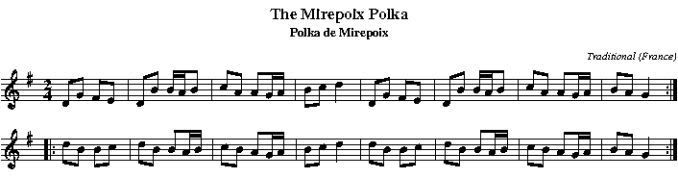
alright ill look up ABC, sorry i just haven’t seen anything written like that I Read standard notation (bass cleff and treble) as well as have fairly good (but not so good english ) ability to sight read and play by ear.
I think she’s already an orhcestral standard dots reader. Is that right, Mirepoix? Meanwhile, Mirepoix, find yourself “concertina.net” on the interweb, and copy and paste the whole thing, from the first of those T: things into it’s abc conversion thingie (is it called something like the “tune-o-matic” or something?) and it will produce the dots for you, on screen and printable.
You’ll like abc’s when you get into them.
Cross-post, but hopefully still helpful …
[My note passed the above in cyberspace]
Copy the following text:
X:1
T:The Mirepoix Polka
T:Polka de Mirepoix
C:Traditional
O:France
M:2/4
L:1/8
K:G
DG FE|DB B/A/B|cA AG/2A/2|Bc d2|DG FE|DB B/A/B|cA AG/2A/|BA G2:|]
|:dB Bc|dB BA/B/|cB AG/2A/2|Bc d2|dB Bc|dB BA/B/|cB AG/2A/2|BA G2:|]
Go to http://www.concertina.net/tunes_convert.html Paste the text in the box, hit submit, and play the music…
Best wishes.
Steve
AH, that helps Thank you! Is music on staffs called “Orchestral dot system” here? never heard of it called that, but then again never heard of this either. Thank you for the help and patience. I have started my investigation of how to read this w/o the translator
Meantime, I’ve been having an argument with Photobucket to get the image at a sensible size… “dots” ( a common English music-slang term!) now posted into my previous post above.
Comments about usefulness of ABC stand, though! J’espere que ca sera util.
(Just to hammer home the point about usefulness of ABC, that staff notation image was generated in the ABCmusicEdit programme by writing the tune out in ABC…
Oh yes, and Mr Hall above - very much an orchestral standard dots reader - used not to see the point of or like ABC, but is now a convert!!! )
Wow, i am way out of my league here i am afraid but eventually will get it, just bear with me
lol i don’t think ABC is commonly used over in the states… since i have NEVER seen it before… but shall learn anyways
I understand (maybe not fully, but somewhat) the use of ABC, but up to this point, never needed/seen it. Thanks for the help One more thing i get to learn on this conquest 
And anymore song ideas are great and Thank you very much Jem for it, and nice title, very fitting
oh and another question that i should know. A Key-D Pennywhistle can only play in the Key of D without transposing correct? or in the 4th with a slight alteration.
You could always use my link creator so
newbies can easily see the sheet music
that goes with the ABC.
Click here to see the ABC as Sheet Music
ABC is common on the Internet no matter
what country you’re talking about. You
don’t see it off the Internet too much
(especially with all the mark up tags like
X:1) but it comes up in traditional settings
when teachers want to teach a tune quickly
to people who may not read music. ABC on
the Internet became a way to pass music
using text back when Internet connections
were too slow to pass graphics files around.
You can use many programs to translate it
into sheet music instead of reading it directly
(see the link above, which uses concertina.net’s
Tune-O-Tron ABC converter).
Believe us, ABC is VERY commonly used in the States - for this kind of trad music - which is what it was developed for really, though it has wider application and developments… The majority of members of C&F are probably from the US, and almost all of them make use of ABC and its resources.
As for what keys and modes you can fairly easily access/play in on a D whistle, there’s loads of old posts here about that too - try using the board search function with appropriate key words.
One finicky note, though, you play TUNES on a whistle, not “songs” ( though you may well play the tune of a song sometimes!) that current generic use of “song” to mean “item”, “piece” “track”, “number” or even “tune” is really, really horribly annoying!
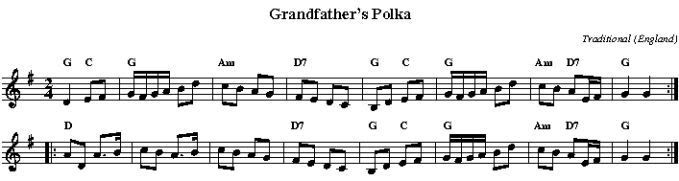
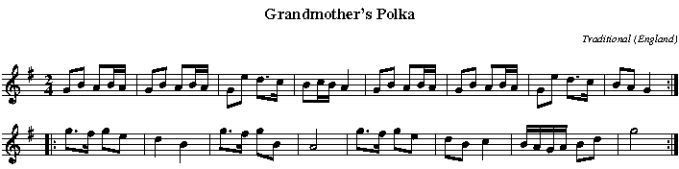
Many years ago Ben (benhall1) and I used to play together, and we had this old set of polkas, starting with The Mirepoix and followed by two old Gloucestershire (English) ones which we learned as Grandfather’s and (possibly wrongly titled but by extrapolation/association) Grandmother’s. I played them (and still occasionally do to this day) on whistle, though I usually take them (mostly) up an 8ve (except for the B music of the last tune). They are simple enough… just play each one 3 times through with all repeats as written (just in case you don’t know that yet, repeats are always observed in trad music, unlike Classical, because the correct number of bars is necessary for any dancing). Here they are:
Oh, sorry. Lol, ok so i guess i just haven’t heard of it before, since i have mainly been more into saxophone and jazz discussions, rather than traditional, and the sites i have been on frown upon passing music from one to another since generally the songs aren’t old enough to be out from under their copy-write.
And i will try to remember about the “songs.vs.Tunes” thing. whats the difference between the two? If you play a Tune, which i am taking it to mean a piece of music, and Song means a a piece/item/track, aren’t they the same thing? both referring to a piece,track, item of music that you play?
Songs have words. Tunes don’t.
To most folk here - and to everyone until about the last 5 years! - “song” meant exactly that - a song of whatever genre, with words and a vocalist… it excluded (and still does, really) any purely instrumental item, even in the pop field. But latterly it has come to be used (irritatingly) as a synonym for those other words/usages I mentioned. Grrrr!
Thing is, in popular music in the broad sense, there aren’t very many non-vocal pieces - pure instrumentals are rare. In folk/trad music, (dance) tunes are at least as big a part of the repertory as actual songs, so keeping the distinction is functional. Most of us here would be puzzled by someone referring to a tune we had just played as a “song” when there was no singer and no lyrics. Most of the dance tunes are not and never have been associated with lyrics, but the melodies of many actual songs are not uncommonly played separated from their lyrics as “slow airs”.
fearfaoin slightly misses his mark in that, of course, songs do have tunes! But if you play a song’s melody without the lyrics/vocals, it isn’t really a song any longer, is it? (And we won’t get into Mendelssohn’s Songs Without Words!!!)
Mirepox…
It’s good to know a little about ABC, but you have plenty to deal with in learning the new instrument. So you may not want to spend any real time on ABC. Since you can read music, there are plenty of sites on the net where you can find actual sheet music. Look at http://www.thesession.org where you will find hundreds of tunes. Nearly all of the tunes there are written simply without ornamentation, so its easy to learn the basic tune and add the “fun stuff” later. If you run across a tune elsewhere that you like but can ONLY find it in ABC notation, you can run a program to convert the ABC to standard notation.
Good luck…
Ok i got it Sorry didn’t understand the difference, and will do my best to not foul up, but if i do… im sorry
and thanks Blazer for the encouragement and site. I figure that I will just start with easy son…tunes! i know, that i will take apart bit by bit to learn fingering, which shouldn’t take to long since the fingerings are the same as on sax except 2 of them, at the same time learning my embouchure and breathing. That shouldn’t take terribly long to get the basics.
Then ill add in terminology, different tech/styles, the ABC notation and so on at least thats the plan…
I am amazed that on a forum like this nobody mentions that one can learn music by ear, by listening, that one does not necessarily need dot music (abc or staff music) in order to learn to play the whistle. I think most people learn to play whistle just by learning by ear. And if one is interested in Irish traditional music (you did not say that, Emm), then i think the best and first advice to a new beginner is to start listening to other players, and learn from them. If you can read sheet music already, then learning by ear may be double important. Lots of people coming from a background of some classical music training find it very hard to learn by ear. But it is an essential skill to develop.
As to looking for tunes on thesession.org: again I find this rather dodgy advice to a beginner. The tunes published on that site are often of questionable quality, and I would not recommend the site as a tune resource for beginners.
I did, Hans, I did! - In my 2nd post in this thread…
.
Did you actually read the whole thread?