In true Iron Age fashion, you should make one yourself. That’s what they did back then. They did not go to the Internet and ask someone else to do it. Go kill a large animal, eat the meat and then hollow out the long bones and make some holes. Why re-enact when you can act?
You could work on the scale using any number of tone hole calculators and use PVC as the tube. You just need the frequencies of the notes. Heat up the PVC or otherwise soften it and flaten the ends to look more like a piece of bone. You can search digiridoo making sites for methods on doing that. If anyone asks about your pipe, tell 'em it came from a unicorn and it’s rare stuff. My flute selling days started out in the faux unicorn horn trade, then moved on to Ressikan flutes, etc. What’d that guy Barnum say?
LOL, that’s what I said when she asked me earlier Unfortunately, I’ve got a ton of reenactment items to make from scratch and we live far enough apart that I can’t easily get the raw materials to her.
I suppose this is where I play the nitpicking pedant and point out that you can’t have a European Iron Age transverse flute. They didn’t exist in Europe until the Middle Ages, having traveled from an easterly direction. But if you want to be authentic, maybe you could wear a sari or something.
A transverse bone flute with the bulbous joint ends intact like you’d just yanked it out of an aurochs? This is a comedy act, right? I guess that would fly, but in that case I think you should aim more for the Mesolithic or earlier in your sartorial approach. You know, like fake fur boots, raggy pleather loincloths, and dirt. Like that.
Cave bear? Aurochs? Those would make some really big flutes. I’m thinking deer would be pretty easy, though some of the examples dragon posted said they were swan bones, so perhaps goose would work too.
You could try Corwen, here, although I believe he is a bit busy, what with just getting married, and all. (Congratulations, Corwen!)
I have a bone flute from Corwen, and it plays nicely (once you know how). He’s made a few in different sizes, but I haven’t seen a transverse one. If there’s a good reason why it’s not possible, Corwen will be able to tell you.
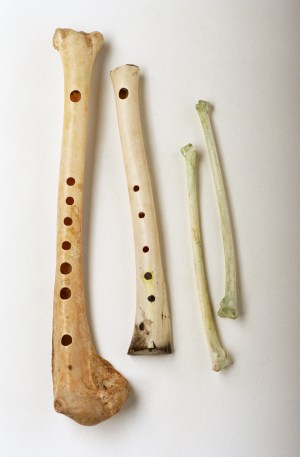
These deer bone flutes are accurate working reproductions of medieval bone flutes, made here in the workshop by Helen Leaf of the Leaf Trading Post. She has studied the archaeological examples as research for her PhD.
The deer bone flute is second from the right of the photo, and has five front toneholes.
If you’d like to know more about bone flutes, we have an article that was published in the Galpin Society Journal - this gives good general information about medieval bone flutes. When the website allows, this will be available as a free download. In the meantime, if you’d like a copy get in touch and we’ll send one to you (thanks to the Galpin Society for allowing this). The full reference for this article is on our info/downloads page.
Due to natural variations in the shape of the bones, each flute has a different and unique sound. We like our customers to try serveral flutes and choose the one that suits them best - if you’re coming along to any of our shows and want to make sure we have them with us, let us know.
I would love to win the lottery , quit my job, buy a house with a heated work room, take lessons from flute makers, and start making Iron age flutes to my hearts content! Sadly, I have not won the lottery nor have the time or space for a flute makeing studio. Just spending enough time to play them and contune searching out infomation about Iron age topics is all I can muster while earning a living so I can pay for the former, and little side things like food, and heating oil. So, I am trying to find a flute maker who can make one- a nice well playng flute, then I will set about playing it until my fingers bleed!
WoW. You are a rude one. Transverse bone flutes did exist during the bronze age - but I’m guessing you did not know that or care. Don’t bother replying to my posts.
It’s an interesting article, and thanks for that. But I’m not sure it makes as strong a case as you think it does.
Depictions or mentions are not necessarily evidence of endemic use, only awareness. The Greeks and Etruscans (via the Greeks) borrowed from the eastern cultures of Ionia, Asia Minor, the Levant, and Alexandrian east, and the Greek examples are sourced as Libyan and Egyptian, not European. The mirliton is typically Asian. That the fistulae specimens are “Roman” could mean anything - African, Mesopotamian, etc. - without footnotes. And even some transverse presence in isolated classical era loci says little about earlier use in preclassical Iron Age Europe north of the Mediterranean - typically the focus of Iron Age Celtic, Germanic and pre-Indo-European reenactment.
The article’s author acknowledges a huge 1000 year gap between these possible early examples and medieval use: “Transverse flutes appear not to exist as archaic folk instruments anywhere in Europe.” With, once again, an eastern vector to medieval Europe, this time via Byzantium. He also calls the Eurasian transverse flute a case of Asian monogenesis with, in effect, late diffusion to Europe.
So while the classical examples may be, technically, a valid quibble, Nano certainly seems correct in suggesting that the cultures associated with the vertical bone flutes above would be unlikely to have used transverse versions of those flutes, if authenticity is an issue.
I could say Dragon’s got no sense of humor, but I can admit just as well that an injudicious lack of smileys did that for me all on my own. I’m willing to call a truce on it.
The Bronze Age record is indeed revealing and food for thought. In any case, if it’s to be a transverse bone flute, I wouldn’t go with one with knobby ends if I were the one reenacting. Just my two cents, mind.
 Why re-enact when you can act?
 What’d that guy Barnum say?
 Unfortunately, I’ve got a ton of reenactment items to make from scratch and we live far enough apart that I can’t easily get the raw materials to her.

 , quit my job, buy a house with a heated work room, take lessons from flute makers, and start making Iron age flutes to my hearts content! Sadly, I have not won the lottery nor have the time or space for a flute makeing studio. Just spending enough time to play them and contune searching out infomation about Iron age topics is all I can muster while earning a living so I can pay for the former, and little side things like food, and heating oil.
  So, I am trying to find a flute maker who can make one- a nice well playng flute, then I will set about playing it until my fingers bleed!