I must say, I was hoping that this one would have gone up to 5000 at least. All ivory, silver ornated key, all in great conditions, that’s pretty rare.
just a guess: the reason could be this one “Le diapason est à 438 hz, diapason standard à Londres à la fin du 18ème siècle.” Still great instrument for that price…
Does ivory sound particularly good? Curious.
I’ve read otherwise, though certainly don’t know.
Sounds lousy most times, IMO: Very narrow frequency response, biased towards the high end, blech. I cringed every time someone would pick one up in the shop to play 
Fermanagh Player James McMahon played an ivory flute, see the tune The Ivory Flute.
Did he also compose the Banshee? At least I think hes the Mcmahon refered to in its alternate name.
An all-ivory flute creeps me out. Would never play one. Just seems wrong to me.
And about McMahon’s Reel, I met an Irishman who insisted that McMahon’s is its proper name and would not countenance the other incorrect name.
Ivory seems such an unstable material. . . .
Bob
As are most woods,  We had a lot of Ivory where I worked, including a number of instruments that were solid Ivory and had been around for years. Didn’t seem any less stable than, say Boxwood, which was our main material. I’d say Ivory is more stable than Boxwood in fact. Less longitudinal warpage and less affected by changes in humidity in general.
That said, Ivory instruments are just wrong considering how the material was/is procured. I wish people would stop buying it (new or used) and products made from it, significantly reducing demand is the only way poaching will be further reduced. So, personally, I’m glad to see that flute sold so cheaply.
That said, Ivory instruments are just wrong considering how the material was/is procured. I wish people would stop buying it (new or used) and products made from it, significantly reducing demand is the only way poaching will be further reduced. So, personally, I’m glad to see that flute sold so cheaply.
I agree when talking of new stuff (is it even legal???) but that ebay flute is an antique, it belongs to a different world and therefore IMO it’s subject to different rules nowdays.
You’re right, of course. But Loren has a point. The demand for ivory doesn’t necessarily make a nuanced distinction between new and old. As long as old ivory continues to sell because it is actively desired (and not simply because there’s nothing we can do about old ivory now), the demand for new ivory will continue to be stoked.
I haven’t worked with Boxwood. However, I have worked with Ivory, Old Ivory only. Both Marine and Elephantine. I’ve had to repair several Ivory heads, and currently have on hand a couple of old Nach Meyer flutes with Ivory heads. Every one I have encountered in person has cracked through shrinkage.
True enough, I have also seen Boxwood which has cracked through shrinkage. but I have also seen Boxwood which has not cracked. Warpage is a different matter, again. For my money, Ivory is less stable.
Bob
Ah, but isn’t the same essentially true of the old flutes made from Grenadilla and Cocus? Those head joints are mostly all cracked too.
I agree, Ivory is unstable, I just don’t see at as being significantly more or less so than the more common materials generally used for the purpose in question. I also suspect as a contributing factor that the same care with regards to seasoning wasn’t applied to Ivory as it was to wood back in the day. Has anyone (Terry? Dave C.?) run across any historical literature regarding the seasoning/drying/preparation of wood and/or Ivory that was employed by the major flutemakers of the time period in question? Unlikely the large scale flute makers laid in a 30-50 year supply of wood and Ivory like my former employer, and I also wonder about what processes and time frames they used for “resting” between steps in the production process. But I veer off topic a few degrees here, forgive me…
You know far more on this topic than I do, Loren, but isn’t grenadilla (what we call African blackwood) relatively new to flutes (and the most stable, as far as I can tell) - as opposed to ebony, which was commonly used for Baroque period flutes, and highly unstable/brittle. Or is grenadilla and ebony the same tree? Just asking for clarification.
Agree wholeheartedly with your comments on ivory - a market for the stuff - be it antique walrus or pachyderm - will only increase the market for the poached stuff. Same with so-called “mammoth” ivory - as if there an endless supply of that out there, and the consumers could really tell the difference..
Seems to me the faux ivory plastics serve perfectly well, and are a more stable alternative for our purposes, in any case.
A quick note in passing -
Much of the ‘ancient’ ivory used in instruments was acquired from mastodon finds in upper Russia. This was particularly true of piano keys and billiard balls. Don’t know if it was also used for flutes, but I’d imagine it found its way into the sideblown world as well.
Ed.
I think Sam Murray has quite a few of this billiard balls and uses them for endcaps and bottom rings (see Harry Bradley’s flute).
You are, of course, correct Gordon: Ebony and Grenadilla are indeed different species of wood. And I should apologize for being less clear than I meant to be about expressing what I was thinking: By saying “Old Flutes” I was thinking both of historical flutes as well as the “new era” flutes that have been around quite a while now - up to 40 years or so for some of the “New” makers - where we’ve seen a fair amount of cracking with the Grenadilla. My point being of course that all of the main tonewoods used by flute makers over the years have been proven fairly unstable. I didn’t think to include Ebony as no one (to my knowledge) is currently using it much, while grenadilla, boxwood and cocus are still utilized.
All of that said, I honestly can’t say with any certainty how much, if at all, grenadilla was used in older flutes as I haven’t made a real study of it. Mostly we see what appears to be ebony on the baroque flutes, and then Cocus on the later flutes but I have seen Nach Meyer flutes, for example, that sure look like grenadilla to me, and from an allergy standpoint I react to it the same way  .
.
At any rate, good on your for pointing out the distinctions Gordon, I really wasn’t clear enough in my initial post. Probably hadn’t had that second cup of coffee yet.
Loren
Yes, I guess I thought you were referring to ebony when you included grenadilla as unstable. Not a nit-picker, usually..  But to my mind and albeit limited experience, grenadilla is far more stable than boxwood, maybe cocus; can’t say for “newer” woods like mopane. Still, if you react badly to it, may as well be downright fragile…
It might be useful then to define what “Stable” means for our purposes of discussion then. The stability of a material with regards to woodwind making is, for me, defined by the following factors:
-
Stability Lengthwise: Does it tend to warp from top to bottom, the way we often see boxwood do?
-
Stability around the bore Eccentrically: Will the piece warp or “Oval” in that way that makes the tenons not fit into the sockets properly?
-
Stability around the bore Concentrically: How much will the wood shrink/contract around the bore axis in the way that causes all the headjoint cracks on flutes with metal linings?
-
Ability to resist stress: How much shrinkage concentrically can the flute resist before cracking? Plus, how well can the wood tolerate differentials in moisture content - which is to say, if you pick up a flute that is relatively dry and play it for an extended period, will it crack?
-
Stability of the grain of the wood Vertically: How much does the grain “raise” over time as the instrument is played causing the previously smooth bore to become rough which impacts tone and playability? Also does it absorb so much moisture the tenons swell an inordinate amount causing ill fitting joints?
To the woodwind maker these should all be considered important measures of stability as they all impact the how the instrument functions over time. Every wood has various proportions of the qualities listed above, and all are inherently unstable it’s a matter of picking your poison so to speak.
Some Examples:
Boxwood: On the downside, it can be very warpy, particularly when not properly seasoned and stabilized properly. It also tends to swell an awful lot when played for long periods. Again this can be largely mitigated if the proper precautions are taken during the design and making of an instrument from the wood. On the positive, Boxwood tends to maintain a very smooth bore if the instrument left the shop that way. And it is very much more resistant to cracking than Grenadilla, Cocus, most of the rosewoods, and many other woods.
Grenadilla and Cocus ( lumping them together for our purposes because they are very similar): These don’t swell or warp much (cocus I think swells a bit more in my limited, pre allergy experience), the grain of the bore stays very smooth if well finished initially, but over time this wood is highly likely to crack if used over any sort of metal liner. Some may say “Not so!” for Grenadilla, but I have seen lots of cracked heads and barrels by current makers, much of this no doubt due to poor seasoning practices, and a few makers are a bit notorious for their poorly seasoned wood, but still, we’ll see plenty of cracked Grenadilla headjoints over the years - hear me now and believe me later  (SNL reference for those old enough to remember Hans and Franz) Also, Grenadilla is nowhere near as resistant to cracking when played dry as boxwood is. I know of more than a few instances where someone cracked a perfectly good grenadilla instrument by playing it for an extended period after the instrument had been sitting for months or years unplayed. I have yet to hear of this happening with a boxwood instrument, although I am not saying it can’t happen.
Mopane: Seems pretty stable in general but (in my limited experience) it swells a bit during play and the grain in the bore tends to raise quite a bit impacting the sound.
Dogwood: Similar to mopane in that it stays straight, but it swells quite a bit, at least as much as Boxwood making for rather problematic fit of socket and tenon joints. Also the grain of the bore does raise some over time, not so much as Mopane but still, I find the swelling enough to impact tone unless the bore is re-reamed or sanded smooth.
So for me, Grenadilla is a fabulous wood for woodwind making, but it has as much instability overall as any of the other woods. Grenadilla’s instability is just heavily weighted in the negative with regards to shrinkage concentrically and inability to handle the stress of radical moisture content differentials.
Anyway, that’s where I’m coming from on the subject of stability and tonewoods. I was lucky enough to work at a shop that had used many different woods over many years and we got to see an awful lot of those instruments for regular services of cleaning, recorking, crack repair, thumb bushing replacements or adds, etc., so I got to see how those instruments held up over time. We kept a detailed record of every instrument made, so I was able to look up every instrument by serial number if I wanted to check the exact age, pretty cool, not to mention informative! In addition the owner of the shop had an extensive collection of antique woodwinds (many I never even saw) and basically what I came to understand from all of this is that over long periods of time, all instruments are going to have some problems regardless of the natural material used. Poor design and/or execution tends to contribute to more problems, but in the end I didn’t see grenadilla instruments faring any better than boxwood instruments. YMMV
Loren
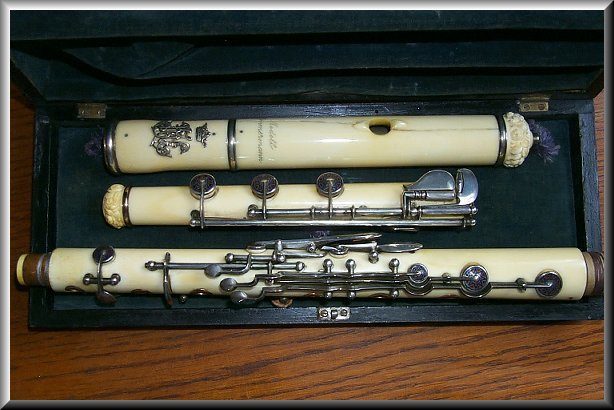
“What a lovely flute! What is it made of?”
“Mother-of-Billiard-Ball.”
Nice one Nano…!
Just thought worth mentioning, Adrianne Greenbaum playing klezmer music with a flute that has an ivory headjoint:
http://www.youtube.com/watch?v=TCNr2sBWFqI&list=FLR0VjQtndMa-OZL7fM7SosQ&index=32&feature=plpp_video