A dramatic 6-year-old tries her hand at shoveling snow

I like that name! We call them beer mats, though my granddad told me they originally went on top of the glass rather than under it, to keep out insects and so on.

Then they became an advertising device. They’ve become unusual now, possibly because they’re not the most hygienic things. Their main practical application always seemed to be the levelling up of wobbly tables or use as short-range frisbees, though they were also collected by people who like ephemera. I imagine another reason they’re vanishing is that they’re quite an expense for breweries to supply.

I guess smartphones means they, split through, are no longer the go-to way of noting phone numbers, tunes etc. Backs of fag packets being in shorter supply as well.

I always roll my eyes when a character in a TV show borrows a phone and promptly taps in the number. It’s 30 years since most people knew their families’, friends’, and work numbers off by heart.

All of that with a couple of exceptions: They’re not vanishing around here; my bar always has stacks of 'em. Apart from the fool’s errand of keeping the bar’s surface drier, the local practice is to put the coaster atop your drink when you’re off to the conveniences, and while insect stoppery is built in, the main purpose is to notify one and all that you haven’t relinquished your seat, and you’ll be back shortly to address the drink waiting beneath. Interlopers violate this convention at the risk of their good standing. It’s also a help to the bartender who has to keep an eye on things; the less prudent have had their drinks stolen or even spiked by the unprincipled - not common practices, but I think we’d all agree that once is more than enough - so the coaster’s a bit of added defense when your friends might be distracted. Sure, the coasters eventually become nasty, and even in a dive bar I suppose hygiene crosses people’s minds from time to time, but apparently not that often; if you don’t like yours, toss it and get a fresh one. They’re biodegradable, and never in short supply.

They’re not called “beer mats”; they’re beermats - one word (source, Chambers and the OED). And I think your granddad is pulling your leg. They were, literally, originally invented precisely to be a disposable coaster, and were introduced to the UK by Watneys in 1920 - as coasters, and in order to advertise their products.

And they’re certainly not disappearing around here. Pubs have huge stacks of them. They’re everywhere.

They go back much further than that. He was born at the beginning of the 1880s, and worked as a youth in a well-to-do hostelry that used decorated tin-glazed pottery beer covers, which doubled as mats. I doubt they were a new invention even then. The village alehouses where he, his parents, and his brothers would go to drink themselves used paper or card covers/coasters. Someone presumably saw the advertising potential and the modern version was born.

You occasionally see really old, unusually wide ceramic coasters with upturned edges in junk shops, and it’s likely some of these are the beer covers he was describing. I only ever saw granddad use an ordinary tea saucer to keep stray ash out of the tankard on the hearth, but of course it was the 1960s and 70s by the time I was old enough to remember his reminiscences. I wish I’d listened more attentively to someone who saw the transition from horse-drawn carriages to supersonic passenger aircraft, but of course kids never do.


Edited to add: the reason for my granddad nattering on about beer-related things was that his son, one of my uncles, was a landlord for quite a while. I suspect he got quite a lot of unsolicited fatherly advice about what was wrong with the way he ran his pub.

Ah, well now. Yes, those were a different matter. I wasn’t talking about them. I was talking about beermats, which are specifically the cardboard thingies. They’re relatively modern, although they started in Germany a lot earlier than here in the UK.

I’m trying to remember the last time I was in the thick of a flying disposable coaster battle. Generally you’d see it when things are quiet, the regulars are desperately bored and building steam, and the tourists are elsewhere. Bartenders tend to show mixed feelings about it, naturally; on the one hand, patron morale is good, but on the other, there’s the cleanup, not to mention that you can’t ethically reuse coasters that hit the floor, and that’s going to be most of them. We’ve always tidied up after ourselves in the aftermath, though.

Maybe an awareness of the waste of it has taken over. Such are the times…

Okay, I just had an exchange with another friend and I asked her if she understood “Beer me.” She didn’t right away, because she’d never heard it. This was perfect, because it was an opportunity to test my claim that in context, any Yank should get it. Presented with that context, she got it right away and said that the “Give me beer so that I may drink it” message ought to be obvious, and for the British as well. “Don’t count on it,” I replied.

Both sides of the Pond speak the same language, but it’s nominally, I would say, because the thought processes often prove very different in our vernaculars.

I still don’t understand - or trust - the phrase, and I would back away slowly from anyone who said it to me.

And on my end I keep harboring the nagging thought that you Brits must be pulling my leg! I’m sure that given a broad enough sample of Left Ponders I’ll find someone who doesn’t grasp the rhetorical concept, but so far, no. It seems to take no prompting at all. To us it’s hearty, supremely informal, humorous, and - to British confusion, apparently - devoid of confrontation. It is only a request that one be served, and its intentional disgrammar signals that one will not be putting on airs (the truth of which must remain to be seen). It’s lighthearted, and suggests high spirits. My above friend’s take, which is entirely in line with that even though she’d never heard it before, seems to reinforce this tendency of shared meaning. And in my query I was careful not to lead her, but let her arrive at her own conclusions. I would reiterate that I’ve heard the phrase enough for it to be cast as canonical Left Pond vernacular. Whenever it’s been said, no one was confused, and beer was duly proffered, completing the social exchange as Heaven intended. How is it, then, that despite not having previously heard it, she fully - and independently - understood it in the same way? What I can say with confidence is that in decoding it, the context is everything. Without that, it’s meaningless. To us there’s nothing complicated or arcane about it; it’s quite simple. Child’s play. The only thing complicated about it is in my having to explain it.

But I’m discerning enough not to utter it if ever I found myself on the Scepter’d Isle. Especially now. :slight_smile:

Maybe ‘ me’ is a more commonly used construct with you folk, but not common enough for us to have noticed.

Yeah, I’m pretty sure it’s a mostly, if not exclusively, Left-Pond thing. I Googled the words “beer me”, went looking for images, and found scads of them with the phrase:
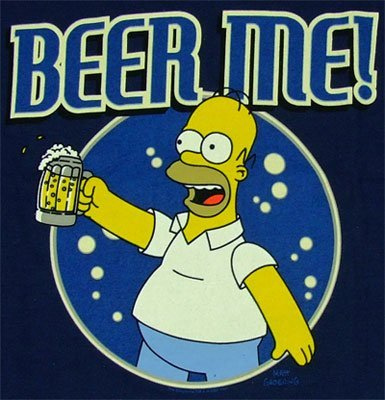
Totally captures the spirit.

But remember that while in theory we can permit ourselves to say “[verbnoun] me” for a lot of things, in practice it’s overwhelmingly applied to beer. The phrase has become sort of a cultural artifact in its own right.

Ask yourselves, Right Ponders: Given ordinary circumstances, why would I ask to be assaulted? It makes no sense, and is therefore way off base as a conclusion. I invite you to open your minds to a new perspective. Here’s another, semi-related example of US vernacular that might arouse confusion in the UK, but doesn’t to those familiar with it: In the US, when playing at cards and you need a new one for your hand, it’s common, especially in an energetic game, to say to the dealer, “Hit me.” In no way is this a request to be physically struck - it only means “Give me a new card” - yet the words are far more akin to that than “Beer me” ever was. Said in the card-playing context, violence doesn’t even enter my mind one bit, much less that I ask for it; I’m just asking for something other than what it conventionally sounds like. Vernacular can do that, after all. We also say “hit [someone] up”, which means to make contact, as in this exchange: “We should hang out more.” “Hit me up!” Of course it helps if you know that “hit” has several admittedly energetic meanings in US English, “give (me)” being one of them in certain circumstances - but context, my friends; context. Not everything requires it, but it’s not to be left out. Just because a vernacular phrase initially conjures a certain image for those who are unfamiliar with it, it doesn’t mean that that image is right, nor all that’s available. Context goes a long way in determining meaning when we’re swimming in vernacular waters. “Hit the hay (or sack)” is a commonplace for retiring with sleep in mind, and in no way does it mean pummeling plant matter (or bags). “Hit” here could be thought to suggest throwing oneself on the mattress (signified by “the hay” or “the sack”), but it’s purely by chance; here “hit” only means “go to”, and many other formations will have this meaning as well. And I’m sure we all know “hit” in its meaning as a popular success. In a situation where something can be started, “Hit it” serves as an urging to begin, let fly, get going. It serves in popular music contexts, and others such as starting, and especially accelerating, a vehicle. We also say “punch it” for acceleration. “Hit the road” means to depart, and by extension is a way to say, “Get lost.” I would agree that these “hit” forms do suggest figurative impact: a new card is an important thing, and the road is depicted as being met with the percussion of a solid step. “Where the rubber hits the road” suggests tires and, well, roads, but unlike “hit the road” on its own, it means that point at which something is put to the test. The tire isn’t suddenly making contact, but rotating, and where the rotation makes contact - the point where it “hits” - is where things matter and the truth is told. In all of these the notion of impact is rhetorical, and nothing more. If I’m announcing my plans to go out for a drink, I would easily say that I’m going to hit the pub. Very colloquial. Does it mean I’ll walk up to the building and strike it? Please. The very incongruity of the image should tell one that a different, more likely interpretation is called for, and that it’s probably time to entertain the figurative. Or just ask. Don’t look to strictly conventional meanings for guidance. “Hitting the sauce” means one has been overdoing their alcohol consumption, not giving the marinara a thrashing. “Hitting the books” is a tad more prosaic in that it means study time; the books’ welfare is not in question. There are others yet in this fold, but I hope you get the general idea, if not an intuitive understanding which is probably too much to ask for without exposure. :slight_smile:

Continuing the topic of “hit” as slang, here’s a new one for me: “Don’t hit my line.” A few days back I heard a song with this as its title - I’d never heard it before although it’s not recent - and initially I was brought up short by the phrase, but not for long: I put on my Yanklish hat, and correctly surmised that it means “Don’t call me (line = phone).” It’s US street English of a sort that I don’t speak, but it has all the elements of the vernacular I do speak, so in the end the connection wasn’t all that difficult. I imagine its opposite, “Hit my line” (call me), is also in use.

This is one that I wouldn’t expect anyone in the UK to decode on their own.