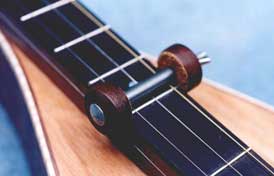
Attending the NAMM show last weekend, I happened to stroll by the Shubb exhibit, and I stopped in to look at the newer anodized aluminum Lite capos in fancy colors. I’ve always liked Shubb and have 4 or 5 Shubbs in various models.
While chatting with the rep, I pulled my trusty old Shubb out of my pocket and told him I’ve had it since around 1982, long before they started putting Delrin caps on the adjustment screw. Even the other rep came over to look at my antique.
“Would you like a Delrin cap?” he asks. “We can retrofit one.”
Off he goes with my capo, and a minute later returns with a brand new Delrin cap fitted. “Enjoy!” he says.
Now, I know it’s no big deal, it’s only a $1 part. But this kind of little gesture can make all the difference. These guys obviously care about the quality of their little product and were very proud that my Shubb has held up after 30 years of constant use.
I shouldn’t have been surprised. The last time I called them because I needed to replace a rubber sleeve, they stuck 3 of them in an envelope and mailed them to me for free.
So yes, sometimes I use other capos, especially my Quick Draw. But Rick Shubb and his crew get a special MTGuru thumbs-up for their consistent service and for making and supporting products that, unlike so many things in our throw-away world, are really meant to last.
It’s interesting to compare the above with my experience at the Kyser booth, which I also stumbled upon. There, the rep was demoing their various partial capos with the piston lever to fret the un-capoed strings.
Now, I’ve played with partial capos for years, and the pistons are kind of cool. But I know how to finger un-capoed strings either at the capoed fret or behind the capo. Which I told him. Instead of listening to me, the rep seemed more interested in convincing me that I had a non-existent problem for which he had the solution. And he especially frowned when I described turning the Kyser capo upside-down to capo 3 strings with the white neck cushion. “Capo abuser!” I could hear him thinking.
Kysers are fine and have their place. But the different attitude is … interesting.
That is interesting. I do use Kyser’s Quick change capos. They are convenient at times. I’ve come to think of them as throw away capos. And they do make quite a few models. I have a couple of the regular full bar type as well as the drop D, double drop D and “short cut” which does cover just three strings (open A tuning? and varients). Oh, and their banjo/mandolin capo can act as a short capo on a guitar too. And yes you can play behind the capo on the open strings (or sound sympathetics behing the capoed strings). Did they even realize that was what you might be talking about?
But the Third hand hasn’t struck me as something I can bond with. I have talked with players (like Phil Keaggy) who use one or more of them to do remarkable things with tunings. It beats retuning or carrying several guitars with them. I don’t play out as much as I did when I was younger but I’d rather have a couple guitars with me strung to the different tunings.
Have you seen these?
Probably don’t work farther up the neck. But it’s another idea.
I like Shubb’s stuff. I play squareneck lap steel too and their steels and squareneck capo are with me all the time. I’ve tried to engineer a better squareneck capo and I just keep going back to the Shubb.
Dulcimers can be tough, IME, because the uniformity of design is not what it is for guitars. Most of the Mtn. dulcimers I run into are hand made, usually by the player with a wide variety in fingerboard width and string height. So you’d have to test these with your instrument but the Folkcraft and Ewing capos are all I’ve seen out there. Both are similar capo designs.
You can easily make one too. People used to use spool clamps that luthiers used to fix mandolins, violins and guitars as capos. Basically take a dowel ( 1.25" to 1.5" diameter) and cut two sections maybe 3/4" long. Drill a hole in the center of each. Cover one end of each with felt. Run an appropriate bolt with a smooth shaft through the pieces and secure with a wing nut. You can cover the bolt with vinyl tubing if you like. Voila!
Now, in the spirit of full disclosure, in 40 years of dulcimer ownership/playing I have never once used or desired to use a capo.
Guitar players have it easy. Just take a dowel (or pencil in a pinch) and a strong, short rubber band and you have a capo. Been there…
I’m usually the first one to pooh-pooh yet another hairbrained new magic capo design that will make you smart, good-looking and popular. But this is actually pretty cool. Simple and obvious. And you can use your own favorite capo.
Of course, you can get many of these patterns by using multiple partial capos, especially if you include a configurable Third Hand capo. And I wonder how much the plates get in the way, preventing you from playing behind the capo. But I’d definitely be willing to try this system before passing judgment.
Oh, and I’m still puzzled at the Kyser reps. Using the Kyser Quick Change upside down is SOP with guitarists but Kyser’d probably prefer to sell a Short Cut instead of admitting to that. I’d bet that’s where the idea for the Short Cut came from. Even their on-line videos talk about using the Short Cut in the manner MTGuru describes. But the standard capo does pretty much the same upside down.
I’d be interested in hearing how folks here use multiple capos. I have used partial capos but haven’t gotten to a point where I felt the need for muliples. I guess if you need to change the drones to another home key that would be a reason.
I caught that bug after seeing David Wilcox perform for the first time back in the very early 90s. I remember thinking something along the lines of “no wonder I couldn’t figure out how to play that.” So I did what he did. I bought a few regular Kyser capos and fired up my grinding wheel. Those are the ones I still have and use occasionally. But John is right, Shubbs really are the best out there. I was on a quest to find better at one time. Spent a lot of money …even bought one capo that cost around a hundred bucks. Nothing was as good for me as the Shubb.
When I watch CMT, I notice Kyser Capos. I’m not seeing other capos but Kyser Capos do have a much more obvious profile. So maybe other brand capos are on CMT and I just don’t see them.
Maybe they just didn’t have their first string rep at NAMM.
And I’ve said this before but I’ve only had a Shubb in my hand once and for the life of me, I couldn’t figure out how it worked. I can figure out how a Kyser works. I’ve only shot them a short distance. I’ve seen other folks shoot them across a room a couple of times.
There’s really not much to figure out, mute. Set up is a bit like Vice-Grip pliers. You put it on and screw it down tight. Then take it off and give the screw an extra twist. Then it just snaps on and off.
I’d guess Kysers on CMT is a case of what may be common is not always best. That is, gigging musos often compromise on equipment choices and sacrifice musicality for the sake of practicality.
The popularity of acoustic-electric instruments is a good example. Piezo pickups usually sound like crap unless they’re carefully pre-amped, EQ’d and processed. But compared to the hassles of dealing with tricky microphone placement and feedback night after night in unpredictable acoustic environments, the convenience of just being able to plug and play may win out, especially when your audience doesn’t really care. The net result is an army of crap-sounding A-E instuments on stages everywhere.
Kysers are easy. They need no adjustment anywhere on the neck; just clamp 'em on. Stick them on the headstock when not in use, no pocket required. Never mind that you can’t adust the tension, and the rubber is too hard, so the effect on intonation is often dreadful. Or that the capo is butt-ugly with its completely superfluous baroque curl, and looks like a hideous dragon on your headstock - where it will ruin the finish of your headstock if you keep doing that. Practicality, you know. It’s good enough.
The ultra-soft rubber of the Shubb and its adjustable tension mean that you’re much less likely to mess up your intonation. And that’s a huge deal, especially for more open tunings like DADGAD. It’s also very unobtrusive, which may be why you haven’t noticed it as much. And with a tiny bit of practice it’s just as easy to do one-handed quick changes. And if quick changes are your main concern, the QuickDraw capo is a far more elegant solution than Kyser or Shubb - again, if you’re willing to compromise intonation.
The next time that I am at my Luthier’s new shop, I’ll ask him to show me what is going on. He’s dealt with my cluelessness before. That was nice to know about the difference in rubber. I like the shape and the colors of the Kyser capos.