I would like to find an online finger chart for a chromatic 10 open hole simple system flute. Skip Healy makes such a flute in various keys, but the link to his finger chart doesn’t seem to be working. I have a Broadway musician who is using several of my flutes for The Lion King. He has asked for a 10-hole chromatic high C flute. I’m trying not to reinvent the wheel.
What configuration do you want for the the holes? I don’t know if there is a standard 10 hole fife or flute.
I remember McDonagh fifes having a configuration (I think) of
T L1 L2 L3 L4 R1 R2 (double hole) R3 R4
I think Healy’s fife has a second thumb hole, and doesn’t have the double R2 hole.
I don’t know how Ralph Sweet’s 10-hole Enfield Model is set up.
Anyway, I couldn’t find anything under “10-hole finger chart fife” either.
Skip’s link to his 10 hole fingering chart was non-op last time we went around with this.
hows about
D  TXXXX TXXXX
Eb TXXXX TXXXO
E  TXXXX TXXOO
F  TXXXX TXOOO
F# TXXXX OXOOO
G  TXXXX OOOOO
G# TXXXO OOOOO
A  TXXOO OOOOO
Bb yer fork or mine?
B  TXOOO OOOOO
C  OXOOO OOOOO
C# OOOOO OOOOO
I have modified a whistle or two using the F#/FNat fingerings as below:
D TXXX TXXX
E TXXX TXXO
FNat TXXX OXXO
F# TXXX ?XOO (Usually leave the R thumb down since the whistle was designed to work this way and it keeps the whistle a bit more physically stable.)
The above arrangement means that if you leave the thumb down, then the whistle plays like any other whistle - which is very useful if you ever want to pick up non-modified whistles… For a classical player then it is probably a matter of which tone is more important, Fnat or Fsharp. Note, if the player wanted one in C, does he mean that all fingers down should be C? In which case we are talking about E or Eflat being the notes affected by the thumb hole. Then it is a question of which of those two tones is more imortant to the player.
Also, there is a choice of whether the Left thumb is for Cnatural or Bflat. I thought (though I have not seen Skip’s fingering charts, nor had one of his in my hands) that the Skip healy 10 hole flutes used the Left thumb for Bflat and cross fingerings for CNat (like any 6 hole keyless…). My modified whistle used the thumb hole for CNat since that is how I play my other instruments. Bflat can fend for itself.
Note, on the whistle I found that I had to tape up the Gsharp and Eflat holes since I had problems covering them. Maybe some better thought out offsetting might have got my left pinkie to reliably seal the hole, but I couldn’t make friends with the arrangement.
(The whistle in question is a Sweetone of no great intrinsic worth dedicated to experimentation, though I have added a CNat hole to one my better whistles, which works well.)
My goal is to make a 10-hole chromatic flute where the finger assignment for the diatonic notes are the same for the index, middle and ring fingers as they are for the standard six hole flute. This way you could adapt an existing flute (with some modification of the existing holes), and the the flute would play in a similar fashion to your other non-adaptied flutes or whistles. The right hand thumb postion may be a little problematic for the large flutes, but for small flutes I don’t see a fingering problem. The following is my idea of the fingering for a high C flute. Anyone see any problems?
C (D) XTXXX XXTXX
C# (D#) XTXXX XXTXO
D (E) XTXXX XXTOO
D# (F) XTXXX XXOOO
E (F#) XTXXX XOTOO
F (G) XTXXX OOTOO
F# (G#) XTXXO OOTOO
G (A) XTXOO OOTOO
G# (Bb) CROSS FINGER/HALF HOLE
A (B) XTOOO OOTOO
Bb (C) XOOOO OOTOO
B (C#) OOOOO OOTOO
From my experiments, I would say that the open G# (on a D flute) is the hardest hole to place in a reachable position. Other than that, Doug’s fingering looks ok. Except, that his C# (B) may or not be better with the thumb hole closed? But that is something the player can choose later.
naw…‘cept maybe Chris’ recorder fingering 
Chris has a point that the G# is not very playable with the left hand pinky for larger flutes, like the low D flute. For larger flutes the G# can be fingered with the thumb of the right hand. Depending of whether you prefer the D# or the F as a fingered note, the layout of the holes could be as follows:
D XTXXX TXXXX
D# (E) XTXXX TXXXO
E (F) XTXXX TXXOO
F# XTXXX TXOOO
G XTXXX TOOOO
G# XTXXX OOOOO
A XTXXO TOOOO
Bb XTXOO TOOOO
B XTOOO TOOOO
C XOOOO TOOOO
C# OOOOO TOOOO
Just some thoughts. For most of the simple system flutes I have played (including a couple of Baroque flutes and some keyed flutes) I have found the following to be more or less constant:
- Eb/D# is hard to get unless you have a key
- a solid Fnat is very hard to get unless you have a key. Some flutes can be half holed, but not reliably. Baroque flutes are a special case, and even then you are talking about a veiled sound…
- G#/Ab is somewhat achievable as a cross fingering, with some flute being quite solid, and others less so.
- Cnat and Bb/A# are usually pretty solid cross fingered.
Now, in the case of the Tipple D that I have, I find that the Fnat is not too hard to half hole, and the Eb is somewhat achievable. If I was in a destructive mood, I would try taking my Tipple and drilling an offset G# hole for my LH pinkie finger, and an offset Eb hole for my RH pinkie, and then see whether I could then comfortably hold the flute so I could use the RH thumb hole for Fnat.
Perhaps one could use an “acoustically inefficient” small/high RH thumbhole to get a tolerable Fnat, or, set up the holes so that you have a solid Fnat using the standard Baroque cross fingering, and use a small RH thumb hole to help vent a very flat F# up into tune?
Now that I am messing about with a couple of Bach flute sonatas on my 8 key and a one key flute, I have found that many of the more challenging passages are easier to work through with the baroque flute than when using the keys. To the point that in some cases I am trying out some variations on the “keyless” fingerings on the keyed flute…
Note to Doug. If you could figure out a way to alter your basic flute so that it would work with baroque fingering (using a RH4 for the Eb/D#) you might find a nice market in the Baroque flute world.
Watching this with great interest.
Clinton
…never touched a recorder in my life - or at least not in the last forty years. I like the idea of whatever modifications one makes leaving the original 6 holes unchanged - then one can always block up the holes again if you want and it is not totally impossible to play on non-modified instruments.
I didn’t mean that there was anything wrong with borrowing a fingering that had been thought out and used for, ah, weeks by countess dozens. 
I also make no claim to originality…
Doug - check private email.
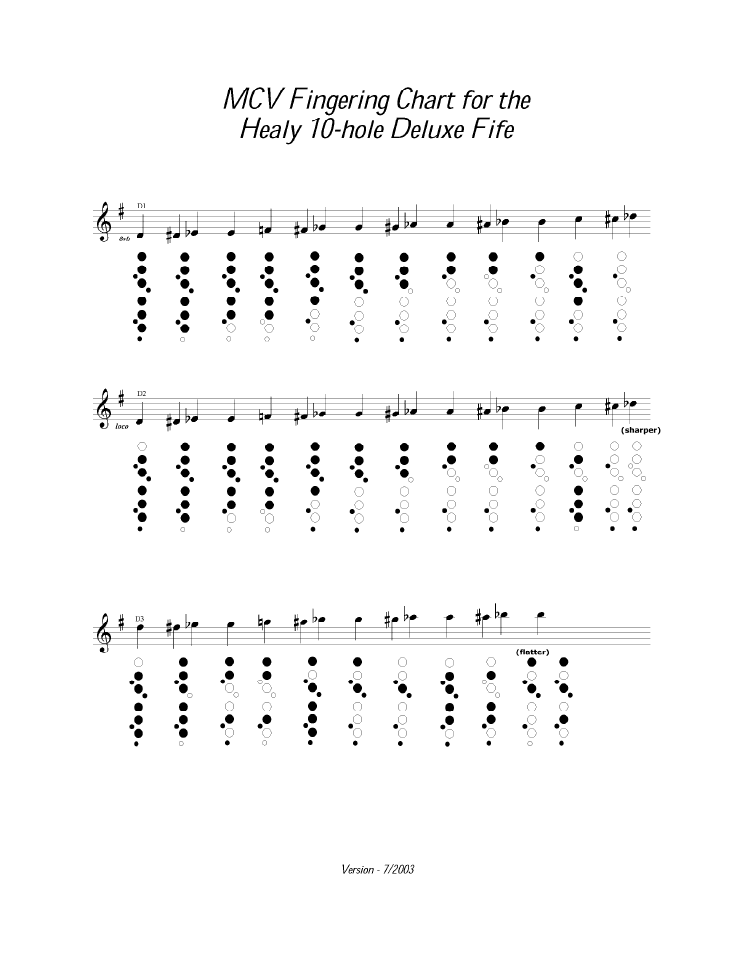
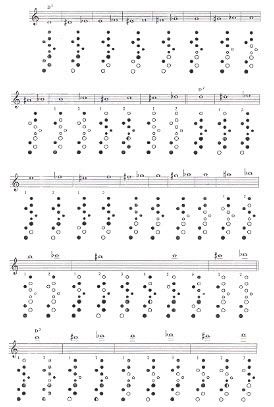
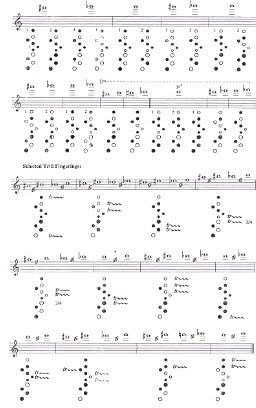
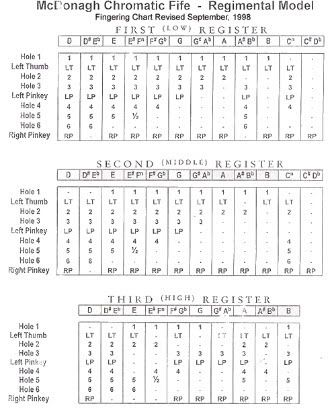
Two people have sent me fingercharts for the Healy 10-hole fife and the McDonaugh 10-hole fife. I am sharing what I have received below. BTW, my first experiment with a 10-hole flute/fife in high C was successful, although even though I am using the same fingering for the regular six holes, it will take some practice to manage all 10 holes. Notice where Skip Healy places the left hand thumb hole (between L2 and L3). I used what I consider the standard position for the LH thumbhole (between L1 and L2). I’ll see if I can make the small photos larger.
ya aitn’ foolin’ me Doug…
Skip spent a lot more time on that than I did! (‘bout 3 minutes, while the burgers were grillin’)
besides “Ctrl +” ? (Firefox anywho)
should go okay
Yes, Healy puts the thumb hole between L2 and L3. I play a Healy ten-hole fife. The Healy layout makes sense to me. I’ll try to explain why. Let’s use a D flute as an example.
Because I have played whistle and simple system flute for many years, I am very much accustomed to playing a half-holed C nat, or with a cross fingering. Many flute designs give a strong note with a half-hole Cnat. Same for cross fingered C. It’s the one note players have to either half-hole or cross finger to play all of those tunes in G. A thumb hole is not a “standard” hole for the Cnat, IMO. The Cnat hole on my keyed flute is not activated with my thumb. The Cnat thumb hole makes no sense to me in that frame of reference.
The Bb hole is another story. Is that really the Bb? It doesn’t come up as frequently as the C nat, at least not in traditional music played in the keys of D and G. You can half hole it or cross finger Bb. The results are not always as strong as the Cnat note though. The Healy thumb hole gives a strong and stable Bb. And yes, I do have an Bb key of my keyed flute. And that key is activated by my thumb. So that is “standard” to my mind. Is that making any sense?
Anyway my point is that the Healy layout has a lot in common with my keyed Irish flute.
Now the instrument I am playing is the ten-hole Healy Bb fife. It’s a smaller instrument in the flute realm, relatively speaking. The upper hand thumb hole is not placed on the back of the flute but more to the side near my face. It’s comfortable for a Bb instrument but not where I would place that hole on a D flute which would be more in line with where the touch of my Ab key is on a keyed flute. But that touch is no where near where the tuned Ab hole should be. So I am not sure where the ergonomics work best on the larger ten-hole flute. Geeze, keys just make so much sense.
Feadoggie
Since I posted this inquiry about a 10-hole flute fingerchart, I have been busy thinking about and making 10 and 11-hole chromatic flutes. The photo below shows what I have accomplished thus far. I soon will have a page about the flutes at my website. A couple of flutes in the photo look like they are closely related to the banana family, but actually they are all straight. The low D and G flutes do not have a hole for the half-tone above the fundamental. I need to think about keys for this. The other 3 flutes are fully chromatic. All of the flutes can be played as standard 6-hole flutes by taping up the chromatic finger and thumb holes. Please send me an email or PM if you have questions about the flutes.
