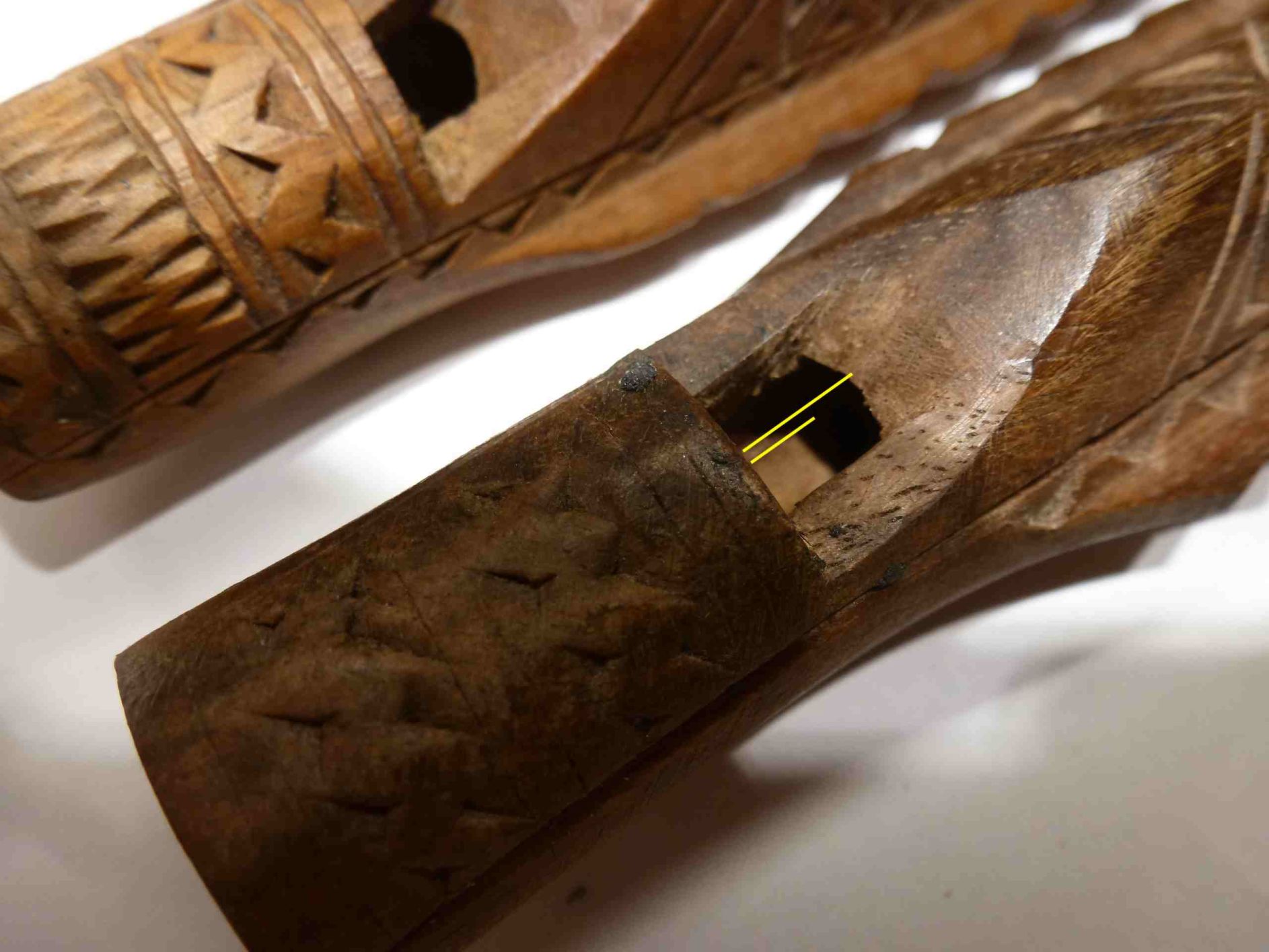
I have two intricately carved wooden whistles. They are more exercises in carving than serious whistles, but that’s not the point. I didn’t make them, but bought them for a very small amount of money.
One plays, roughly in C#, and I can get a scale out of it. It’s sort of playable.
The other, similar but a bit shorter, doesn’t play at all. It looks similar, the lip looks OK, I replaced the plug and played with the airway size, but if anything made it worse. I cannot get a single note, not even a squeak.
The only difference I can see is that the distance from plug/top of airway to lip is about 1mm more. Moving the plug deeper makes no difference. The lip height with respect to the airway looks much the same as the other.
It’s only for fun, but is there anything glaringly simple I should be looking at?
Yes, look for an air leak in the tube. Could be the size of a pin hole but can make a wood whistle unplayable. Look at the carving for a place where it may go through to the inside of the tube. There are also some woods that are so porous they leak all over it. Then the wood needs to be propely sealed.
Look at the direction of the air stream leaving the windway, relative to the sound blade. If the air all goes above the blade or below the blade … no sound.
A crack is a good possibility. I just repaired a Glenn Schultz C whistle which had a barely visible crack and wouldn’t make a sound. Filled, it plays like gangbusters.
Could you take some close up pictures, particularly of the sound producing region?
Some progress.
The bore is 11mm, length lip to end 10.25 ins and overall 11.75 ins.
No holes, no cracks, wood doesn’t seem porous.
It has a few issues. The mouthpiece end is rotated with respect to the body, which makes it hard to align the plug with the lip. The airway is in the plug. The beak is definitely out of shape.
The airway may have been too wide, allowing air either side of the lip. The top of the plug was flattened off to make the airway, it looks like it needs a channel instead.
The top of the airway is level with the bottom of the lip, the lip may be a hair’s width below it. The other whistle, which does play, is very similar though.
I made a temporary extended lip with a lolly (popsicle) stick and with some experimentation was able to get a fairly clear note, not sure what it was though!
Thanks for the hints so far. Don’t think I can attach images to a post, will investigate.
Honestly, I’d use those as decorations but not spend a lot of time getting them to play. Go ahead if you want to for fun, but you’re not likely to ever get them to play well. They are quite attractive as display pieces.
Thanks for posting the images. It looks like someone else has either worked on it or that whoever made it also tried to make some adjustments. They seemed to have an issue with the blade and continued to cut it until the “window” became too large. The “window” is the area between the plug and the blade. The issue then with playing it is that it is impossible to add more material to the blade.
I haven’t made many whistles, but if I remember correctly if the window between the plug and the blade gets too large, the whistle will not whistle.
(I need to search some stuff and see if I have good pictures or more explanation somewhere about this.)
In comparing the windows, the one that doesn’t whistle has a substantially larger window. I’ve drawn yellow lines comparing the two. To me, it looks like I can see where the blade originally was. Additionally, the blade looks a bit rough. They probably had to cut that much away in order to get the correct angle for the blade; however, it is my understanding having that large of a window doesn’t allow for good solid air flow for splitting the air-stream on the blade.
Width of a whistle window will determine volume, and length will determine strength of the two octaves. It is simple enough to add to a blade, or replace then reshape. Finding the compromise length comes from experience.
Prior to trying to replace the blade, would it be worthwhile to put a temporary bit of plastic on the blade, extending it to where the rebuild might go—not dissimilar to what some of the “tweakers” do to modify a factory produced whistle, just to see if the effort would be worthwhile?
(Just counted, that sentence contains 53 words. Run-on much?)
Yes. The thing has crossed the boundary between cosmetic and music.
A ceremonial instrument was never intended to play.
I would square the ramp-edge to get a decent sound.
The wind-sheet created by the mouthpiece demands a flat edge for the vortex to form.
It is true the the wind-sheet has a slight curvature, but not that much.
But it is a lot of thinking and work to calculate the curvature from the windway exit to the ramp.
I would slowly reduce the curve with knife or file until a 2-octave sound appears.
After that, I would work on the height of the wind-sheet and how it spreads to the ramp.
Play with it. Then play upon it.
11 mm is difficult for the bottom notes - but achievable.
From the photo, a good instrument might be had from it if you can accept big pressure gradients between 1 and 2 octave.
Work with the curve. It’s complex.
The one that works takes some care to get into the low octave, it’s fairly quiet but they are never going to be session whistles. I haven’t tried to get the full range of notes out of it.

 Educational. perhaps.