I’ve got a d/c Jerry mellow dog blackbird combo that I’m delighted with. I’ve got a number of Gen Bb tweaked and stock that are ok but I prefer the d/c whistle sound. I’m looking for recommendations for a G or F alto that would be an extension of the d/c combo. I like a little chiff, no raspyness or excessive breathiness, some back-pressure and a strong lower end/bell note - more of a smooth sound. I won’t be using it for sessions so low volume isn’t a problem. And I don’t want to pay a lot for this muffler - any suggestions ? TIA.
If I were you I’d contact Guido Gonzato either through his website or this list. His PVC low whistles are as you describe and low cost. You could also use the plans on his website to make your own if you like.
ecohawk
Ecohawk - made a few of those but they came out poorly - suspect my pipe being different diameter, may try again.
made a few of those but they came out poorly
… Guido’s finite dimensions are good, but unfortunately only for the size of pipe he uses. He also quotes “percentage of length” dimensions which are good for pipes of different diameter. Simply cut your pipe obviously too long (maybe an inch or so), then once you’ve got the whistle end whistling a nice bell note, trim the pipe to your chosen bass note then drill your finger-holes from there. One at a time, lowest note first, start out small and enlarge a bit at a time until it’s in tune … then on to the next 
The nice thing about making your own instrument is that you can position the holes (within reason) to suit your own hands
If you can get couplers for the tube you are using, any major drilling mistakes can be recovered simply by cutting a new tube for your whistle-head (the bit that takes the time to build), also, of course, you get the opportunity to make two or more bodies to fit the head … or experiment with differing head designs for pre-tuned bodies … or even make a side-blown head and play it as a flute, should you wish 
Kypfer - I made about 3 Bb following guido’s plans, I was able to get them in tune but I found them very breathy and the bell note was weak, no matter how long I made the window. I love to build stuff but I got real frustrated with the above. The idea of being able to build good sounding whistles in different keys at a low price is a dream ! But still out of grasp for me.
I found them very breathy and the bell note was weak
… if you’ve still got them around, try modifying or replacing the fipple block with one that has a sloping upper surface, the object of the exercise being to “squirt” the air up against the sloping edge more efficiently. One of the limitations of the “concentric tube” style of whistle head, IMHO, is that the windway is not optimally positioned in relation to the blade edge.
A second (or additional) option is to extend the windway cover to include the window, then cut the window through both thicknesses of plastic … this definitely makes the tone much more “mellow”. You may not like it, but it’ll be different 
Another thing I’ve found very important is step 5 in Guido’s instructions:
you should see a hairline of space just below the lip - say, the thickness of two or three sheets of paper…
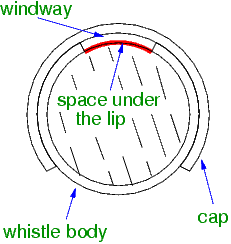
It may be that the bottom of the windway is too high, and most of the air is going across the top of the window, instead of hitting the lip.
Shade the window, and peer through the windway with the end pointing toward the light, looking for a sliver of light under the lip. Turn the whistle around and peer up the other way, looking for a sliver of light above the bottom of the windway. If you don’t see that sliver of light, try sanding the fipple block until you do.
Keep at it, the dream is within reach.
If you don’t see that sliver of light, try sanding the fipple block until you do
… probably as good a piece of advice as you’ll get
I feel there is insufficient emphasis on this aspect of the design … leaving the fipple-block totally concentric with the pipe is a mistake I made initially, with disappointing results. The “trick”, for want of a better term, seems to be to get the flat-spot on the fipple-block, ie the floor of the windway, JUST as wide as the window at the window end, but a bit wider at the other end, so it looks trapezoidal from above and slopes slightly upwards towards the window.
I believe this induces what is termed “the bernoulli effect”, which is an acceleration of the airstream and apparently a “good thing”, but I’m not an expert in flow dynamics 
The issue illustrated by Tunborough is well worth looking into but personally I don’t think you have to go the point of making flat surfaces for the windway floor. Of course it’s fine if that’s what you like to do for your design. Lots of geometries will work. The piece of wisdom is certainly that you have to direct the wind sheet to the blade to split the airstream. And there are several ways to do that. The GG whistle design is the simplest way to make things work - everything concentric. Bear with me here for an explanation regarding what Tunborough brings up.
I order to make the GG whistle design work the floor of the plug has to be the same diameter as the bore of the tube or ever so slightly smaller. What I have observed in helping a number of folks make whistles to GG’s instructions is that they are frequently not as patient as they need to be when they fit the plug. It’s exciting to finish your first whistle right? So you sand and shape the plug until you can get it into the tube. One problem is that the tube has had a slot cut into it for the windway and when you place a slightly oversized plug into the tube the pipe expands a bit to accept the plug. And as Tunborough points out that leaves the windway floor high and the edge of the blade low in relation. Of course the outer collar just expands to fit over the while thing so that doesn’t help either. Not a good situation! A little more sanding/turning and measuring brings things down to the proper level and then with a very slight bevel on the plug edge at the exit of the windway makes things work.
What I suggest is fitting the plug to the tube before the windway slot is cut to help keep the pipe from expanding as you make it fit. That way the size of the plug is more likely to be in line with the blade. Undercutting the blade a tiny bit can help too.
Just my observation.
Feadoggie.
That works for me too. I like undercutting the blade last so I can hear the subtle but important difference it makes.
Thanks for the tips guys, I’ll start another one tomorrow. I also went back and re-read Guido’s instructions - I missed the part about using thicker pipe and the suggestion about using a narrower window - will try all tomorrow - again - Thanks.