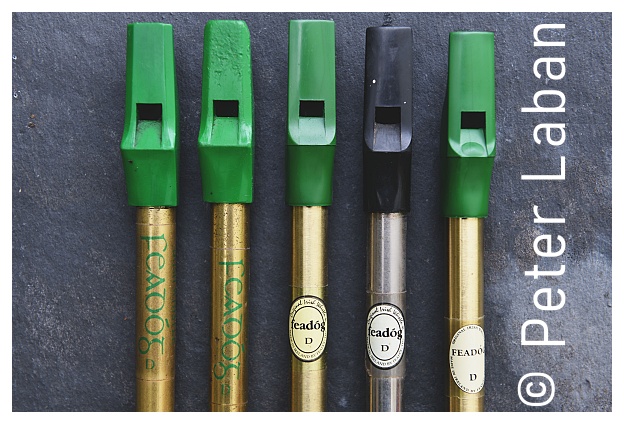
I took the liberty of copying your great photo there and making up designations for the various head designs I think I’m seeing.
I’m calling the original head with the pointy corners in dark green 1A, and in lighter green 1B.
I’m calling the head with clipped/rounded corners and a flat ramp 2A, and the same but with a blister on the ramp 2B.
The cylindrical head I’m calling 3.
Actually I don’t know the chronology of those heads, I’m just making up numbers.
Does anybody know the actual sequence?
BTW I’m following the head designs rather than the stickers.
The important question is “how do they play?” My 1A is my favourite, what’s yours?
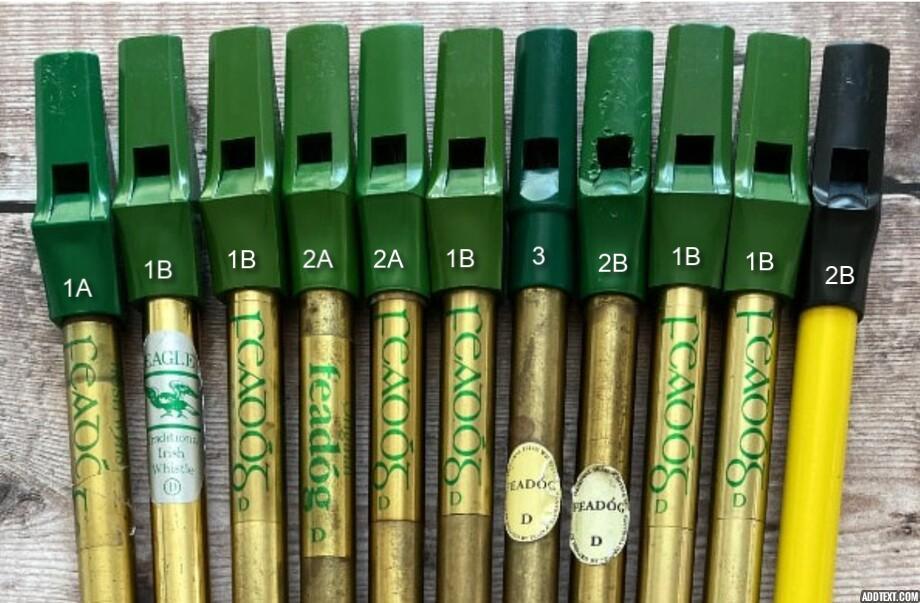
Thank you for adding the codes to the heads.
1A is my favourite of the lot though 1b is pretty close. These 2 are very stable in the higher octave. The 2b with the teeth marks is plain awful but the yellow one is actually not too bad. Number 3 is pretty screechy so I won’t be lifting that one in a hurry. The 2a ones are not awful but 1a and 1b are a lot more stable and I prefer the tone.
Anyway I have far too many whistles and I should concentrate on learning to play the instrument and not filling my drawers with whistles. Perhaps I need help to stop me purchasing cheap whistles on eBay.
Is it just the head? Looking at that array of Feadogs 4,7,8 and 11 from the left have a smaller bottom hole
McCullough Piggott was a a music shop in Dublin that started up Feadóg production. When it took off they split off whistle production into a separate company, Feadóg Teo. There were always MuCulloughs and Piggotts involved in the company.
I never fully took to Feadógs, for various reasons.
Question is, why did they keep changing the head design?
Your three on the right have the clipped/rounded corners, with the one at far right having the blister on the ramp. I wonder why they added the blister.
What’s not present is the pointy-corner type in the dark green, which I perceive to be the earliest type (though I’m just guessing) and the kind with the more cylindrical head that I’m calling Mk3 now due to perceiving to be a later type.
Good observation. I hadn’t noticed that.
Right David, most have a bigger Hole 6, but two of the Mk2’s and the Mk3 have a smaller Hole 6.
I think the earlier hole layout is a tad bigger overall as well.
Then there’s the yellow whistle far right that’s the outlier.
The original hole layout is something that flies under the radar for me because most of my whistles have had the holes enlarged here and there to get the scales in tune.