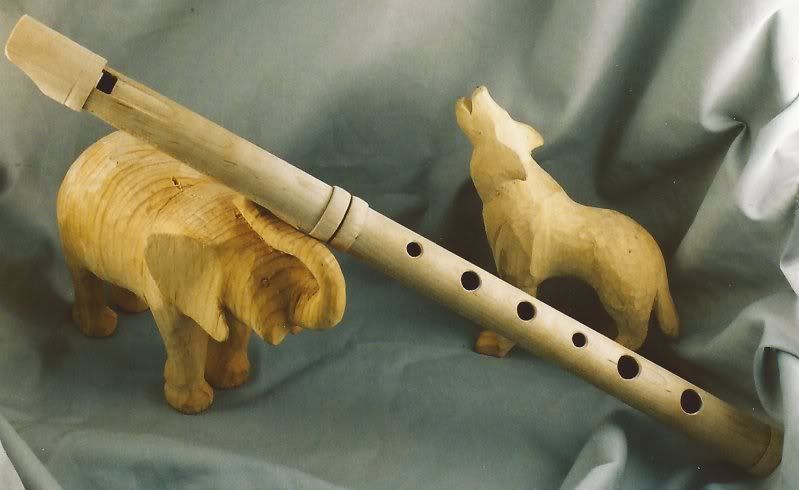
I am retired and play both the whistle and uilleann pipes… badly. But I have lots of time on my hands. I was thinking of trying to make a uilleann chanter. I am playing with reeds right now. But… that is a complicated instrument. So I thought it might be smart trying to make some wood penny whistles first. I am lucky to live near a place called APX in Portland who has all sorts of woodworking and metalworking tools/machines with classes. So I thought I could use that facility to try this out.
So…
Is this a crazy idea?
Does anyone know where I could get my hands on a wood pennywhistle design/plan?
Or do you think I could reverse engineer my wood whistle ( an old sweetheart in D)?
Welcome to the world of whistles and whistle making.
Yes, but call me crazy anyway. Quite a few of us have done the same.
Plans are not pre se available in a commercial form. That should not stop you. You can find enough information through the Internet to make your own plans.
You coiuld start with a few books on woodwind making. The Amatuer Woodwin Maker by Trevor Robinson is what I started with 40-ish years ago. That will have plans for several instruments related to the whistle like recorders and fifes. Take your knowledge from where you can find it. You might also look for an article written by the late Glenn Schultz in Woodwind Quarterly that overviews his whistle making methods and philosophies. Although that article does not constitute a set of plans it does give you a lot of very helpful details about whistle making. That is available from Lar’s Kirmser’s website.
I would suggest you start with a couple of well known sources. Guido Gonzato has generously provided drawings on line for making whistles out of plastic pipe. You can modify the dimensions to accommodate a design made of wood. In any case I would recommend that you suss out your designs in CPVC/PVC pipe first before you start cutting down the rain forests. You will make waste to start off.
For methods you can look at Tyrone Head’s web site to see how he approaches making wooden whistles. That wll give you a rough outline of a process. We have all developed our own methods, use different tools and shop fixtures but that site wll give you a more extreme way to approach things. You can see your way through simplifying the process I am sure.
Yes, you can. Many do just that to start off. Keep in mind that cookbook whistle making and copying rarely result in a whistle as good as the original to start off. There are a lot of reasons why that is the case. Still reverse engineering is a tried and true method to s get started.
And there are a lot of whistle makers here that are willing to discuss things as you proceed.
You’re welcome. As for the pipes, there are plans/drawings and books available. The pipe forum would be the best place to ask about those. I have dabbled with David Daye’s Penny Chanter which I am sure you have found already.
Making wooden whistles is not something to be undertaken lightly. The hardest part is getting a solid stick of wood turned into a thin walled wooden tube. Tyrone’s excellent site will give you an idea of what you’re up against.
For a couple of whistles, I don’t think it’s worth the time and effort. Still, since you have access to the major tools, go for it if you’d like.
You’ll need some custom equipment too including a gundrill in the ID that you want and a steady rest.
Good luck.
Plus a word about tuning … The dimensions of the window and the windway have a significant effect on tuning, and the calculators may not take this into account, so don’t take their recommendations as absolute. I’d suggest:
Leave the tube a bit long, and make the whistle head before drilling toneholes.
Cut the whistle to length to tune the bottom note, maybe a wee bit sharp. (The closed toneholes tend to flatten the note a bit, in my experience.)
Use a calculator to determine tonehole position, but measure up from the bottom, not down from the window.
Drill the toneholes smaller than the calculator tells you, and enlarge them as necessary to get the tuning right, working from bottom to top.
If this is what you want to do it is a good idea.
I don’t know where to find wood penny whistle/plans.
Reverse engineering has been working for orientals for a very long time.
You did not mention at what level your wood working skills are at this time. Whether you obtain a wood lathe or machine lathe could be decided after a few classes at APX. With either type of lathe I think square one should be to become very proficient in sharping the tools before they become to dull grab your wood and shatter it.
With any type of wood working sharp tools are indispensable. All the parts of this whistle are made with wood including the ferules and tuning slide.
If I recall correctly, the old Sweethearts had a conical bore, right? That adds a whole other level of complexity.
I agree with the advice to start with the Guido Gonzato plans for PVC whistles. Make a few and see if you really have the “bug” to do this.