What? No one going to mention the possibility of tonguing three D’s?
 That’s what I do . . . .
Edited to say: Make that did . . . .

Being a piper, I usually do what amounts to g/d/e grace notes on a GHB chanter. First lift the left index finger and replace it quickly, then the right index finger, and then the left ring finger. It’s embarrassing but I’m not sure what that’s called in Irish music, cranning possibly?
Dave
Hi, FJ.
I would respectfully encourage your teacher to acquire a philosophy toward embellishment that is less dogmatic and more adventurous. . . less self-restricting and more open to allowing his students to create the music they hear and feel without trepidation or arbitrary technical limits. If you need to use a cran, use it. Triplet works there? Use it. If it’s in your toolbox of acquired ornaments, whip it out and throw it down. When you play music, saying YES is a heckuva lot more fun than saying NO.
The cran is no Big Mystery. It’s simply what a fluter, whistler, piper does to approximate a long or short roll on the D. That’s its function, to ornament the same rhythmic space as a roll. I learned to use it because I heard great Irish musicians using it and I wanted to play up to their level. . . the same way when I study a spoken language I make sure to learn all the verb tenses and all the suffixes and other elements of grammar. Just because someday I might need them to converse with speakers of that language and would want to be considered fluent.
Unlike your teacher, I’ve never heard of any official or unofficial standard governing cran usage by tinwhistle players. Then again, I don’t know if I’m a real whistle player, but I drop crans whenever they fit and like where it’s gotten me.
Best,
L.E. McCullough
p.s.: I’ve always loved your postscript. . . it’s so true and, in fact, raises my spirits whenever I read it.
This passage in The Flagstone of Memories would be a short roll on the whistle if it were on any note but D…emmline’s verbal description of it is spot-on. Sure the cran would work here, but listening to Vincent Broderick playing it himself (on his Turoe Stone cassette) it sounds like he’s playing it close to the way Peter Laban described above with the D-E-D triplet, though in some places it sounds like he’s just playing it BDD, holding on to the last D a bit longer. It’s hard to tell for sure because the fiddle is mixed higher than the flute, and the fiddler’s doing triplets or there. It’s written out as BDDD in the Turoe Stone book, but those transcriptions don’t always jibe with the way Vincent plays them on the recordings.
On the triplet, if you find that going from D to E and back to D is difficult, you can always finger it this way:
xxx xxx
xxx xox
xxx xxx
or even this way:
xxx xxx
xxx oxx
xxx xxx
My middle finger and index fingers are stronger than my ring finger, so I find this gives a more reliable triplet, and there’s a little more contrast in it.
Cranning low D and E on the whistle poorly compares to cranning the same notes on the pipes. On the whistle crans on these notes lack strength and conviction. Ofcourse you can crann them if you want to but personally i find the effect lacking while the more common (among older players and playing styles anyway) approaches to the notes have more strength, in other words supply in a better way the effect the ornamention is trying to supply.
Brid Donohue’s playing O Farrell’s welcome to Limerick and the Hurler’s March on her new CD is a good example of this. She treats both tunes, notorious piping tunes she learned off her grand-uncle Willie Clancy, as whistle tunes, deliberately not using the cranns. The tunes sound better for it. A touch of class and taste in my opinion.
Given your opinion, Peter, I’m curious to know what you make of Clancy’s use of the cran in Banish Misfortune? I realize that in print this question has a challenging tone, but, in all honesty, it is not meant to. I’d just like to know how you put this together.
Also, do you feel more postively about a cran on the high D?
It’s possible that I may have been guilty of embellishing his attitude for dramatic effect, but he has said that there are good places to cran and less good ones. I think what he really means is more like what Peter said.
I knew that one would come up immediately: As I said, you can cran whatever you want. It is a force of habit with pipers and i will readily admit to cranning there in the past. I have gone off it though, or try to :roll: . I feel playing simply DED there in Banish misfortune has more clarity and strength.
Cranning high d is not something I’d do unless taking the mickey. They are stylistic choices, everybody has to make them for themselves. Just be sure you make them for the right reasons.
… like fame, glory, and buxom groupies. 
For godsake, it’s almost Willie week, there will be plenty of those no matter what stylistic choice you make. 
Since I originally replied to the initial question of this thread, I purchased ‘Micho Russel, The Whistling Ambassador,’ a CD of various solo performances by Micho Russel. Absolutely amazing! I’d have to say, the most amazing whistling I’ve ever heard…mad old school. This CD really changed my concept of what whistling should be. Micho very often tongues three D’s in a row. Now I’ve started to tongue three notes in a row from time to time rather than constantly craning or rolling notes.
Micho played rolls (or a rhythmic movement so close to them calling them (his version of) rolls is justified enough) by not exactly tongueing all three notes but using a cut for one:
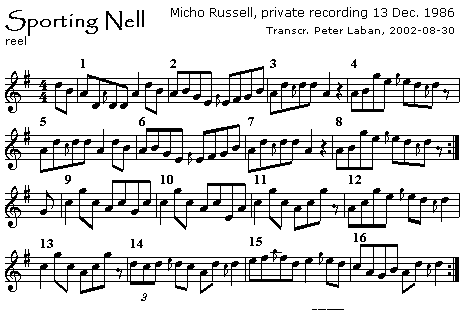
It is an excellent example of what I was saying above, finding a solution to the problem suitable for the whistle, rather than opting for the weaker, halfarsed piping imitation.
Micho’s style was so personal that you have to be very careful adapting from his playing, it very easily becomes second hand music.
best job at it i have ever seen was Michael Hynes playing ‘The Boy in the Gap’ on the whislte for a performance of a play about Micho "Out of the Heavens in Showers’. He had the essence down to a T without being a bare imitation.
Mr Laben,
I agree Micho played rolls. I also agree that he often cut the D note (kind of a half cran or what Bill Ochs calls a Warble…I love this move as well..I was doing this ‘warble’ long before I heard Micho). But he didn’t always use these techniques. On the ‘Whistling Ambassador’ he often tongued three of the same notes in a row.
I also agree that his style is highly personnalized and exact replication may not be the best idea, but the point is that this known player, Micho, of extraordinary talent often employed the technique of tonguing 3 D’s in a row (among other tones) which is relavent to the question possed in this thread.
[/quote]
I was just listening to the Clancy recording of Banish Misfortune (so kindly posted by Peter Laban) to see if his use of the cran did, in fact, sound like a “half-arsed” version of a piping ornament. I don’t think it does at all. It has a sound all its own–not the rat-a-tat-tat of a piping cran, but more a lovely, gentle gurgling, like a brook. I don’t think the issue isn’t so much the ornament per se so much as what effect one expects from it. In any case, in the end obviously there’s no arguing about taste; however, I intend to keep on using crans, not to sound like a piper but to emphasize the lyricism of the whistle.