To do either, they’d need to be paying someone with the skills and experience to test the lot and make the decisions.
Yes this would also work very well, and I’d like them as a brand much more. Same with Feadog. They could even test them all, and then put them in tiers. Mediocre ones could be $10 (and dont sell the garbage), good ones $30, and the few amazing ones could be $50+. they could call the good ones the ‘pro’ version, when they were actually the same model haha. Because all I want is consistency. When someone says the best whistle they ever played was a feadog pro, or a gen, I want to be able to buy one and get the same experience. And not end up with my Feadog pro, which I’m considering making a new tube for and tweaking the head haha.
This is true but if they are able to sell them for much more I think it could work out. If they were able to find a good player whos current job doesnt pay well they would only need to pay a bit more to have them want to test whistles instead.
It would also do away with the notion of the whistle as an easy cheap instrument that is accessible to all. Putting a price tag of 100 euro on it will take it out of reach of the thousands upon thousands of schoolchildren who get their start in music on the whistle.
my Feadog pro, which I’m considering making a new tube for and tweaking the head haha.
There is nothing wrong with feadog tubes, they are extremely consistent and the exact same measurements and hole pattern are successfully used by several other whistles. I am using a pro body with another head after throwing out the original and it is fine, nice black finish too.
There is a certain whistle maker who is very popular here in the US, and who makes a fairly loud model of whistle. I don’t think I’m being uncharitable when I say that 9 times out of 10, if I see someone with that whistle at a session they will not be very good at all. I always chalk it up to trying to buy your way to a better sound, since it’s an oft-cited “premium whistle” maker.
What’s funny is that I actually also have that whistle; it’s lovely but yes, loud! I generally play it busking. I guess I have to hope I’m the 1 out of 10…
Ok upon further inspection its tuning is fine. I had to Teflon tape the head so I can pull it out more so it wouldn’t be extremely sharp (pulling it out more made it loose). Not ideal but now that its in an intelligent position its fine. Which is good because I’d like to think of anything that should be consistent its a machine drilling holes in a tube haha.
And yes the finish on feadog’s is fantastic. Nickel and black coatings look awesome. I play low whistles 99% of the time and havent touched this thing in a while but I’ll give it another shot later. My issue with my first whistles is the memory of them is always tainted because new players suck lol.
I’ll re-post an image for you that shows the extensive use of the Feadóg pattern (I was on my phone last night and didn’t have access to it):

it can’t be all wrong. There was a story going around Cillian O Briain redesigned the original Feadóg to improve the tuning tube but as you can see in the pic the pattern hasn’t really changed since the early ones so the stopry may or may not be true.
Someone did in fact redesign the Feadóg tube at some time during the early 1990’s. Per Mr Paul McCarron’s message to Dale (see below) the MK I’s were made from the beginning to the early nineties. He said the Mk II’s and an experimental version of the MK II that many call the MK 2.5 were made until 2001 when there was once more a redesign (the MK III’s). In the picture you posted there is not an early MK I. The green headed one on the left is the MK 2.5 and the green headed one on the right is a MK II. None of the other whistles pictured are MK I’s. The MK II’s and today’s MK III’s do use the same body. But the MK I’s do not. See my picture below. The whistle on the left is a MK I. The Feadóg Pro (middle) and current MK III’s use a different body than the earliest Feadóg production whistles (the MK 1’s). You can clearly see the MK I has larger holes and the holes are placed higher up on the body than the others. So somebody did redesign not only the heads but the body also of the MK I’s. As your picture shows since the early 1990’s the body has not changed. But is is not the same body as the early Feadóg’s pre 1990’s.
TxWhistler’s picture:
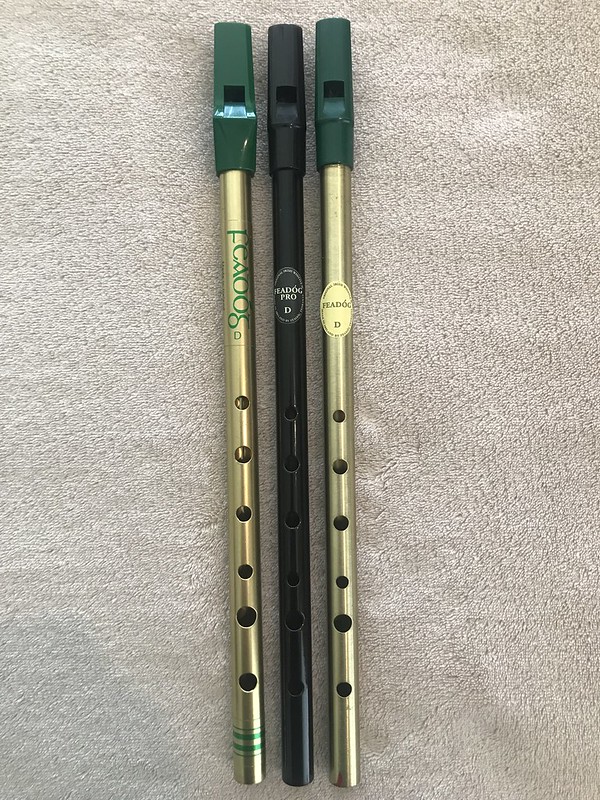
++++++++++++++++++++++++++++++++++++++++++++++++++++++++++++++++++++++++++++++++++++++++++++++++++++++++++++++++++++++++++++++++++++++++++++++++++++++++++++++++++++++++++++
I did not include the picture Paul McCarron is referring to below so you will need to go to the link and find Dales post on page 4 to see it.
(See page 4 for post below)
Copy of a post by Dale » Mon Jan 31, 2005 7:40 pm
Dear Dale,
… The three whistles that you have pictured do look like Feadóg mouthpieces. However the one in the middle was only made in very small quantities and was made as an experiment. Let me explain:
There have been three mouthpieces for the Feadóg. The Mark I went from the beginning until the early nineties. The mould at that stage was beginning to wear out so it was redesigned and we produced the Mark II. In 2001 this was once more redesigned in conjunction with several highly respected Irish Whistle players and the Mark III was born. However, and this is where it gets a bit confusing, there was a slight amendment to the Mark II mouthpiece near the end of its life. That is the “bubble” that you see on the middle whistle at the top of the ramp. The usual Mark II did not have this “bubble”.
Therefore there are three Feadóg mouthpieces in existence but a small number of the Mark II’s have the experimental mouth pieces. The whistles that I sent you do indeed have the Mark III mouthpiece on it. I hope this helps in clearing up the debate.
If there is anything else I can help you with, please do not hesitate to contact me.
Kind Regards
Paul McCarron
Feadóg “Original Irish Whistle”
You are right ofcourse, I put up a pic that is some years old and went off on one based on my assumption what was in it, without verifying if what I assumed was there, was actually there.
However, the mk I s I have do have the same tube as the other ones, as far as I remember, so perhaps things are not all that clear cut and well defined (they often aren’t).
More later.
[Add:] Later.
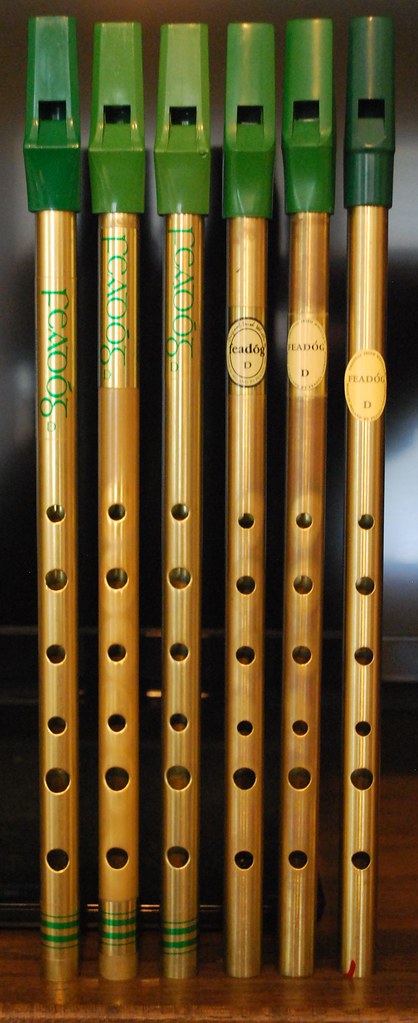
A quick grab of a few Feadógs for an identity parade. I, II, II 1/2 and III all same tubes (which obviously doesn’t mean the original first ones didn’t have a different configuration, it just shows they didn’t have it all the time):

Mr Gumby if I have misunderstood your point then I apologize. It appears to me you are saying the Mk I tubes in your picture are the same as the rest of the tubes in your pictures. I don’t see that. I see the first two whistles on the left (Mk I’s) having larger holes than the rest and drilled higher on the tube than the others.
Here’s another picture of mine. The first 3 whistles on the left are Mk I’s and then going left to right the final 3 are Mk II, Mk II 1/2 and Mk III.
The Mk I holes are larger than the others and have been drilled higher on the tube than the others. The L2 and R2 holes are the easiest to see that they are clearly larger than the others.
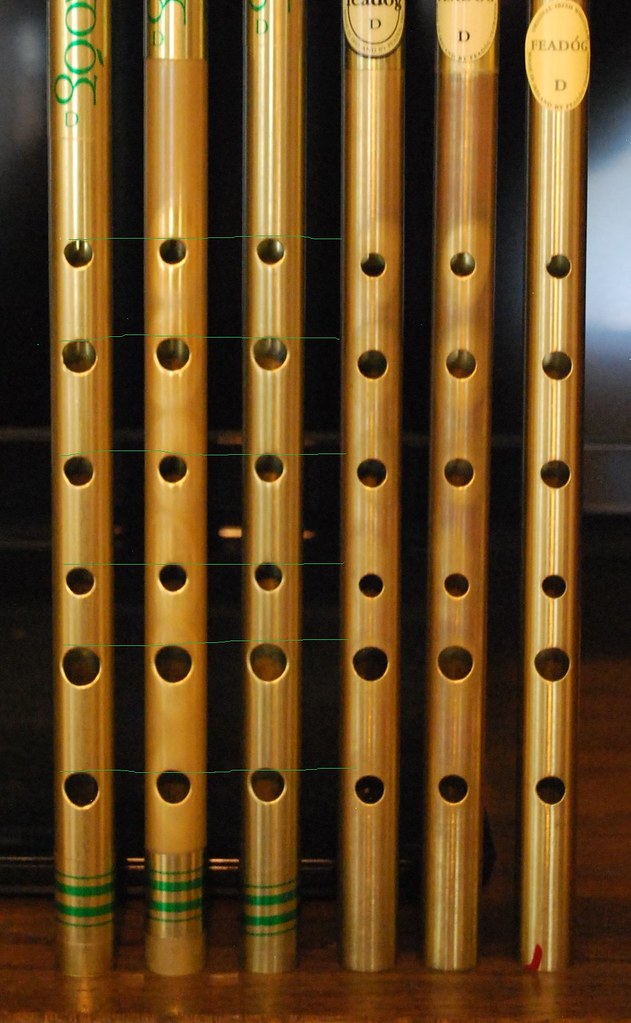
I agree with you that the Mk II, Mk II 1/2 and Mk III whistles have all used the very same designed tube but the Mk I’s have a different tube that even your picture attests to that fact. In the whole scheme of things it doesn’t matter whether I’m correct or not so this will be my last post on the subject.
Hoping you have a great weekend and cheers!