
I found them yesterday, took pictures, and let them go.
They walk on their backs by wriggling their muscles around–they don’t use their legs.
I found them yesterday, took pictures, and let them go.
They walk on their backs by wriggling their muscles around–they don’t use their legs.
Grubs, by the look of them. Not sure on the species.
They look like maggots to me
http://images.google.com/images?client=opera&rls=en&q=maggots
looks more like white grubs to me
http://images.google.com/images?svnum=100&um=1&hl=en&safe=off&client=firefox-a&rls=org.mozilla%3Aen-US%3Aofficial&q=white+grub&btnG=Search+Images
Yours will probably turn into june bugs when grown.
Looks similar to this White Grub:

Thank you everybody. I had no idea what they were. I was kind of thinking they were baby moths or butterflies or some kind of beetle. I guess June bugs are beetles. 
They look delicious, full of umami.
Those C-shaped grubs are typical of beetles in the Scarab family. Other
beetles have larvae of different shapes. Mealworms are beetle larvae;
leaf mining beetles have extremely thin larvae that feed between the
upper and lower surfaces of leaves!
Here’s Wiki on the Scarab family
http://en.wikipedia.org/wiki/Scarabaeidae
The C-shaped larvae, called grubs, are pale yellow or white. The
grubs mostly live underground or under debris, so are not exposed to
light.
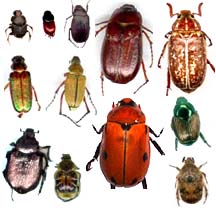
Some of the well-known beetles from the Scarabaeidae are Japanese
beetles, dung beetles, June beetles, rose chafers, rhinoceros beetles,
Hercules beetles and Goliath beetles.
common ones


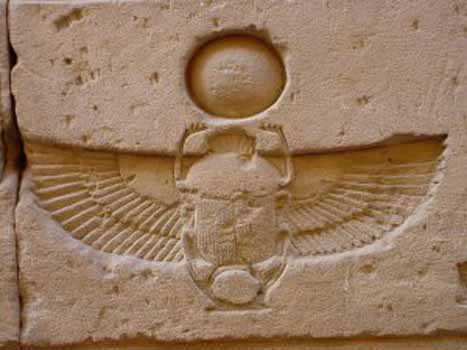
Here’s what Egyptian scarab beetles look like in their non-glorified state. That’s probably elephant dung they’re rolling.

Here is my favorite scarab beetle-- called the Bumble Flower Beetle.
It’s fuzzy, about the size of a small bumblebee and when it flies by it
buzzes just like a bee. The grubs are C-shaped. The scientific name is
Euphoria inda, and I have a strange sense of happiness whenever I
find one. Maybe your grubs were baby Euphorias, Cran!

They’re so cute! They make me want to collect beetles!
You could put them in a Miracle Whip jar and keep them until they die.
Then you could get new beetles and repeat, ad infinitum, ad nauseam.
Sure, they die, but heck, they’re only beetles.
Don’t let them close to your ear or they will crawl in and control your brain.
True story.
You haven’t perhaps already done that have you?
Other uses for dead beetles
http://en.wikipedia.org/wiki/Spanish_fly
The Spanish fly is an emerald-green beetle in the family Meloidae,
Lytta vesicatoria.[1][2] It is 15 mm to 22 mm long and 5 mm to 8 mm
wide, and lives on plants in the families Caprifoliaceae and Oleaceae. The
beetle contains up to 5% cantharidin which irritates animal tissues.
The crushed powder of Spanish fly > is of yellowish brown to
brown-olive color with iridescent reflections, of disagreeable scent and
bitter flavor.Its medical use dates back to descriptions from Hippocrates. Plasters
made from wings of these beetles have been used to raise blisters. In
ancient China, cantharides beetles were mixed with human dung, arsenic
and wolfsbane to make the world’s first recorded stink bomb.[4] It is also
one of the world’s most well-known aphrodisiacs.
Do you have to actually throw them on the sidewalk to get them to pop, or will just tossing them do?
Oh, and you didn’t hold them very long, did you? If you should develop a swelling with a teeny-tiny hole in its top, see a doctor. And for gawd’s sake, don’t put your hands in your mouth after handling them.
June bugs are a variety of scarab beetle.
You’re paranoid and need to get a life.
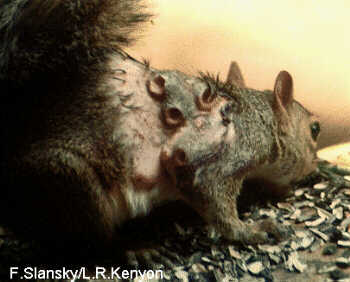
She’s not being paranoid. Those things can burrow like bot larvae. Here’s a squirrel with grub infestation –
They’re found all over the US except the really cold states, and they are most plentiful in a belt running from Kentucky down through Georgia and to Florida.
You don’t have to wash your hands if you don’t want to, but you have to promise not to come running here for sympathy when you’ve touched your face and peepee and you start looking like you have barnacles.
Oh, for goodness’ sake. They didn’t burrow into my skin. I may not be the smartest person in the world, but what do you two think I am, an idiot? I only held them long enough to take a picture, then I let them both go free in the grass outside my apartment. I think I would have noticed if they chewed through my skin!
It’s the eggs, Cran . . . the eggs . . .
The entrance bored by the ovipositor is microscopic; you would never even see it. But don’t worry. After the larva leave, the skin shrinks back to normal, and you would probably not suffer any permanent damage unless one made its way to your scrotum.
Oh yes, of course. They laid ten thousand eggs apiece inside me and now I’m completely infested. Thank you oh-so-much for your collective wisdom.