G’day all,
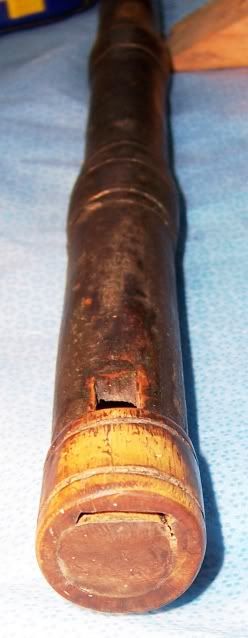
I wonder if someone could please identify this instrument for me..
It is Bamboo or Cane…24 " long…The lowest note is in the neighbourhood of C#,and the ascending notes sound like a Minor’ish scale…There are 6 finger holes.
The Mouth piece and Blade are on the OPPOSITE side of the finger holes..
Aparently it was brought back from Japan by a soldier after the end of World War 2..
Sorry about the pathetically small photos…I’ve been doing battle with the computer for the last 3 hours,trying to make them bigger and if go on any longer,the computer will die !!..Death by sledge hammer ..!!
Thanks…weedie..
I think is is a quenacho with a pinquillo mouthpiece. A quenacho is a big quena (the Andean flute) usually tuned to low D, which has a notch at the end and it is played like a flute but straight, not sideways.
The pinquillo is a small Latin American instrument which has a mouthpiece like a recorder or a whistle.
It is possible to find quenachos that have a pinquillo mouthpiece.
To see a picture of a quenacho with a pinquillo mouthpiece, see my thread “the Andean ancestor of the irish low D whistle ?”.
Thanks Gerardo…
I’m still unsure about the instrument…If it IS a Latin American instrument..I wonder how it came to be in Japan at the end of WW2 ?..
Maybe one day we’ll find out…thanks again
I don’t think it is Latin American - the fipple on the opposite side of the fingerholes is often found on East European flutes, but I haven’t found this feature on any photograph of quenachos/pinquillos. This does of course still not answer how the instrument came to Japan, IF it is East European…
The look is just about identical to a Hungarian folk pipe on a photo illustrating an article on these. However, they don’t have bamboo in Hungary. Or anywhere in E. Europe.