and perhaps a bibliography sighting the sources as to what motivated them to feel that way because, though we might not agree, it might be to all our best interests to have an understanding.
“The Sabre of Desirable Mindfulness” It fits! Oh, it FITS!
Unity Temple UU Congregation? I thought Unity was different from UU.
Time to do some Googling.
Unity and UU are different, but there are a few UU churches that hold the Unity name. I can’t recall if they’re congregations that switched over, or, more likely, congregations that used the Unity name before Unity became what we know as Unity today.
Eric,
Lapsed UU
From the Hometown of Unity
Uh huh.
Unity as the name of a religion comes fairly recent compared to the tradition of Unitarian or Universalist congregations (or any congregation of any of many faiths) having used that name to name their congregation.
In this case, 2 UU congregations in a small town (one of the congregations had split off from and another UU congregation about a mile away not very many years earlier) joined together and decided to change the name of their joint congregation to something that didn’t lord the other one’s history over each other.
After much committee deliberation (much of it debating if they should call themself a “church” or not because so many members who were ethnically Jewish had “issues” with such a Christian sounding title) they decided to name the congregation after the building they met in, Unity Temple (though that structure had been built by a then mostly Universalist congregation to replace an original structure called Unity Church that burned down after being struck by lightning in 1905).
There’s a Unity Church in the town as well but Frank LLoyd Wright didn’t design the building that group (not related to the UUA) meets in.
You laugh, but this is my church…
Sister Immaculate Boomerang of Equanimity
I love it!!!
Brother Claymore of The Short Path
I’ve always wanted to go to a Unitarian Church–how do you worship? What do you worship? If you’re really accepting of absolutely everyone, how on earth do you accomplish anything?
Glittering Spearhead of Meekness wants to know.
Jeah, just like Jesus. He never accomplished anything, either, by really accepting absolutely everyone. And then they killed him.
Being accepting of everyone is not the same as believing everyone’s beliefs. The seven principles of the UUA focus on individual spiritual growth. You’re encouraged to find your own path and respect the paths of others. “Respect for the paths of others” might seem like a small or obvious thing — indeed, many people who are not UUs say that the seven principles are just a basic description of views which they presume a majority of people share — but I personally feel that if everyone really lived these principles to the fullest, then society would be a freer and happier place.
So how do UUs get anything done? Well, a lot of people seem to interpret the notion of “getting stuff done” as causing change in other people. In fact, however, there is nobody in the world that any individual has more power to change than themselves. UU churches aim to provide a nurturing environment for personal spritual growth, with the idea that this is by itself an important thing to do, and my personal opinion is that an individual cannot do anything for others until they reform/develop themselves.
As for how worship is organized, unitarianism and universalism both come from christian traditions, and UU services are in my experience very similar to christian services, insofar as there are readings, singing, sermons, offerings, etc. But the content is different; although the christian bible is used from time to time and christian principles might be discussed, they’re not nearly so central as in a christian church. And ideas from other religions and non-religious philosophers play a major role as well.
For an example of some of the readings used and sermons in one UU church, here’s an archive of selected sermons from my church. I particularly like this one [PDF].
-Craig
Craig beat me to it. But one important point is that people sometimes dismiss us as those people that can believe anything they want. Actually, you are expected to figure out what you believe by following your personal convictions, wherever that leads you. When enough people have the same strong convictions, we get something done. We feel a person’s convictions are too important to leave to the church.
Letting people have their own convictions often leads people to be agnostics or atheists, but those are perfectly rational points of view, so we have a number of those in the congregation. I was chatting with a neo-pagan on the net once and told her I was a Unitarian Universalist and it is against my religion to burn witches. I almost said and if we did, there wouldn’t be anyone to tell us what to do during a solstice or equinox. I didn’t, because it might have possibly sounded flip. We were having a get to know UUism lunch when I related how I had told a neo-pagan that it was against my religion to burn witches. The minister promptly said “And if we did, we wouldn’t know what to do during a solstice or equinox!”
Speaking of neo-pagans, the UU church in Portland Oregon would let the local neo-pagans use the wooded grounds behind the church for their ceremonies. In front of the church is a concrete statue of a man that had weathered to the point it had a large crack in its head. According to some of the local irrational religious extremists, the Unitarian Universalists sacrificed babies to Satan in ceremonies behind the church and placed the babies’ ashes in the crack in the statue’s head.
Rod
I’m sure there must be some workable symbolism in that. Someone, please let me know when you figure out what it could possibly be.
When all the extraneous bits have been burned away, only the essence remains. 
djm
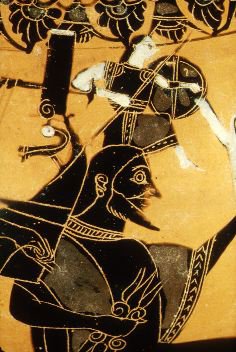
When Athena was born, didn’t she come jumping out of a crack in Zeus’ head?
(edit: here she is, after Hephaestus took his hammer and whacked Zeus upside the head…)
I thought this interesting (at the bottom), from a much larger Wikipedia entry on Unitarianism. On this account a thread running through all
forms of unitarianism is rejection of the trinity.
When I’ve attended these churches it seemed to me there
was a dichotomy being drawn, one I’m doubtful about.
It’s that any solid teaching or doctrine is dogmatic and
coercive. So either we have no doctrine or we are coercing
people. Now obviously doctrine can be coercive, so believing
very little is a safeguard against (some forms) of forcing
people into a mold.
But doctrine needn’t be dogma. So the Buddha, who had a definite
teaching, the Four Noble Truths, of a pretty radical nature, in fact,
simply invited people to ‘come and see.’ He was emphatic that
nobody should accept anything in his teaching but what they found true and practical for themselves. A definite teaching needn’t be coercive. So if a religious organization respects people’s right
to decide for themselves, it can have a definite, even a radical, doctrine.
Another saying: ‘The problem with people’s not believing in God
isn’t that they will believe nothing, but that they will believe
everything.’
The concern is that what you may get is a hodge podge of different
religious traditions, none of which is understood particularly well.
A feel-good smorgasbord, from Zen, from Christianity, from
Native Americans, neo-paganism, from atheistic humanism,
in which nothing goes very deep. Justice is never done to any tradition.
I think that every religious or spiritual tradition holds out a hope–that
there is a transcendental goal and that we can, somehow, be
transformed to live in it. But if it’s going to go at all deep, the tradtion needs to start saying
something about what the goal is and how to get there,
there’s a teaching, usually there are real spiritual demands made,
it stops being ‘nice’ or a matter of arranging society more
equitably. To find your life you must lose it.
The concern is that if the religion stays really vague or very pluralistic,
figure it out for yourself,
most people aren’t going to get anywhere. It will be the spiritual status quo ‘lite.’
Personally I think there have
been people who are vastly wiser than any of us.
One has to go pretty deeply into their teaching
and follow their practice for a long while to begin to understand
what they meant, not just intellectually but practically.
And then what one finds can be pretty terrifying.
A standard practice in early Buddhism is to go to
the charnel ground and watch the bodies rot.
Nobody understands Buddhism, I think, who does not
find it at some point deeply repugnant.
There’s nothing the matter with Unitarian practice. Most people don’t
get anywhere in any tradition, and people hanging out
together and trying to be kind and concerned and enjoying
each other’s fellowship is positive. Why not touch on the
edifying things people say from various traditions? Makes
us better people, hopefully. Probably we won’t get into
trouble this way. No crusades or burning martyrs.
But I wonder if it will go very deep. All depends on
what you want.
…
There are four distinct schools of Unitarian thought [citation needed]:
-
‘Biblical Unitarianism’—God is one being who consists of one “person”—the Father. Jesus is the Messiah and the Son of God, but generally not God himself; the Son may be a pre-existent being (Arianism), the result of the union between the Divine Logos and the human being Jesus, by which Jesus became God himself (Servetism), or Jesus after being filled with the Holy Spirit (Socinianism). Biblical Unitarianism remains as the only or main theology among Unitarians in Transylvania, Hungary, France, and several countries in Africa. Famous Biblical Unitarians include Michael Servetus, Faustus Socinus, and Isaac Newton.
-
‘Rational Unitarianism’—God is one being who consists of one “person”—the Father. Jesus is not the Son of God, but merely a good and wise man who taught others how to lead a better life. Rational Unitarianism emerged from the German Rationalism and the liberal theology of the 19th century. Its proponents took a highly intellectual approach to religion, rejecting most of the miraculous events in the Bible (including the virgin birth.) They embraced evolutionary concepts, asserted the “inherent goodness of man” and abandoned many principles of Christianity. Rationalist Unitarianism is distinguished from Deism (with which it nevertheless shares many features) by their belief in a personal deity who directly acts on creation, while Deists see God as an impersonal force which remains aloof from creation. Notable Rational Unitarianists include William Ellery Channing, Ralph Waldo Emerson and Andrews Norton in theology and ministry, Joseph Priestley and Linus Pauling in science, Susan B. Anthony and Florence Nightingale in humanitarianism and social justice, Charles Dickens in literature, and Frank Lloyd Wright in arts. Many Hungarian Unitarians embrace the principles of Rationalist Unitarianism–the only Unitarian high school in the world, John Sigismund Unitarian Academy in Cluj Napoca (Kolozsvar, Klausenburg), Romania, teaches Rational Unitarianism.
-
‘Unitarian Universalism’—There is no formal creed or set of beliefs required to join a Unitarian Universalist congregation, reflecting an institutional consolidation between Unitarianism and Universalism in 1961 in the United States and Canada.[2] Today, many Unitarian Universalists no longer consider themselves to be Christians [3]. Of those who do, there is no requirement of unitarian or trinitarian belief other than what the individual concludes on his/her own, although the Trinity itself, being a dogma, is generally rejected as such by this anti-dogmatic denomination. Unitarian Universalists promote a set of Principles and Purposes rather than a doctrine as their bond of union. Notable Unitarian Universalists are Tim Berners-Lee (founder of the world wide web), Pete Seeger, Kurt Vonnegut and Christopher Reeve.
-
‘Evangelical Unitarianism’—Since the 19th century, several Evangelical or Revivalist movements adopted a unitarian theology. Theologies among Evangelical Unitarians range from varieties of Socinianism (i.e. Jesus is a mortal man who did not exist before his conception and subsequent birth, conceived by the Holy Spirit, who later received immortality and divine nature), to Sabellianism (Jesus is God in the flesh, the manifestation of God, but not a Person of a Trinity). Evangelical Unitarians share their strict adherence to sola scriptura and their belief that Scripture is both inspired and inerrant. Christadelphians and the Churches of God are Evangelical Unitarians. Other modern non-trinitarian churches, such as the Filipino-based Iglesia ni Cristo, may also be included, although they reject the “unitarian” name to avoid confusion. Jehovah’s Witnesses also have a unitarian theology with specific traits.
The development of the various forms of Unitarianism is intermingled. Unitarian Universalism is the most recent form, while Biblical Unitarianism is the oldest. Modern Unitarians in Europe are primarily Biblical or Rational Unitarians, while Unitarian Universalism is the predominant form of Unitarianism in the United States and Canada. Most Evangelical Unitarians are found in the USA and the UK. The International Council of Unitarians and Universalists (founded in 1995) includes among its members groups from all theological persuasions except Evangelical Unitarians.
Do you have an argument for your hunch, Jim, because, if not, isn’t this wondering just groundlessly condescending? I don’t see any clear reason why the ‘single focus’ religions would be deep in a way that Unitarianism couldn’t be. Maybe the rejection of that sort of focus is the deepest spiritual enlightenment there is; why not?
Even if it were true that Unitarianism couldn’t be deep, something I haven’t really seen a single reason for, it’s not at all clear why that mightn’t be an advantage. Perhaps, persued single-mindedly, the more focused religions are all deeply wrong. Superficiality might then be a virtue. You can’t get any deeper than the bowels and look what they produce.
So, I really can’t yet see any reason why Unitarianism can’t be deep. And if it can’t be, I don’t see why that migiht not be thought a virtue. A little distance from our ritual, a little irony, a reluctance to take oneself too seriously seem to me, at least superficially, to be supremely healthy things.
Be careful about confusing “Unitarianism” or “Universalism”, which are essentially sects of Christianity, with “Unitarian Universalism,” which is not. Christians are certainly welcome in UU churches. One survey in Ohio found that just over 13% of UUs consider themselves Christian; other areas may have different numbers. There is also a Unitarian Universalist Christian Fellowship. But it’s not really accurate to call the UUA a Christian sect, because many if not most UUs don’t consider themselves Christian.
Unitarianism and Universalism individually, however, most certainly are Christian denominations. Unitarianism is very old; it is based on ideas considered heretical by Christians who followed the First Council of Nicaea. As such it is neither protestant nor lower-case-C-catholic.
Unitarian Universalism has its roots in the Unitarian and Universalist traditions (along with other traditions as well), but it is not simply a mashup of the two, and there are non-UU Unitarian and Universalist churches still in existance today.
So one should be careful about abbreviating “Unitarian Universalist.” The abbreviation “UU” works fine, but “Unitarian” means something very different.
-Craig
On the whole “pro life” issue, I have set in a UU congregation and listened to the minister condemn abortion in no uncertain terms.
I see this happening with more or less equal frequency in “single-source” churches. I’ve personally known Christians, Jews, Pagans, and Buddhists who had little to no understanding of their tradition, and folks from the same religions who understood them profoundly. You’re either interested in understanding the tradition you personally draw upon or you’re not. There isn’t a special exception for people who go to churches which draw upon more than one tradition.
“Feel-good smorgasbords” are quite easy to find, actually. They’re not restricted to any one group.
-Craig
Right. I meant that the ‘let’s not have a teaching but draw
on edifying statements from lots of traditions while
we all figure things out for ourselves’ approach can be a good
way to end up not getting so far spiritually–pretty dependable
in that respect, from what I’ve seen, anyhow. Not
that it’s required for that result.