It wasn’t a mistake. I figured tuning it so that the bottom hole could be closed for F# would help with stabilization of the whistle (I keep my pinky on the whistle at all times, personally). I figured if the holes were far enough apart, keeping the bottom one closed for F# wouldn’t change much (try playing F# on a whistle with the bottom hole covered, and it’s only a tiny bit flat). But I guess I was wrong about this?
Anyway, if this did create an issue for tuning, I wouldn’t be opposed to a design where F# was played totally open.
It’s not valid to assume that the acoustic effect of a terminated (shorter) tube is the same as the effect of a longer tube with an open tone hole lattice
But it’s also not valid to assume they’d be any different, is it? What reason do you have to think the effect would be different? The open holes together make an effective tube length, and I’d think you could just shorten the tube to exactly whatever length that is. Once you have that tube length for G, I don’t see why the placement of the two tone holes would need to change at all to get A and B in tune. Maybe it would, but what I want to know is why it would and to what degree it would. And I’m also curious how you know it would. I guess it’s just hard to wrap my head around this.
To be clear, I’m mainly talking about getting A and B in tune in one octave here, not about the octave spread thing you discussed later on. What I’m asking is this: at least in the first octave, why exactly would A and B be tuned differently if the whistle was simply shorter vs. if the whistle had open tone holes below it? Do you have a physical explanation for this, or have you simply tested this specific thing out and found it to be the case? If you’ve tested it, fair enough. I’ll shut up about it. 
What we are saying isn’t about octave spread.
What I mean by octave spread is exactly what you’re talking about: a given note’s tuning in the second octave vs. its tuning in the first.
Anyway, I appreciate your explanation of the octave spread thing, because that part does seem to make sense. But I still wonder how much of an issue this is. I guess I’ll have to test it out some time.
Right, that would be a more valid strategy if you want to try to just blindly use the same tone hole locations and sizes, but you are still basically a tone hole short if you want to use two fingers (i.e., a thumb and pinky) to do the same work that three fingers normally do in playing G, A, B and Cnat.
Well, right. That’s a good point. I suppose we could nix the Cnat idea if getting that to work isn’t possible. If we did that, the only tone hole we’d be missing is the top one, and that one is closed for all notes but C/C#, so it shouldn’t affect any other notes significantly.
 Flute acoustics sure are wild.
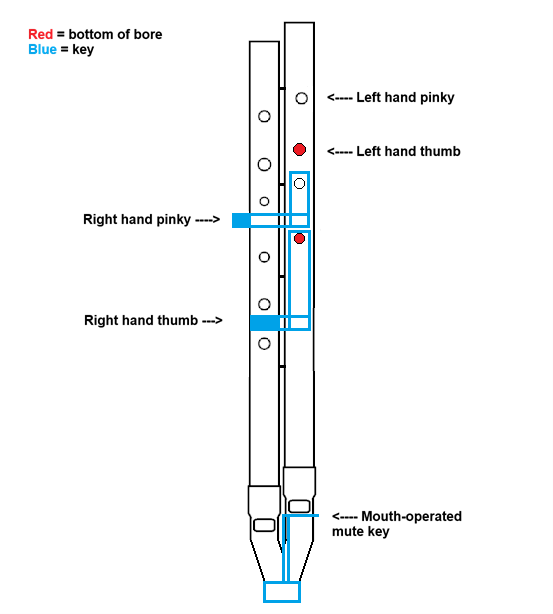
 I’ve tested the ergonomics of this design on two whistles I taped together, and I think it would be quite easy to play melody with any drone of your choice. Complicated harmonizing would be difficult, but that’s pretty much a given for double whistles.