One of our three cats has a terrible scratching habit. Apart from this, she’s the greatest cat in the world. We’ve tried ALL of the training things: lots of different scratching posts with and without catnip, water pistols, repellent chemicals, harsh words etc, etc.
I can’t really see those glue on nail caps, and I don’t like the idea of traditional declawing which basically removes the tips of the toes.
I just heard that there’s a procedure involving severing the flexor tendons, thus preventing the cat from extending the claws to scratch. This is supposedly a lot faster healing, less prone to infection and quite effective.
Does anyone have any experience with this (well, not you: your cat)?
Back in my podiatry days, I used to do flexor tenotomies on people’s toes, and sure enough it was very simple and effective (to straighten hammertoes, not to prevent scratching  )
)
Have you talked to your vet? That’s probably the best way to get information about the most up-to-date procedures/behavior therapies.
I think I’ve heard the nail caps are pretty popular (though I have no idea how they work) and they do strike me as among the least invasive options.
Yeah, ask your vet but keep in mind the vet will only offer the services they are qualified to do.
My mother had her cat declawed with lasers. The vet Crazy Glued the toes instead of sewing them shut.
Mom claimed the cat came home and acted as if nothing had happened, but my mom isn’t the most observant person I know.
I was having lots of claw damage problems with my cats. Ultimately my daughter, in her wisdom, reminded me that a pet is supposed to be pleasurable and if I’m afraid to step inside my house for fear of what damage its done, the cat has blown its value as a pleasure giving pet.
I hunted around and found a vet who uses lasers and was willing to supply lots of pain meds until the surgery healed.
My cats figured out their claws were gone only when they tried to climb the living room curtains. Then it was a case of, “oh well. That doesn’t work any more” and they were off to different adventures.
I also had to take the top shelf off their “kitty condo”. They could still get up there but came close to falling off while rolling over in their sleep (until they learned to pay more attention).
If your cat is an older cat there could be adjustment problems to anything your decide to do. If the cat is over weight they tell me pain from a declawing becomes more of an issue too.
First I’ll say that it’s been 10 years since my vet tech days so I’m not familiar with laser surgery for declaws so can’t speak to that.
The easy way to understand declawing is to imagine someone cutting off the last joint of your fingers (or in some cases just from the nail down, so that the nails are gone. The vets I worked for used a scalpel to do this- I’ve known of vets who used dog nail cutters-shudder. Shortly before I bid that career good bye we were using surgical glue to close the sites and it seemed to work well. I can’t say I saw any lessening of pain reactions though. Unless they were given something for pain it was bad-comparable to a dogs waking up to an ear crop. Pain meds did help seemingly. I’m not a cat person , but the only way I’d consider it would be a case of declaw or put down. If not done well the nails can grow back.
Oh and we use to use the nail caps. They were successful on some, not on others. I think success was determined by how relentless the cat was in trying to remove the things.
Keeping the nails trimmed goes a long way to cutting down on the scratching. Not doable with all cats, mind, but many get quite used to it, and it is far, far more humane than declawing.
$15 grooming to clip all nails (if you won’t do it yourself), every 6-8 weeks. Otherwise, please give your cat away to someone who will not declaw.
As was said previously, declawing is the removal of the last joint of the cat’s “fingers”. There are frequently reported complaints of resultant permanent behavioral problems, primarily problems with not using litter boxes (as it hurts kitty’s feet), and poor balance. Laser declaw is the same as traditional surgical techniques, but with less initial pain and faster healing from the mutilation. Better an abortion in a clean clinic than a back-alley coat hanger.
OK, References, a small section of Declawing Technical Facts, which is quoted below, from http://www.declawing.com/htmls/declawing.htm:
"Psychological & Behavioral Complications
Some cats are so shocked by declawing that their personalities change. Cats who were lively and friendly have become withdrawn and introverted after being declawed. Others, deprived of their primary means of defense, become nervous, fearful, and/or aggressive, often resorting to their only remaining means of defense, their teeth. In some cases, when declawed cats use the litterbox after surgery, their feet are so tender they associate their new pain with the box…permanently, resulting in a life-long adversion to using the litter box. Other declawed cats that can no longer mark with their claws, they mark with urine instead resulting in inappropriate elimination problems, which in many cases, results in relinquishment of the cats to shelters and ultimately euthanasia. Many of the cats surrendered to shelters are surrendered because of behavioral problems which developed after the cats were declawed.
Many declawed cats become so traumatized by this painful mutilation that they end up spending their maladjusted lives perched on top of doors and refrigerators, out of reach of real and imaginary predators against whom they no longer have any adequate defense.
A cat relies on its claws as its primary means of defense. Removing the claws makes a cat feel defenseless. The constant state of stress caused by a feeling of defenselessness may make some declawed cats more prone to disease. Stress leads to a myriad of physical and psychological disorders including supression of the immune system, cystitis and irritable bowel syndrome (IBS)..“The consequences of declawing are often pathetic. Changes in behavior can occur. A declawed cat frequently resorts to biting when confronted with even minor threats. Biting becomes an overcompensation for the insecurity of having no claws. Bungled surgery can result in the regrowth of deformed claws or in an infection leading to gangrene. Balance is affected by the inability to grasp with their claws. Chronic physical ailments such as cystitis or skin disorders can be manifestations of a declawed cat’s frustration and stress” David E. Hammett, DVM
Kevin Krell
The cat with whom I lived while growing up – the cat that is the major reason why I am NOT a “cat person” and would never intentionally become a cat owner – was declawed when we got her. She was just a big kitten at the time, less than a year old, and she grew up to be a rather neurotic animal and a nasty biter. She mostly lived in my room, due to a need for pet segregation in the house. I’d sit in a chair petting her, and she’d purr and nuzzle against my chin – and then suddenly sink her teeth into my jaw bone. (I’m sure that when I screamed, pried her off my face, and threw her across the room it didn’t help her neuroses much. But I was just a kid – forgive me, please! I was a quiet, gentle child, and most of the time I was very kind and gentle to the cat. I was only mean to her when she had already made me bleed.) She’d also hide under my bed, and when I walked near, dash out and sink her teeth into my ankles. Most kids are scared of the monster under the bed; mine really did jump out and bite me. If the declawing contributed to her biting, it was a very bad thing indeed.
In the interest of full disclosure, I was right in there with my siblings begging my parents to get us the beatiful little kitty. She was a Persian/ Angora cross, snow white and incredibly silky, with an angelic-looking little round face that belied her true nature. We should have quit after the guinea pigs, bird, and dogs . . .
Oh, that’s a whole lot easier said than done.
I clipped the claws myself. The girls still managed to trash furniture and go through window screens with what claws they had.
I got tired of screaming at them. We get along much better since their front claws are gone.
They didn’t seem to have a problem with the kitty litter after the declawing. For a week or two I gave them fancy litter made out of recycled newpaper and then I put them back on the stuff made out of wheat.
I guess I’m pretty evil to think I could rescue them as kittens from a life of living in the alley after their mother left them in my back yard.
I guess I’m also pretty evil to have found homes without requesting the “no declawing” clause for all the litters of kittens left in my back yard by their stray mothers each spring since then.
It was hard enough finding loving homes for them. That time of year the no kill shelters around here always have too many kittens already to accept even more.
I was out shoveling snow about an hour ago. There were lots of cat paw prints in the snow of the stray cats we have around here. In the spring I imagine there will be a whole new crop of kittens in my back yard to find homes for
and I’ll probably be evil again and not make the new cat owners swear they won’t declaw them.
But honestly, I think if you ask my girls they’d say they were more concerned about which flavor gourmet cat food I give them when they’re not sneeking things off my own plate of food.
We’re talking about cats aren’t we.
P.S.
I probably should mention that both my girls have never bit me, my husband, or my grandchildren. When I come home from having been out they do trip me up by trying to walk between my feet and rub on my legs but they’re always purring so loud I don’t mind.
You were lucky. Many other cat owners are, I’m not disputing that. Let it be an informed decision, then.
Bless you for taking care of them.
For the outside strays or ferals, I suggest Trap, Neuter, Return (if it is a safe situation to return to). I also suggest the Feral Villa ( http://www.feralvilla.com/ ) to help them through the winters.
Kevin Krell
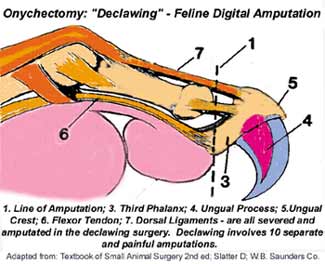
Here’s a good pic to show what I was talking about. A traditional declaw cuts along the dotted line at #1. The tenotomy or tendonotomy makes a much less invasive cut on the bottom of the digit at #6. The distal toe bone and claw are still there, they just can’t be extended to claw furniture.
Again, we’ve tried everything with this otherwise superb cat. She’s easygoing and is no problem as far as nail clipping. However, as soon as we clip her nails, she runs somewhere to sharpen them back up! This is not something we undertake lightly, believe me.
Again, we’ve tried everything with this otherwise superb cat. She’s easygoing and is no problem as far as nail clipping. However, as soon as we clip her nails, she runs somewhere to sharpen them back up!
Yeah, with some cats you’ve just got to keep at it. I clip my cats’ claws every week. They head off to the scratching post and start sharpening up again right afterwards too, but with the clipping as part of our routine, my furniture isn’t in any danger.
That surgery certainly seems less invasive, but I wonder if you’d be running the risk of the same behavioral problems as a result of the cat not being able to use her claws? And seems like you’d have to really stay on top of clipping her claws so they don’t get ingrown. But your vet would know more about that.

My wife and I have 5 cats. We only had clawing problems with our slightly
mentally challenged tomcat. My wife elected to do a tendonectomy on him
(she’s the family vet, and she really hates doing declaws). He does really well
now, but we have to keep up with trimming his claws because now they
cannot be worn down by scratching. If we neglect them, they could grow until
they curve back around into his paw.
EDIT: Personal opinion redacted…
A lot of vets won’t do declaws anymore, and a lot of vets refuse to do
tendonectomies because they’re not sure that owners will be able to take
proper care of the claws afterwards (and sometimes that’s true!) Check
with your vet to see what she’d even be willing to do.
I had a cat that was declawed (normally I don’t have that done, but he was living with my mother for a spell and she had much nicer furniture than I’m prone to own, so I ruefully consented to it), and I was amazed to note how well he could climb trees, successfully hunt, and defend himself afterward. Of course, he still had his back claws.
I imagine that this wouldn’t be the case with all cats, but there you have it.
NO to declawing.
Might as well just cut off the entire mitt and add a prosthesis.
Here is Peg with all her legs done and she seems just fine don’t she?

I think as Kevin said.
Give you cat away to someone that will not declaw.
Peg?
Oh cute!
Kevin Krell
Hi Paul,
If she doesn’t object to the nail trimming she’d probably be a good candidate for the “Soft Paws” nail caps. Let me know how big she is and I’ll put some in the mail for you to try. You just clip the nails and glue the rascals on.
I’d recommend against the tenotomy. From all I’ve heard they don’t do well. The claws can become thickened and hard to trim and the cats can’t care for them. Oh and they can still damage furniture if it’s horizontal just not vertical. I don’t know of anyone doing them.
If you must declaw, I’d recommend a laser by all means. The difference is astounding. I wouldn’t even consider doing one with a scalpel.
As to the argument that declawing is the equivalent of removing the last digit of the finger…not strictly correct. It’s true the last little bone to which the nail is attached is removed, but Look closely at Paul’s picture above. The pink lumps on the bottom represent the cat’s pads. These are the “fingers”. All the sensory structures of the “finger tip” are retained.
I do declaws with a laser when declawing is necessary (it isn’t always…I’m a big fan of the “Soft Paws” nail caps)
I’ve done 15 years worth of kitties with only one or two complications. On the other hand, not one of my declaw patients has ever been euthanized or dumped in the country to become feral because of destroying furniture.
Some of my own cats are declawed some are not (I have many) I see no difference in the behaviors or lives of any of them. Oh, except that I never holler at the declawed ones when they “Scratch” at the furniture (which they all still do).
Doc
Weird, they’re all the rage out here (at least among young vets).
EDIT: OK, I asked about laser declawing, and apparantly there are a lot of
larger practices doing it out here. I forget that vets aren’t really suppose to
advertise in general media, so I wouldn’t have heard of someone using it if
I didn’t ask about it or look them up in the phone book.
Seriously, a laser scalpel, how cool is that?