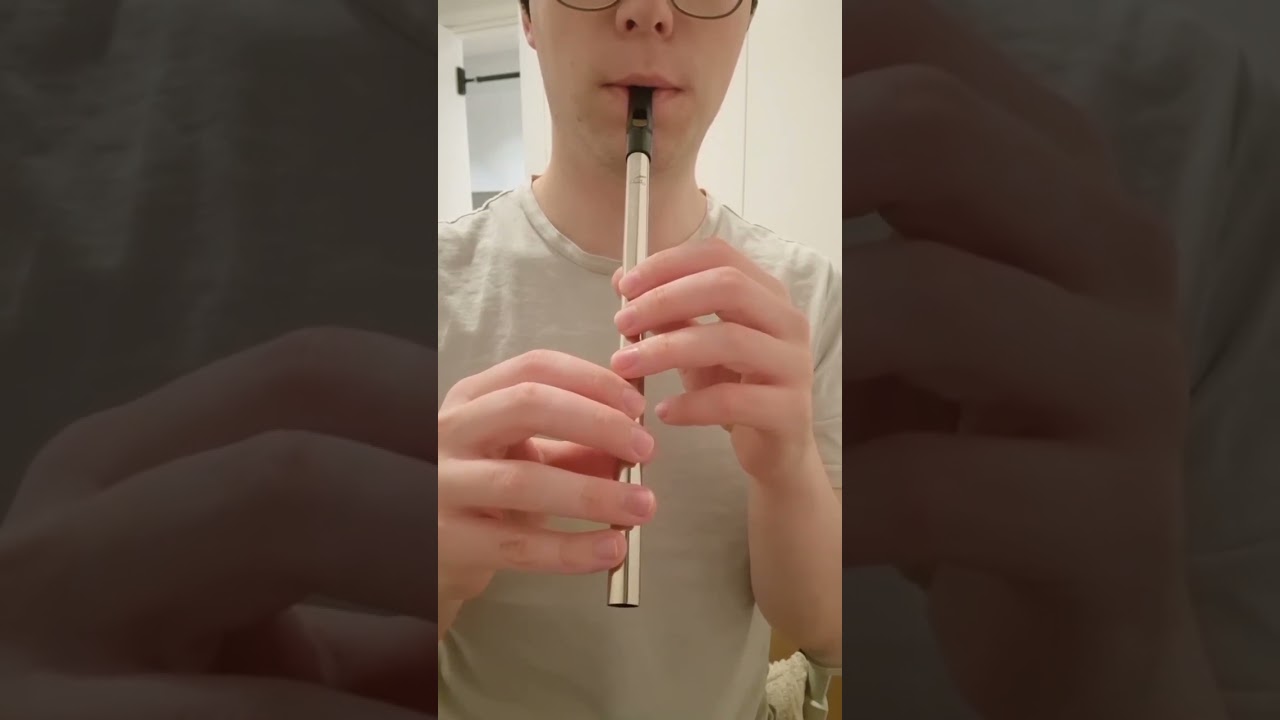
My Shush D whistle, which is the only whistle that I have, often produces high pitch sound when tonguing or switching octaves. If I slowly increase breath pressure on the lowest note it first starts to play D two octaves above before jumping into D one octave above. This is behaviour is repeatable and always happens at breath pressure that is inbetween first and and second octave.
Is this a problem with my unit or do all Shush whistles behave like that?
The best way to get an answer to that would be to make a video of it being played (you don’t need to appear in it - we only need the audio, but it’s easier to do a video and stick it up on youtube), and it would then be easy enough to tell if you’re blowing it competently. You can also delete it soon after getting a diagnosis. If you’re doing it right, it’s most likely a fault with that individual whistle.
Thank you for your reply! I will upload video later, to better show what I mean. I now realise that maybe some clarification from my post is needed. When played normally, whistle sounds good and this high pitch sound is pretty quiet and mostly appears when tonguing.
I bought Shush as a first proper whistle, because I was making my own diy quiet whistle and wanted to compare against it and learn more. Because of this I’m trying to pay attention to all the sound details to learn why Shush sounds the way it does.
The only repeatable way I found to highlight this high pitch sound is to very slowly increase pressure on bottom note. I was expecting it to maybe sound distorted and then flip to second octave, but instead it first plays D5+D7 at the same time and then flips to D6. This seems strange to me, but since I’m relatively new maybe it is actually normal and I just wasn’t aware
I can get those three octaves on my whistles if I blow them like that, but I don’t usually increase air pressure and speed gradually when playing. I give it the right amount to produce the note I want.
Some notes need a tiny break in the airstream to jump the octave cleanly, which is one of the reasons for tonguing. When you first start out you might get a little click or squeak at that point (specially with the highest notes) but it usually disappears with practice.
If tonguing is noisy, try doing it by making the letter K inside your mouth instead of the letter T. It’s harder to do, but gives a softer transition.
The whistle here is performing perfectly normally. When you play the lower note, it is a stable standing wave in the instrument. As you increase the air pressure it goes through a “break”, a period of turbulence, before it hits the next stable standing wave and produces a note an octave above.
Some whistle have a more turbulent break, others a less turbulent one.
When playing a tin whistle, we do not play the break between the octaves as you are doing here. We simply learn to apply the right amount of air for each note and skip the turbulence. Often an octave break like this is tongued or even ornamented.
My diy whistle does have a much less turblunet break with the biggest differences between my whistle and Shush being labium thickness (thin on mine, big and round on the Shush) and windway height (1mm on mine, 2mm on the Shush). Is it reasonable to assume that one or both of those parameters strongly effect the turbulence of the break?
I’m not sure, but I do think the issues you’re experiencing are probably typical for a new player.
It’s only two or three years since I came back to playing, and I found it really hard to adjust to any new whistle I tried. They seemed to handle so differently that it took a frustrating length of time to get used to them.
That disappeared as I got better, and it will for you too. It won’t be long before you’re wondering why on earth you found octave transitions difficult.