This may be reopening a similar question from way back, but I’d like to focus on the traditional Irish player. Would there be any scenario where a Low F might be useful other than playing solo or along with Lunasa, McGoldrick, etc.? I’m looking for reasons beyond tone or ease of play. Maybe it’s best to focus on mastering the high and low D’s.
15 20 years ago when there were several coffee shop sessions I remember a guitar singer!
She could play in any key but would only sing if we played in the key of F! So I always had a F whistle in my kit for “The Fogy Dew”
Hope that gives you some insight to ponder!
1 Like
That helps. I’m completely ignorant of music theory despite playing the button accordion from my childhood. It was all completely by ear, as is my current learning on the D whistles. A follow up question would be if the F is an ideal pairing with most guitar players.
The one session usage I can think of is to play Tam Lin reel within a reasonable range
Honestly though the E/D/C whistle trifecta goes a longer way for session usage and requires little adjustment between whistles. At my session people are often calling G tunes in A, or Em tunes in Dm, so having whistles separated by a whole tone is surprisingly useful.
If you play many songs, ballads, and the like I reckon F has a nicer range than a C though.
1 Like
It’s a good question.
I’m not alone if feeling that there’s a certain magic in that “middle” range of whistle. My Colin Goldie mezzo/alto F is possibly my favourite whistle of any size.
Beyond accompanying singers, my mates and I used to do “F” sessions (back when I owned an “F” flute). They would capo their guitar and octave mandolin on the 3rd fret and off we’d go playing all our regular tunes and sets, but completely transformed. It was tremendous fun.
BTW the fourth on an “F” whisle is B-flat, something to keep in mind if you find yourself having to play in Bb Major (which happens).
1 Like
About Tam Lin, for some reason it had never occurred to me to finger it in B minor and use an F whistle to transpose it to D minor. Clever! I’ll have to try it.
I’ve always fingered it in A minor, using a G whistle to transpose it to D minor. I have to half-hole F-naturals as can be seen in my setting, #13 Tam Lin (reel) on The Session
3 Likes
I’ll start by remembering a Harmonica player that I knew who wore a bandolier of different keyed harps on his gigs. This way, he could play along with any song in any key just by switching harps as needed.
So, how many whistles do you need in a session or any other gig? Should you buy an F whistle? I don’t know - should you?? It comes down to versatility, and the experience level of your group. But really, consider this: your standard D whistle allows you to play comfortably in the keys of D, G, and A major, along with their relative minors and modes. Any other pitched whistle you play will increase your range of key signature options, while still allowing you to play using those same fingerings you are most comfortable with. So a C whistle gives you C, F, and G ( major), an F whistle gives you F, Bb, and C, a Bb whistle gives Bb, Eb and F, and so on. All of these other whistles are used in order to eliminate the need for half-holing or using other crossed fingerings. Your hands are always “playing” in the key positions of D, G, or A, but the whistle’s pitch determines the actual key that you’re playing in.
So, do you need an F whistle? 

Long time Irish flute and whistle player here, as you might imagine the number of whistle keys you need depends on the context.
In typical “Irish sessions” most people are fine with just a D whistle. There’s a levelling effect exerted by D uilleann pipes and D flutes. If you look at the pipe repertoire you’ll see numerous pipe versions of tunes which make them comply with what the pipes do. These versions likewise are readily playable on D whistles and flutes.
On the other hand I used to do a lot of “legit” gigs, sightreading gigs at churches where the pieces could range between four or five flats to four or five sharps.
Back then my whistle roll had whistles in every chromatic key from High D to Low D.
There was one gig where the only whistle I needed was my Db/C# one!
Generally though I could do most “legit” church gigs with just Eb, D, and C whistles.
Yes your point is well taken that every size whistle gives two Major keys, one based on the Tonic and one based on the Fourth.
However it’s not just about key, but also about where a particular tune “sits” best on a whistle.
Thus I’ll often use a G whistle for the key of C, an A whistle for the key of D, etc.
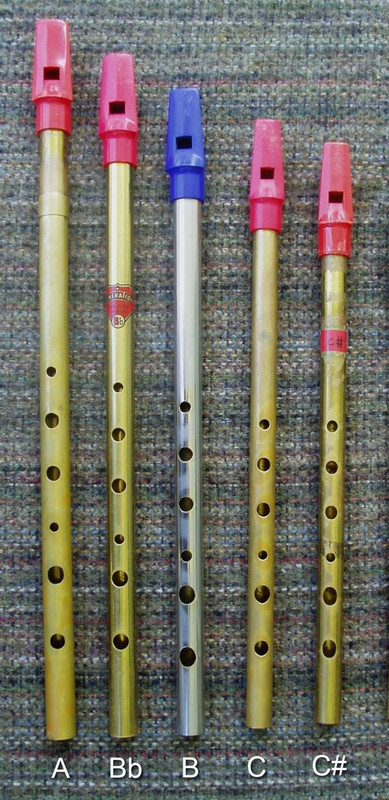
Here are my Generation whistles (most self-modified) to give a range of keys
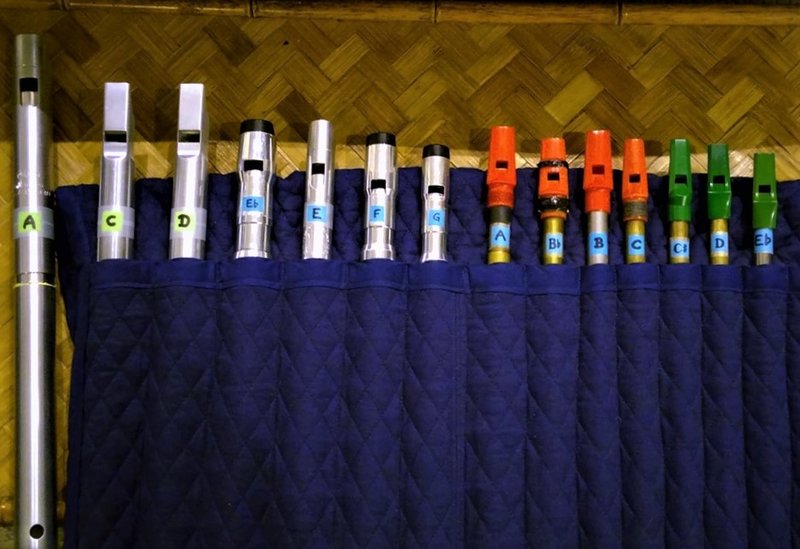
And my more recent whistle-roll after I had sold off my Ab/G# and Gb/F#
2 Likes
Based on other posts and YouTube videos, I was under the impression you had sold off your Burkes for Goldies; but I see a Burke F in there. I’m not sure which of the two to buy in F. Any suggestions? I already have Low Ds from both makers. I like the responsiveness of the Burke, but I’ve heard a few people say the Goldie F is the best whistle in any key.
I once bought a Reviol low F whistle, just for fun when playing along with Lunasa recordings. Eventually sold it when I got more serious about flute, and especially keyed flutes.
One thing I’ve noticed is that I enjoy playing certain tunes at home on my low Bb flute, just to hear them in a different range. If I was primarily a whistle player I could see myself wanting a low F again for the same reason. Not for sessions, but just fooling around at home. Some tunes have a different feel shifted down a bit, and not all the way to a full octave below.
Speaking of Lunasa, I once attended a small concert by Kevin Crawford and Cillian Vallely, and I asked Cillian after it ended about their low F whistle use. Was it just to provide some variation so all the tunes sounded less alike, and he said yes that’s it. Just a break from the usual to grab the ear.
1 Like
Yes, sorry, that’s an old photo. All my Burkes are gone.
Here’s my current roll
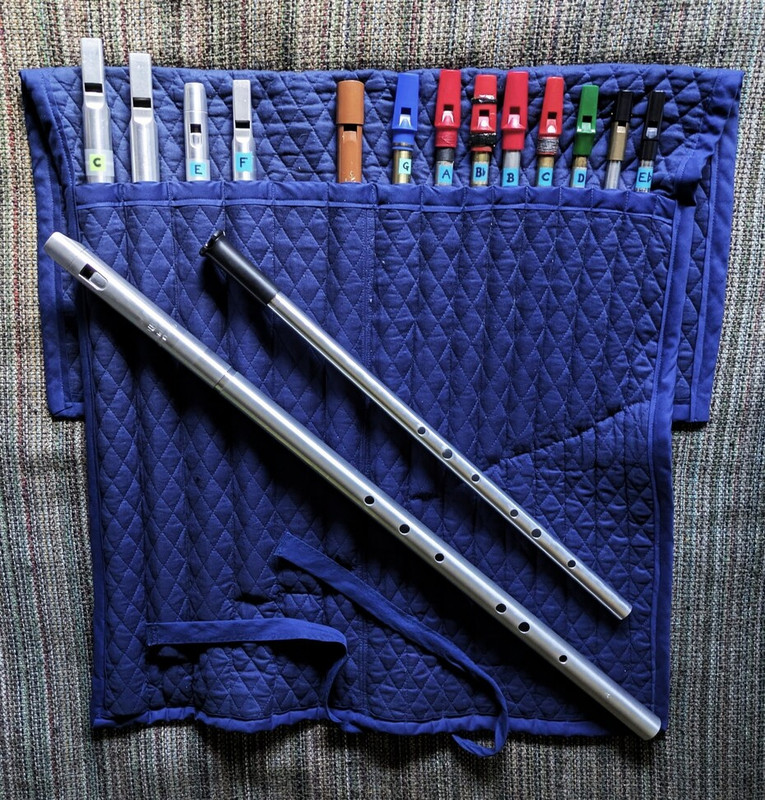
My current F is a Colin Goldie and I love it. I like Generation high whistles down to mezzo “A” and Goldies lower than that.
Besides those I have an Alba Bass A (laying on top) and an Alba Low E which play great.
Also laying on top is an aluminium Selkie vertical Irish flute in D.
I haven’t yet found an ideal replacement for my sold-off Burke mezzo G. Currently in my roll are a Jerry Freeman modified Generation mezzo G, a nice player, and a c1980 early-style Susato mezzo G. I really need to pony up and get a Goldie mezzo G.
Another need is Low Eb.
1 Like
Thanks to all for their replies; although being ignorant of music theory, it’s tough for me to discern where the discussion went beyond the context of the Irish Trad player. To oversimplify, it sounds like there is no real need beyond the D (or occasionally the C and E) in Irish sessions. The F would be “nice to have” or something that might pair well with the odd guitarist, singer, or Lunasa recording.
1 Like
It’s a performance thing, a different sound. For the same reason an awful lot of fluteplayers pull out an F flute nowadays for a set of tunes or go to B if they have the puff. Fiddlers have their five string or Hardanger fiddles or violas for the same reason and accordionplayers will do a bit on a melodeon. Or bands get a dancer to hoof around a bit.
It’s variety in concert. The unfortunate thing is, when so many people are doing it, the element of surprise is gone. The novelty wears off and it all becomes a bit of a cliché.
Other than that, the ‘need’ for such an instrument/key is fully determined by your own taste and circumstances, who you play with what music you play etc.
I think it’s when Fenor asked “how many whistles do you need in a session or any other gig?” and I responded with answers to both sides of that question.
I play and love my low F from MK Whistles in Scotland. I have his F and low D and they are both spectacular. I back more pub songs than play trad tunes so I have the whole scale of whistles. Check out MK Whistles, they are my favorite after my Copelands
2 Likes
I have a F flute and an alto F whistle. While I originally got an F to play along with a singer who liked that key I don’t find it useful out of the house anymore. But I really enjoy playing them at home as a break from the pitches of my Ds. Tunes take on a whole new character when played in different keys. You can sink into a tune differently when played with the same fingering on different keyed whistles.
2 Likes