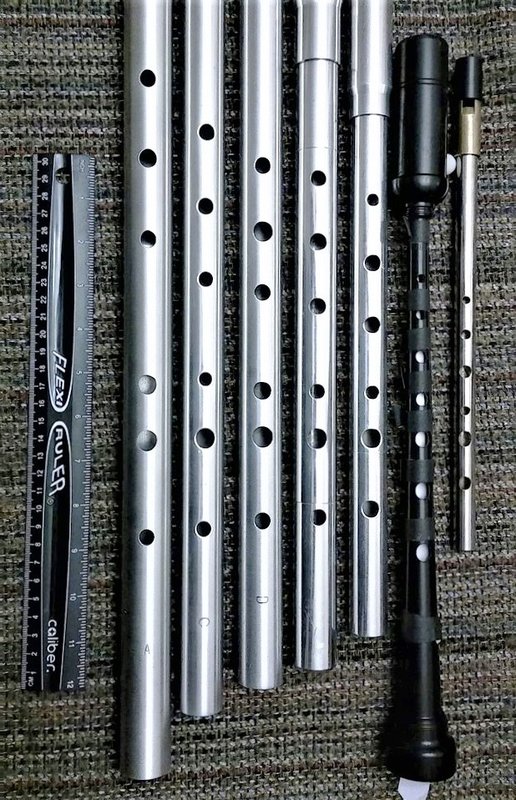
There’s lots of discussion of fingerhole placement on these forums. Undercutting also has a lot of good info.
However, what I’m interested in is the scaling of toneholes for different size whistles or fifes. For instance, if I have a plan for a whistle in C and I want to make one in G, obviously I will aim to put fingerholes in similar positions, but what size should the holes be?
I’ll probably approach this via the scientific workshop method, aka ‘suck it and see’, but I would be interested in knowing a bit about the acoustical theory behind the issue.
Andrea, I would suggest that you have the design factors (tone hole size and placement) in reverse. Meaning that if you are scaling a whistle (flute, etc.) to a different key, the finger hole placements are what need to be scaled (adjusted), and the hole size not so much.
The finger hole sizes often change a little bit if you are trying for optimal placement, but when I make a flute in C (middle C) and I make a much higher flute like the key of G, the actual finger hole sizes might be pretty similar, but their placements along the bore vary radically. This is an extreme example because there is a significant size difference between these flutes, and in such a case the holes on the G might be a trifle smaller simply because the diameter of the flute is much less, but it’s not as radical a difference as you might think. But even flutes that are closer together (say D and Eflat) have this same feature. On my D and Eflat flutes the hole sizes are pretty much the same, but where they fall along the bore is different.
But I may not be understanding what you mean when you say you’d put the finger holes in a similar position.
I work out the fingerhole placement as a percentage of sounding length. so the placing of the holes scales quite naturally. My usual work when I need to adjust scaling is just semitones, adjusting say an A=392 flute to play at A=415.
I just wondered, as for the first time I’m making a set of fifes in “all the useful keys” over a whole octave, whether I need to change the sound hole diameters dramatically. Sounds as if I can go for a pretty similar size across the range, and adjust if I need to with a little undercutting.
It’s good fun making something different from my usual Renaissance and Baroque flutes. Much bigger holes, much more noise!
The ideal I think would be scaling the hole sizes with the bore of the whistle or fife, but (unless you’re playing a fully-keyed Boehm flute) you soon bump into the maximum size hole your fingers can cover, at which point you have to start moving them up the tube.
Again as an ideal, the bore doubles in size with every 14.4 semitones down.
When designing a new flute in a given key, you have some latitude in choosing bore size and tone hole size, while maintaining the same pitch and intonation balance. However, the choices you make will influence the voice of the flute. Not just the loudness, but the tonal qualities, harmonic mix, and the effect of cross fingering options.
If you want to create a family of flutes in different keys which feel related in their voicing and tonal qualities, you will probably have to do some experimenting with several different bore profiles for each given key as well as different tone hole sizes and layouts for each bore profile.
This quickly becomes very time consuming, especially when you are making conical bore instruments and need to make new reamers for each new bore profile. Often makers try to make do with the reamers they have, which constrains the tone hole sizes and layouts that will work, and often ends up with flutes in different keys having their own unique voicing aside from just the pitch differences.
I think the easiest, and ultimately cheapest, way to approach this is to try to get your hands on the best flutes from other makers, or antiques, that play well in each given key, and to profile their bores. That way the first reamer you make for your new flute in that key is pretty much guaranteed to have a good bore profile.
In my opinion, getting the bore profile right is the hard part. Tweaking the tone hole sizes and layout is relatively easy, although still time consuming. You can go through a lot of wood doing the experiments for flutes in new keys, so its worth doing the early prototyping using something other than your best, well seasoned, flute wood.
I ended up standardising two separate sets of diameter dimensions for fingerholes, one for the top four flutes and one for the bottom five. The fingerhole placement was based roughly on a Cahusac fife Cahusac Family – The Fife Museum - he was a good maker of flutes so a decent example to copy.
I have now made a whole octave of fifes and so far, I’ve been quite pleased with how well in tune they were straight from the workshop. It’s holes 3 and 5 that are the flat ones on practically every fife, so I will enlarge/move them up the flute in the next set of fifes.