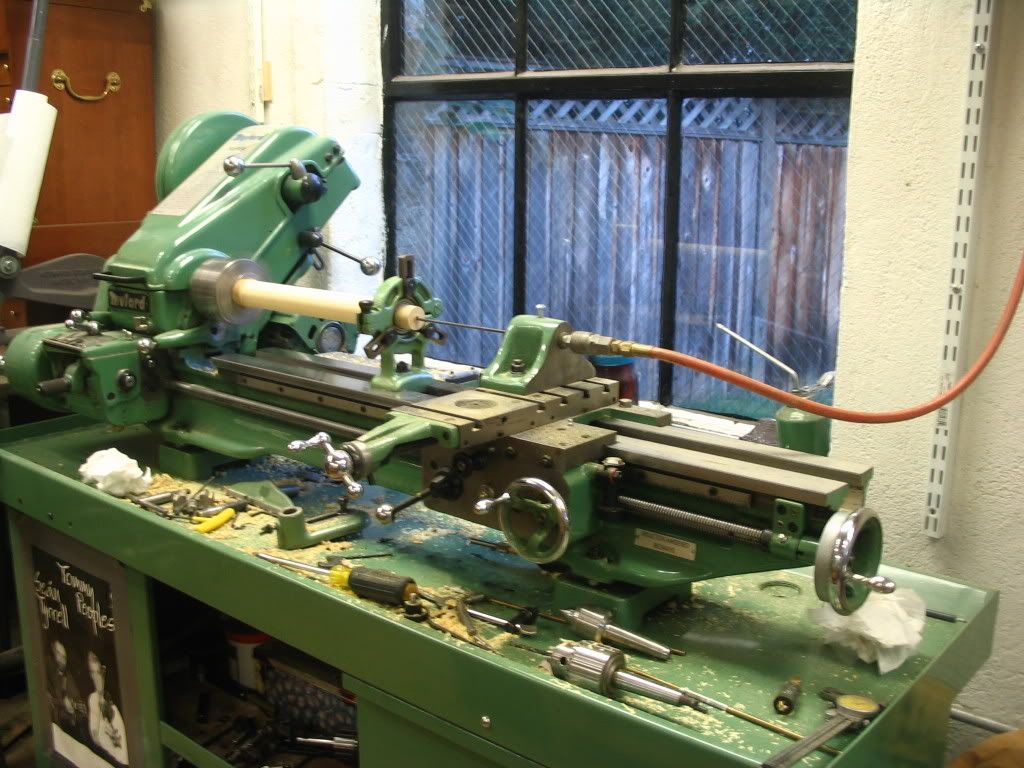
A gun drill wont do you much good unless you have an air compressor. If you have a compressor, or can borrow one, a gun drill will do a LOT of work for you. If you plan on ysing it for chanters, a 3/16 x 18" long would be a reasonable way to make a pilot bore. You will need to tap into the gun drill holder with a taper pipe tap to feed air to the drill, so you will also need the proper drill bit and tap. I feed air to the gundrills from the back,i.e. in line with the drill, but some makers use the gundrill held in a regular drill chuck in the tailstock, and so have tapped into the side of the holder. You will need to start the hole carefully with a regular center drill and stub length drill, just enough to get the tip of the gundrill into the end of the wood. Feed the bey very slowly, so that the chips exit the bore as a fine powder. If you plan on using gun drills for drones, order the drills with no back rake on the tip. One of the nice things about gun drills is that the air going throughthe bit cools the tip very efficiently and since it does not get hot, it does not get dull.
If you have a metal lathe, or a grinder, you can take the connector that is on the end of your air compressor hose and turn down the nipple so you can hemp it up and it will plug right into the back of the gun drill.. I’ll try to post some pics… This is how I did it when I started using gun drills…
there are plenty of quick-release fittings available, some less than a dollar each for the male ones, you screw them into the gun drill. Very little leakage, quick change action with a female connector on the compressor hose.
I’t leak’s a little, not enough to matter… I have a couple of gun drills that I have JB welded the connector on and those dont leak at all… I do what works for me , noething is set in stone …
I just saw one the other day and was amazed. What I want to know is how they bore the two tiny holes through the drill itself. I’m saving the pennies and getting a couple for sure.
I expect that the coolant holes are created by small cores that are part of the sintering mold. Some drills have “kidney-shaped” coolant holes, which could not be drilled, even with a diamond-tipped drill.
The carbide tip is brazed to a long, hollow hardened steel shank.
I do have a compressor but it is fairly ancient and probably could not give me more than 50 psi. Is that enough?
3/16 = 4.7625mm. Does everyone agree that this is a good size to start messing around with?
Relevent information may be, when I’ve finally got these C drones finished I’ll probably try a D chanter and drones.
Is it sensible to think I could mount it on a vertical slide?
Hammond seems to be the supplier in the UK. I realise this may be a stupid question but would their recommended Wood Grind cutting geometry (NG86) be the one to get? http://www.hammco.com/gundrills_cuttinggeometry.htm
These things are used on the lathe, with the stock spinning. I’d suggest a rotation speed of 700 RPM or so. Because the gun drill is long and thin, and you don’t want to risk forcing it, you can guide it by hand. Drill a nice straight pilot for 25mm or so first, using a short bit held in the tailstock chuck, then use a fixed steady, remove the tailstock chuck and guide the drill in by hand. Don’t force it and all should be safe.
50 PSI is a little low bit should be OK if you go slowly. You might find that with a small gun drill even your venerable old compressor is up to the job; bigger gun drills may tax its capacity.
The rule of thumb that DMQ has suggested, IIRC, is that the ‘chips’ should come out like dust, and if they sting the back of your hand, you’re going too fast. Seems about right to me.
5/32 is almost too big for flat chanters (well, too big for some flat regulator bores). You might consider 9/64 if you’re interested in Coyne-syle stuff, check the throat diameter of the chanters you’re interested in first. 9/64 is handy for drones as well; again, check your design first. I’ve seen a tenor drone stand that needed 7/64, which is pretty tiny.
I was hoping I could mount the gun drill through a vertical slide mounted on the cross slide, something like Uillmann’s arrangement with a special drill mounting block.
Then switch on the power feed and drink a cup of tea, whilst watching the lathe bore out the wood for me.
I’m happy to hand feed as that’s what I’ve done previously with home made borers.
Thanks for the useful advice on sizes, I can see I’ll need to build up a collection of gundrills over the next few years.
I think you’ll find that the slowest automatic feed rate will be too high; the only way to slow the feed rate, once you’ve geared down to the lowest ratio available, is to slow the rotation which doesn’t help you much.
uillmann may disagree, but I think you end up in excess of the optimum feed rate.
If you do it right, you won’t have time for a cup of tea.
I would strongly advise against relying on feed via the leadscrew. Bill’s recommendation to hold the shank and feed up by hand is a good one on several levels, not the least of which is that this obliges you to be there and to pay attention to what’s going on.
If you’ve got enough bed length to do it, I’d suggest rigging some way of holding the gun drill in the tailstock (which has been discussed here already, I think) just for the sake of alignment, and feeding the tailstock up by hand.
Some lathes have fine feed tumblers which allow for a feed rate of .002"/rev. Is this too fast? I run the lathe spindle at around 400rpm. It has always left an amazing hole, even with the less than optimal “R2” and “R4” Eldorado tips. This arrangement has never strayed more than 1/8’ or so from the center at the exit, but usually comes out damn near dead center. When the drill exits at the end of the bore, the loud shhhh of air inside the chuck tells you to put down your tea cup, but I have always kept myself in front of the machine in case of any trouble. Sometimes, especially 18’’ bores, I will dampen the shaft of the gundrill near the steady with my fingers to minimize any vibration, being sure not to upset the true approach of the drill.
I think the most important thing is that you’re there. Your results speak for themselves. All I’m saying is that I don’t think it’s a good idea to get into the habit of taking your attention away from the process. Suppose you were to slip into a tea-induced reverie and missed the whoosh. What would give way first? The steady rest or the leadscrew chain? I have no doubt that Mark Uillmann is there when he needs to be. Anyone who is contemplating using gun drills and automatic feed needs to remember to “Be here now.”
FWIW, the feed rate of 400RPMx.002"/rev, i.e. 0.8"/minute is about the same as what I use at twice the rotation speed; much faster and things just ‘feel’ a bit forced to me, with the small drills. If you could get the rate down to 0.001" per thou my guess is it would be about right, but I, too, like to steady the end of the drill a bit to reduce buckling and dampen the vibrations.
South Bend lathes have a clutch on the longitudinal feed (which is separate from the half nuts used for screw-cutting), so a carriage stop on the ways will prevent such a collision (and allow unlimited reverie!). Not so on the Atlas or Myfords?
Not that I would encourage anyone to shift their focus away from the task at hand when working with whirling machinery, of course.
David, you have previously alluded to your preference for step-drilling tapered bore pilot holes from large to small. I understand some of the reasons for this; large-diameter drills are stiffer and thus bore a straighter hole than the small ones, and the smallest, most flexible bits are only required to make short cuts, rather than full-length ones.
But since gundrills are not self-centering, how do you maintain concentricity when drilling each smaller step? Without some sort of guidance near the cutting edge, the smaller bit has a tendency to follow the tangential edge of the larger hole, not the center.
 , noething is set in stone
  …
… OOOk, But, how are you going to drill a 15" long blank perfectly straight on a drill press in one single pass, without stopping the bit…