I thought it might be useful to have a place where anyone wishing to sharte RTTA plots of flutes could feel free to do so. Probably best to remind that it would be unfair to post plots of modern flutes without the maker’s permission, or of modern players without their permission. But old flutes and dead players I can’t see a problem.
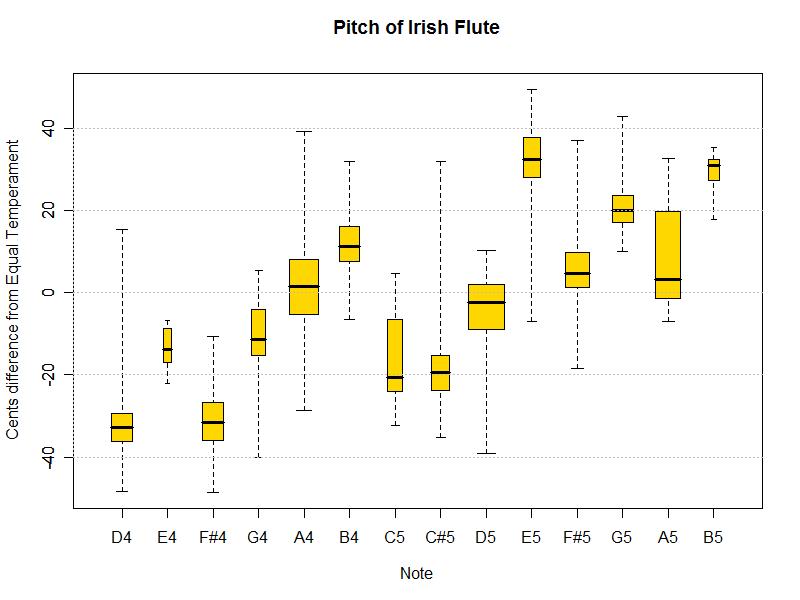
And to kick off, I thought you’d be very interested in a real Nicholson’s Improved flute, made by Prowse of Hanway St, London. This is the style of flute made by Rudall & Rose, Wylde etc. It’s also the flute that Nicholson commented that many thought only he could play in tune. I’ll admit that I certainly can’t!
Remarkably interesting, actually. A lot in common with the Metzler on my Historical Flute Syndromes page:
although better tuned in some ways - the spread from a straight line in each octave is far less. But note the striking tilt of both low and second octaves. Clearly this flute’s scaling suits an earlier period when pitch was lower. Indeed, I find I have to go down to A=415Hz to level out the second octave. Not suggesting that Nicholson expected you to play at that pitch - the slide is out 36mm, nearly 1.5". But clearly they hadn’t changed the scaling since those days.
Hi Terry
Can you do us a plot of you playing the Nicholson with the slide extended another 25mm or so to get it down to where the flute is more in tune with itself? Do the plot with it set to 415 or similar in the .bat file.
Or if not can you edit the .bat file and replot it, to reflect what would happen if you pulled out the tuning slide another 25mm?
Here:
… 440 “-5” boxplot 10 “0” equal
change the “0” to “25”
Leave the 440 as it is because that’s sort of the pitch you played it at.
Actually you could do both and then I can alter the figures used in Polygraph.r so they more accurately reflect what effect pulling the slide out would have.
Cheers
Graeme
It would be interesting to see how consistent the plots are for a single flute across different players, and/or for the same player at different times. My own experiments suggest that there is quite a bit of variability (although that may say more about my own flute skills than anything else). These plots suggest the same thing, since many of the notes have a total range of almost a semi-tone and 20 cents or so for the inner quartiles.
Looking at the Nicholson plot, if all the notes looked like D4 I would think you’d have a lot more confidence in drawing conclusions about the tuning. But what can you say about A4, which has a lot of data and still has a big range of tuning?
Terry, there’s at least one modern flute maker whose work you could easily test . Presumably you’ve looked at plots of your own flutes – can you say anything meaningful about how those plots compare?
I would like to see what the chart might look like for a few instruments that play well (are easily played in tune with themselves).
Just so you all know what I’m thinking, I’m using the program to tweak the tuning of another instrument, an Asturian gaita (bagpipe) practice chanter. I’m wondering what pattern I should be aiming for.
Would an instrument that creates a completely smooth chart (all the notes a 0) be a boring instrument? I’ve thought about trying to imitate the pattern of a well-made gaita chanter, but that may not be important since modern Asturian gaita makers claim to follow the chromatic scale pretty closely.
These are valid points. There is a bit of variability when I do multiple plots on the same flute but the same trends are always there. What you can say about A4 on Terry’s plot of the Nicholson is that its a whole bunch sharp of D4 67cents difference in median values in this case. Now if Terry did multiple plots he would get slightly different results but you’ll always see A4 way sharp of D4. And similarly for all the other notes.
We’re definitely planning on getting an idea of how much different players vary on the same flute. I’m expecting a flute from Terry in the post today to look at this issue, and we’ll be able to compare 5 or so flute players here to how Terry plays it. And in a few weeks time we have a 3 day flute school where I’m going to look at as many players as possible playing several of Terry’s flutes. Meanwhile we’ve lots of recordings to ponder, and all the clips that have been posted right here on C&F where often we know what make/model flute is being played as well as the player.
If you’ve checked out Terry’s website here: http://www.mcgee-flutes.com/Historical%20Flute%20Syndromes.htm
you’ll see a plot of what an accordion looks like. And although that one is tuned to equal temperament there’s nothing to stop you having an accordion tuned to another temperament. Some may find equal temperament boring, but they are free to choose some other temperament if the like. Perhaps many flute players do in fact think an accordion sounds boring because it can’t alter the pitch of notes. But with a flute you can and will vary the pitch of notes as you play. Personally when playing with others I find it more boring playing a flute that I can’t possibly ever play in tune with the other instruments present than one that I can.
As for what you should be aiming for with the chanters you make it’s entirely up to you. But surely the closer the practice chanter is to the real thing the better.
Yes, I’m in a frenzy of narcisistic self-examination as we speak. I think it’s a bit early for me to say what I think I can achieve, but generally I haven’t been shocked by what I found.
I think the main point I can make at this time is that there is just no place for the ghastly tilting we are seeing in the Nicholson and Metzler traces. I feel we should be aiming for a horizontal line, as the accordion shows, unless we have a specific greater need otherwise, eg on pipes to remain harmonious with the drones. I am still wondering whether it is valid to have a slight tilt, given the known psychoacoustic desire for octaves to be slightly wider when playing (as a maker is likely to be) solo in a non reverberent room. In tolerance terms, I think we need to be within about 20cents of the median, and that ideally tuning A should be close to median. You can see on both the Nicholson and Metler charts that is not achieved, indeed the low D in particular is laughable.
+/-10 cents would be even nicer, and should be achievable, and within 5 cents would be stunning. I concede we will probably always have problems with F#, crossfingered c natural and c#, but we should strive to do our best with them.
We don’t yet know what the range of results different players will get on the same flute and that may yet prove to be a fly in our ointment. I don’t expect it to knock RTTA out of the ring however, just that we will need to learn to come to grips with it.
Just piping up to say how sensible and promising I find this RTTA business. It was just begging to be invented. Thanks Graeme and Terry!
Now to get it going properly on my home machine. It works OK on my work machine but I’m not sure what the people in adjoining offices would make of a bunch of strange flute sounds repeated at odd intervals throughout the day!
It would be interesting to see what it makes of a baroque flute, Dan. A bit tricky to know what to ask it to do - I guess if planning consort music you need to set it up for Just Intonation in all the different keys you might play in? C.bat, D.bat, Eb.bat etc. Or if planning to play with a harpsichord, something like Werkmeister III or Valotti and run the chromatic version?
If you’re coming down this way drop in and we can compare RTTA’s on our current and some old flutes. The water temperature is still reasonable!
Forgive me that I haven’t been following this and the other thread (Playing old flutes in tune) too closely. But I notice something about the posted RTTA plots that I find puzzling.
Namely, that not a single note in any of the graphs is actually on pitch.
I’d think after tuning an instrument to a reference pitch, that at least that one note would be in tune - assuming that the vertical axis is calibrated accordingly. But judging from the plots, I can’t even tell what the reference pitch is supposed to be. The closest in all 3 graphs seems to be C#5, and I don’t imagine that’s what’s being used.
Since reference tuning clearly affects the overall intonation in a non-linear way, a consistent and true reference pitch is a critical control variable which should show up clearly in the results, no?
Moreover, if no particular effort is made to pre-tune a test flute to its intended reference and then deliberately play it into tune with normal attention to intonation, the plots seem to demonstrate not so much that the specimen is inherently out of tune, but that it can be played out of tune, given a random setup and imperfect technique. A conclusion which seems both obvious and not very useful.
Not trying to be provocative, but am I missing something here?
Regarding the tuning of bagpipes… I hate to be pedantic here, but you should be aiming to tuning to your drones. So it needs to be flat across the zeros in some kind of just intonation.
Absolute pitch is not that vital, as a little tweak of the tuning slide will correct any deviation there, without affecting the relative relationships of the other notes, providing it’s close enough (e.g. a few mm). In the Metzler example up top, I used the usual low octave A, A4. In the case of the Nicholson, I used G4, as I was aware that A4 was far sharper than average and I wanted to ensure the whole plot fitted between +/- 50 cents. As you can see, I just squeaked it in.
In both cases, the measured pitch wandered a smidge sharp of the reference zero, but that’s probably inevitable. I play a bit to warm up the flute, check the tuning, start Tartini then play some more. The flute will probably warm up more over the next few minutes.
So, ignore the absolute values, and look at their spread.
In regard to intonation, my argument is that ideally no special care should be needed to make the flute play in tune - it should be pretty much there with no effort from the player. This frees the player to concentrate on the other musical objectives, rhythm, phrasing, tone, articualtion, ornamentation, variation, etc. Plenty to go on with!
A couple of questions (serious here, not being sarcastic, in case anyone is uncertain)
Question 1:
Do we know for a fact exactly what pitch the flute(s) being tested was designed to play best in tune at? Tuning slide or no, if we’re play a flute at A=440, which was not standard, then deviating does impact the scale (as has been already suggested) and makes our experiment far less scientific.
Question 2:
What is the effect on tuning of bore and tone hole shrinkage over 100+ years? Proportionally, the foot end of the flute gets smaller (bore wise) relative to the top joint end, how does this effect tuning/intonation? Smaller holes similarly are more impacted than larger holes by shrinkage. When we combine the two, what’s the impact?
I’ve only seen the effect of 25-30 years shrinkage (putting original reamers to instruments that have been out in the world and then come back for service), and it is significant. I can’t help thinking that the wood might shrink more given another 75+ years, thus impacting the instrument’s tuning even more.
EDIT: Graph was deleted because I named the maker of the flute I was playing, and there seems to be a concern with showing RTTA results of modern flutes and naming the flute maker without their permission. SECOND EDIT: Graph is on the next page now.
So, here’s my version of Contentment is Wealth. Maybe not the best tune for this software as it’s got quite a bit of octave jumping and cuts and such that make me wonder about how the software accounts for such things. Would it be better to try to play more simply?
Played on a keyless Olwell.
I think I needed to push the slide in a bit. My C and C# are a bit flat and sharp respectively when they are played. They tend to be the most out of tune of all the notes.

 . Presumably you’ve looked at plots of your own flutes – can you say anything meaningful about how those plots compare?
